Residential vs. Datacenter Proxies: Which Should You Choose?
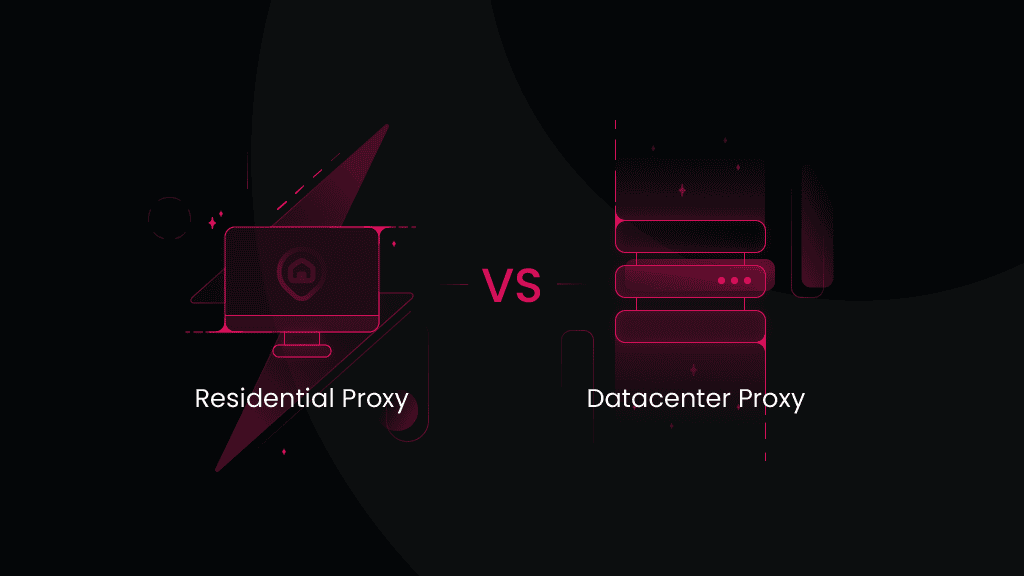
Residential and datacenter proxies both act as intermediaries that hide your real IP address, allowing you to access restricted websites and geo-blocked content. However, they differ in IP origin, stability, speed, and how websites perceive them. This residential vs. datacenter proxies guide breaks down their key differences.

Vilius Sakutis
Last updated: Sep 11, 2026
8 min read
TL;DR
- Residential proxies use IPs from real household devices and support IP diversity, so they blend in as genuine users and rarely trigger blocks.
- Datacenter proxies run on cloud servers, so they're faster and cheaper, but easier for anti-bot systems to flag.
- "Dedicated" describes exclusivity, not IP origin, so a dedicated proxy can be residential/ISP or datacenter.
- Dedicated residential IPs exist too. They're sold as ISP or static residential proxies, not as a separate "dedicated proxy" category.
- The choice between residential vs. datacenter proxies depends on whether you prioritize authenticity and IP diversity or speed and scale.
- Choose residential or ISP proxies for stricter targets and datacenter proxies for more tolerant, high-volume tasks.
What users mean by "dedicated"
Proxies vary along two independent axes, so it's important to clarify terminology before explaining further. The first axis is the IP source – residential, datacenter, ISP, or mobile. The second is exclusivity – shared or dedicated. You can sell any IP source as either shared or dedicated.
So when someone says "dedicated," they usually mean one of three things: a dedicated datacenter IP, a dedicated residential (ISP or static residential) IP, or simply any private IP that nobody else can use. See the table that briefly summarizes this. You can check out our dedicated proxy guide for an in-depth explanation of dedicated residential proxies.
If "dedicated" means…
You're comparing
Jump to this section
An IP from a data center, used only by you
Residential vs. dedicated datacenter
Residential vs. dedicated proxies: a detailed comparison
A real ISP-issued IP, used only by you
Residential vs. dedicated residential proxies (ISP/static)
ISP proxies
Any IP nobody else shares
Shared vs. dedicated, across every source
Residential vs. datacenter proxies: the key differences table
What are residential proxies?
Residential proxies provide IPs from Internet Service Providers (ISPs), sourced from regular users' mobile devices, desktops, and other household devices connected to Wi-Fi networks across various countries and cities. These proxies let you set a specific location, making it appear as though you're a genuine internet user while keeping your real IP address hidden. They're ideal for tasks that require authenticity and are commonly used for privacy protection, web scraping, eCommerce testing, and SEO monitoring and research, as they're the least likely to be blocked.
By default, residential IPs come from a shared pool that rotates between sessions, while the dedicated equivalent is sold separately as ISP or static residential proxies.

When you need to blend in
Residential proxies route through real consumer IPs, the right call when a target's actively watching for bot traffic.
What are datacenter proxies?
Datacenter proxies are sourced from data centers with unique IPs that act as an intermediary between you and the target website, independent of your internet connection or Internet Service Provider (ISP). This independence makes it easy to hide your IP address without being tied to a specific location; therefore, datacenter proxies are most commonly used for web scraping, SEO monitoring, social media management, market research, and more. You can choose between shared or dedicated datacenter proxies.
Shared datacenter proxies
Shared datacenter proxies are like taking a bus to your destination. Multiple users access these proxies simultaneously, making them cost-effective. They're great for market and SEO research, ad verification, entertainment, and browsing. But remember, sharing a proxy can mean slower speeds and a higher chance of getting blocked if another user misbehaves.
Dedicated datacenter proxies
Think of dedicated datacenter proxies as driving in your personal car. Only one person uses them at a time, offering faster, more reliable connections. Ideal for web scraping, multi-accounting, cyber and brand security, or smooth online gaming, these proxies provide stability and security. They cost more, but they're worth every penny for those needing consistent performance. The same shared/dedicated distinction applies to ISP proxies: dedicated isn't a proxy type in itself, but a way of providing a proxy with single-user exclusivity.
What are ISP proxies?
ISP proxies (also known as static residential proxies) are residential-grade IPs assigned to a single user. In other words, this is what a dedicated residential proxy actually is. They're a specific type of proxy directly provided by Internet Service Providers (ISPs) and hosted on servers in data centers. Unlike residential proxies, ISP proxies aren't sourced from user devices. Instead, they're allocated by the ISPs themselves. This proxy is best suited for tasks that require both the authenticity of a residential IP and the speed and reliability of a data center proxy, like managing multiple social media accounts or high-speed data scraping. Check our detailed ISP proxies vs. residential proxies article to understand their key differences.
What are mobile proxies?
Mobile proxies use IPs assigned by mobile carriers and sourced from mobile devices like smartphones and tablets using 3G, 4G, or 5G cellular networks. They excel in activities needing high trust and anonymity, as they rarely get blocked and rotate within network and provider pools. Mobile proxies also enable access to mobile-specific data and offer faster internet speeds.
Comparing proxy types
Now that we've covered the main features of datacenter and residential proxies, let's take a closer look at what sets them apart.
Datacenter vs. residential proxies: the key differences
Comparing residential vs. datacenter proxies comes down to IP origin, uniqueness, speed, geo-targeting, and pricing.
Datacenter proxies are typically cheaper, faster, and more accessible than residential proxies because datacenter proxies aren't limited by ISP constraints. However, residential proxies offer other benefits. It's easier to prevent geo-blocking, your activities appear more legitimate and anonymous, and they can be more difficult to block because residential proxies use real IP addresses from actual devices. This table summarizes the key differences between residential and datacenter proxies:
Type
Residential proxies
Datacenter proxies
IP origin
ISPs (Internet Service Providers)
Data centers & cloud servers
Uniqueness
High, resemble actual users
Low, may be identified as computer-generated
Ban risk
Low due to unique IPs
Higher, with subnet bans affecting many IPs
Response time
Moderate to fast
Fast
Geo-targeting
International access with a variety of regional IPs
Limited to the proxy server’s geographic location
Use cases
- Web scraping
- Multi-accounting
- Ad verification
- Travel fare aggregation
- Cybersecurity
- eCommerce research
- SEO monitoring
- Scraping simple websites
- Accessing geo-restricted content
- SEO monitoring
- Price monitoring
- Website & application testing
Pricing
Best value with shared proxies; higher cost for dedicated IPs
Cost-effective; usually cheaper than alternatives
Dedicated IPs available?
Yes – sold as ISP / static residential proxies
Yes – sold as dedicated datacenter proxies
Residential vs. dedicated proxies
If you're choosing between "residential" and "dedicated," you're usually choosing between a rotating shared residential pool and a single exclusive IP – and that exclusive IP can be either datacenter-hosted or ISP-issued.
Residential proxies typically operate on a rotating IP system, offering users IP addresses that can change every session or remain static for up to several minutes. Dedicated datacenter proxies, on the other hand, assign a unique IP to each user, ensuring exclusivity and a consistent online presence, which is important for tasks that demand a stable, trustworthy IP identity. Regarding pricing, dedicated datacenter proxies often adopt a per-IP pricing model, as opposed to the traffic-based pricing commonly associated with residential proxies.
But that's only two of the three real options. A dedicated residential (ISP) IP combines a genuine ISP-issued address with single-user assignment, so it looks as authentic as a residential proxy with ISP-backed static IPs.
Here's a brief comparison of the three proxy types:
Option
Rotating residential
Dedicated datacenter
Dedicated residential (ISP)
IP source
Residential IPs from real household devices
Data centers
ISP-issued, datacenter-hosted
Shared with others
Yes, pooled
No
No
Session stability
Rotates or stays sticky up to 60 min
Fully static
Fully static
Trust with strict targets
Highest
Lowest
High
Speed
Solid
Fastest
Fastest
Best for
Scraping at scale, geo-coverage, and IP diversity
Volume tasks on tolerant targets
Account management and long sessions
The key difference is what you need from the IP. Rotating residential proxies give you IP diversity and broad geographic coverage. Dedicated datacenter proxies give you a stable, exclusive IP at high speed and are a strong fit for high-volume tasks where the target is relatively tolerant. Meanwhile, dedicated residential (ISP) proxies combine an ISP-issued address with single-user exclusivity, making them useful when you need a stable residential identity for account management or long sessions.
Pick by whether the task needs IP diversity or IP consistency, then pick the IP source by how strict the target is.
ISP vs. datacenter proxies
ISP proxies represent a hybrid of functionality, merging the high anonymity of residential proxies with the enhanced speed and stability characteristic of datacenter proxies. This blend makes them an optimal choice for users who require the best features of both residential and datacenter proxies without compromising on quality or performance.
ISP proxies are usually the answer when someone specifically wants "a dedicated residential IP," since they combine an ISP-issued address with single-user assignment.
Mobile vs. datacenter proxies
Mobile proxies offer a higher level of authenticity by rotating IPs typically assigned to mobile devices, which handles detection systems more reliably. In contrast, datacenter proxies offer stability and speed but lack the inherent trustworthiness of mobile IPs and are more easily identifiable as proxies. While datacenter proxies are more cost-efficient, mobile proxies offer the unique advantage of real-world user simulation, making them a more suitable choice for operations that require operating reliably against web security measures.
Choosing the right proxy for your needs
When choosing between residential vs. datacenter proxies for your use case, ask yourself 3 questions:
- Do you need speed, stability, and cost-efficiency?
- Do anonymity, various geo-targeting options, and avoiding anti-bot systems and IP bans matter more?
- Do you need the same IP every time?
If the answer to all 3 is yes, route to a dedicated ISP or dedicated datacenter IP, depending on how strict the target site is about detecting datacenter ranges.
Datacenter proxies are known for their speed and reliability, but they're more likely to get blocked due to their less diverse IP range. Also, the rapid response time of datacenter proxies can lead the user to be identified as non-human traffic. Residential proxies, on the other hand, offer unique IPs that mimic real user behavior, making them less prone to bans and better for tasks requiring a natural-looking online presence.
Our users who need to efficiently gather and analyze competitor data or create multiple accounts for performance or app testing often find that datacenter solutions work best for their needs. However, for accessing geo-restricted content, avoiding anti-bot measures, multiple account management, AI training, and web scraping, residential proxies are the ideal solution.
In a nutshell
Both residential and datacenter proxies provide tools for secure and efficient web navigation, suiting various online needs. Residential proxies, with their rotating IP addresses, excel in anonymity and mimic real-user behavior, while datacenter proxies offer stable, unique IPs known for speed and efficiency in data-heavy tasks.
At Decodo, we have all the proxy types you may need. We offer 115M+ residential proxies from 195+ locations, a verified 99.99% success rate in the market, and the fastest response time (<0.5s) on our network, with a great entry point through Pay As You Go.
We also have 400K+ dedicated datacenter IPs backed by 1,500+ subnets, alongside 100K+ shared and rotating/static datacenter IPs globally, with flexible payment options (per GB or per IP). Furthermore, you can rest assured of the quality of our 10M+ mobile proxies and shared or dedicated ISP proxies.
We're also offering a free 3-day trial for all our proxy solutions! Try both and see which one works best for you.
And if you ever need someone to talk to about choosing the right proxies, don't hesitate to contact our 24/7 support team via LiveChat!

Still not sure which fits?
Decodo offers a free trial for all proxy types, so you can try before you commit to a single solution.
About the author

Vilius Sakutis
Performance Marketing Team Lead
Vilius leads performance marketing initiatives with expertize rooted in affiliates and SaaS marketing strategies. Armed with a Master's in International Marketing and Management, he combines academic insight with hands-on experience to drive measurable results in digital marketing campaigns.
Connect with Vilius via LinkedIn
All information on Decodo Blog is provided on an as is basis and for informational purposes only. We make no representation and disclaim all liability with respect to your use of any information contained on Decodo Blog or any third-party websites that may belinked therein.