SOCKS5 Proxies for Speed & Security
SOCKS5 proxy is a session-layer (Layer 5) proxy that routes traffic between your client and the destination without inspecting or modifying the payload, making it ideal for high-volume scraping, SEO monitoring, and AI data pipelines. Start your 3-day free trial and unlock 125M+ IPs across 195+ locations with a 99.99% uptime.
125M+
ethically-sourced IPs
195+
locations worldwide
∞
connections & threads
24/7
tech support
99.99%
uptime
What is a SOCKS5 proxy?
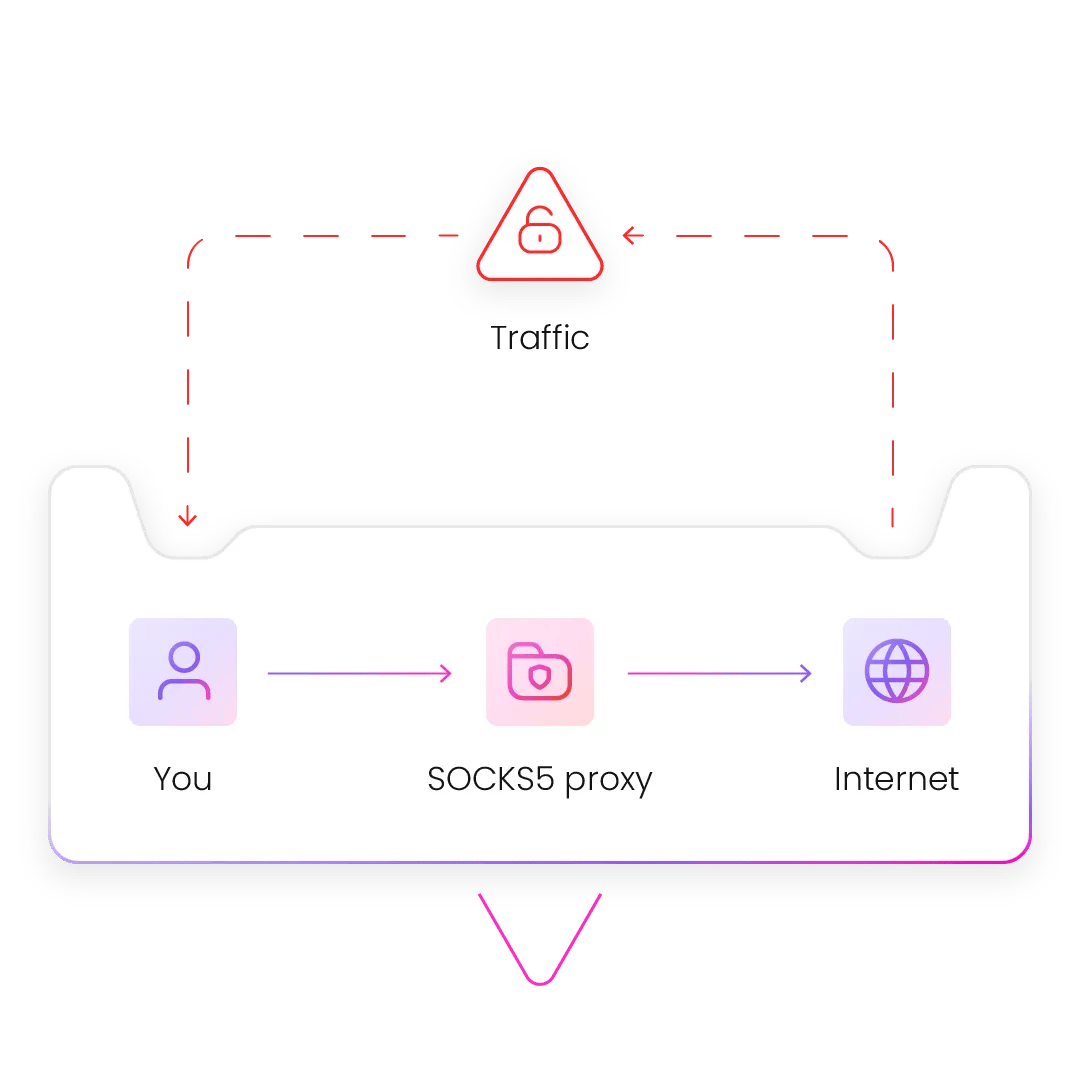
A SOCKS5 proxy works at the network level, routing traffic between your client and the target server without touching what's inside. Unlike an HTTP proxy, it doesn't inspect, modify, or cache your requests – it just moves data through. That makes it protocol-agnostic, meaning it handles virtually any type of traffic. If you're running high-volume scraping, SERP tracking, ad verification, multi-accounting, or AI data pipelines, SOCKS5 is just the right match for it.

TCP & UDP protocols
Maximum authentication flexibility
Lower latency
Explore our solutions supporting SOCKS5
Specifics
Real IPs from actual home internet connections.
Combine the best of both worlds – datacenter speed with residential authenticity.
IP addresses from real mobile devices and carriers.
Lightning-fast proxies hosted in data centers.
Features
- 115M+ IPs
- 195+ locations
- 99.92% success rate
- <0.5s response time
- Country-, state-, city-, ASN-, ZIP-targeting
- 99.99% uptime
- <0.2s response time
- Static IPs with residential credibility
- IPs from premium ASNs
- 99.99% uptime
- 10M+ IPs
- 160+ locations
- 99.94% success rate
- 700+ mobile carriers
- Advanced targeting
- #1 response time in the market
- 99.94% success rate
- <0.3s response time
- Dedicated or shared IP options
- IP replacement option
- 99.99% uptime
Best for
Web scraping, price monitoring, ad verification, market research
Multi-accounting, streaming, social media management, brand protection
Mobile app testing, social media automation, mobile ad verification, app store optimization
High-volume scraping, SEO monitoring, API testing, development environments
SOCKS5 vs. HTTP(S) proxy
Choose SOCKS5 over HTTP(S) when your scripts, headless browsers, and APIs need to share the same proxy pool across different protocols, when you need persistent TCP connections without header rewriting, or when your workload goes beyond HTTP, such as mixing web requests with UDP traffic or non-HTTP services.
Protocol flexibility
The protocol a proxy supports determines what traffic it can handle. This matters as soon as your stack goes beyond standard web requests.
- SOCKS5 handles TCP and UDP traffic for web and real-time applications
- HTTP(S) is limited to web traffic only
Request integrity and TLS
How a proxy treats your traffic in transit affects both detectability and security. SOCKS5 and HTTP(S) proxies behave very differently here.
- SOCKS5 relays raw bytes, leaving headers, TLS handshake, and fingerprints untouched; encryption terminates end-to-end at your destination.
- HTTP(S) may inject Via or X-Forwarded-For and rewrite headers; plain HTTP is fully visible to the proxy operator.
Session persistence
Connection stability matters for workloads that run long or maintain state across multiple requests.
- SOCKS5 maintains long-lived TCP connections for deep crawls, large file transfers, and stateful logins.
- HTTP(S) treats each request as discrete, long sessions can drop or get rewritten by the proxy.
AI and LLM workflow fit
Proxy compatibility becomes a real constraint when building agentic or data-heavy AI pipelines. Not all proxy types handle the full range of transport requirements these workflows involve.
- SOCKS5 plugs cleanly into LangChain, n8n, OpenClaw, and other AI-first tools, like MCP Server, and custom RAG pipelines as a single transport.
- HTTP(S) works for HTTP-only LLM tooling, but can run into issues with WebSocket or streaming endpoints.
Developer use cases
Choosing the right proxy type from the start saves integration headaches later. Your tooling and traffic mix should drive the decision.
- SOCKS5 is a strong fit for development tools, APIs, custom applications, and testing environments.
- HTTP(S) is a natural choice for web scraping and browser automation.
SOCKS5 proxies vs. VPN
A SOCKS5 proxy works at the application level. You point a single client at it requests, axios, cURL, Playwright, a Scrapy worker and only that process gets a different IP. Everything else on your device uses your normal connection.
That makes it a flexible fit for a wide range of tasks. Running a scraper, working around a rate-limited API, testing geo-specific behavior, verifying ads, managing multiple accounts – SOCKS5 handles all of it without touching the rest of your setup. You can rotate IPs per request, target specific locations, and only pay for what you actually use.
A VPN encrypts everything leaving your device and routes it through a single tunnel, which is useful for personal privacy but isn't designed for this kind of targeted, per-process control. For developers, SOCKS5 is usually the more practical starting point.
Best SOCKS5 proxy features
Enhance privacy and reduce latency with a perfect balance of speed, versatility, and technical capability.

UDP protocol support
Unlike HTTP proxies, SOCKS5 handles UDP traffic for real-time applications requiring low-latency performance.

Authentication mechanisms
Built-in user:password authentication provides secure proxy connections for team environments and mission-critical websites.

Dev-friendly integration
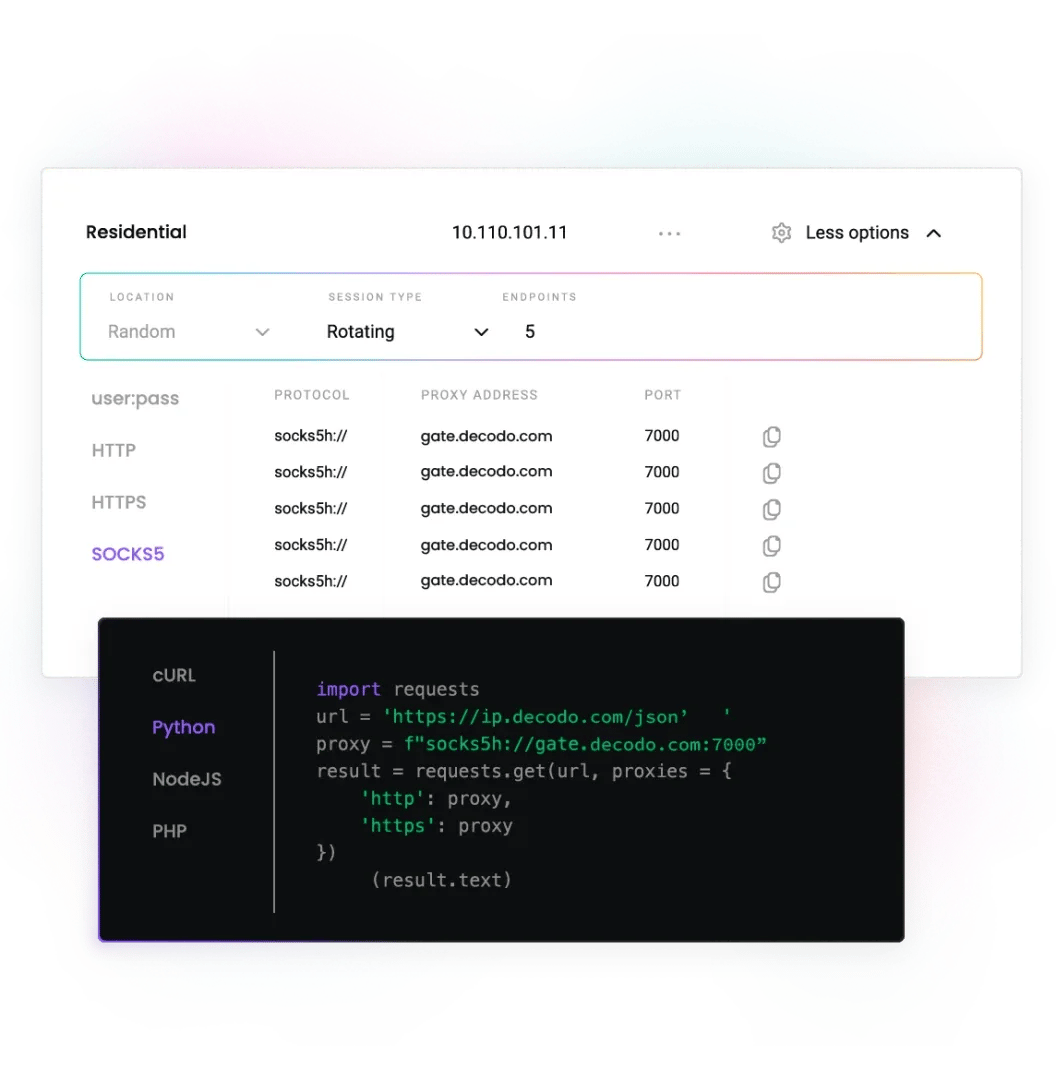
Native support in Python Requests, cURL, and development tools makes SOCKS5 ideal for custom applications, API testing, and automated workflows.
Multi-protocol versatility
Handle TCP and UDP protocols beyond web traffic, essential for comprehensive data collection projects and application development.

Concurrent connection management
Manage multiple accounts at scale with SOCKS5 proxies designed to handle numerous simultaneous connections.

High-bandwidth support
Process large datasets and train your AI agents without interruptions, thanks to SOCKS5's ability to handle high-volume data loads efficiently.
Flexible pricing for SOCKS5 solutions
Leverage cutting-edge SOCKS5 proxies and complete your web scraping projects without a single restriction.
14-day money-back
SSL Secure Payment
Your information is protected by 256-bit SSL

Which locations and geo-targets does Decodo SOCKS5 offer?
Access the most popular SOCKS5 proxy locations for fast, secure, and reliable connections. Choose from residential, shared, and dedicated SOCKS5 proxies across 195+ countries, states, and cities worldwide to meet your needs.


What people are saying about us
We're thrilled to have the support of our 135K+ clients and the industry's best.

Attentive service
The professional expertise of the Decodo solution has significantly boosted our business growth while enhancing overall efficiency and effectiveness.
N
Novabeyond
Easy to get things done
Decodo provides great service with a simple setup and friendly support team.
R
RoiDynamic
A key to our work
Decodo enables us to develop and test applications in varied environments while supporting precise data collection for research and audience profiling.
C
Cybereg






Featured in:





Frequently asked questions about SOCKS5 proxies
What is a SOCKS5 proxy?
A SOCKS5 proxy is a type of internet proxy server that routes your network traffic through an intermediary server, masking your real IP address. Unlike ordinary HTTP proxies, SOCKS5 supports multiple protocols, including TCP and UDP, and offers authentication methods. However, it typically doesn't encrypt your traffic by itself, it simply forwards your data, so your content may still be visible unless combined with additional encryption.
Where to get a SOCKS5 proxy?
You can get SOCKS5 proxies from reliable proxy providers like Decodo, offering residential proxies, dedicated, and shared SOCKS5 proxies for various use cases. Choose a provider that ensures high uptime, fast speeds, and strong security.
Which proxy types support TCP and UDP?
Our ISP and datacenter proxies support both TCP and UDP communication protocols. Residential and mobile proxies support TCP connections. For more information, visit our documentation.
Can I get SOCKS5 for free?
Users can choose HTTP(S) or SOCKS5 proxies at no extra cost. Additionally, we offer a 3-day free trial for all of our proxy types.
How do I know if SOCKS5 is the right proxy for my workload?
SOCKS5 is a good fit when you need a single set of credentials across mixed traffic types, HTTP, HTTPS, custom TCP, WebSocket, and UDP, or when you need long-lived sessions that won't get rewritten mid-connection.
For pure browser-based scraping, HTTP and SOCKS5 both do the job. SOCKS5 becomes the stronger choice when scripts, headless browsers, and APIs all need to share the same proxy pool.
Why choose SOCKS5 over HTTP proxies for development?
SOCKS5 proxies offer superior protocol flexibility, handling both TCP and UDP traffic types that HTTP proxies can't manage. This makes them essential for development environments, gaming applications, and real-time data collection, where HTTP(S) limitations become apparent. The built-in authentication and lower latency also make SOCKS5 ideal for professional development workflows.
Buy Best SOCKS5 Proxy Servers
Experience fast results with 125M+ IPs from 195+ locations – only at Decodo. Start your free trial today!
14-day money-back option