AI Search Monitoring for Brand Visibility in AI Answers
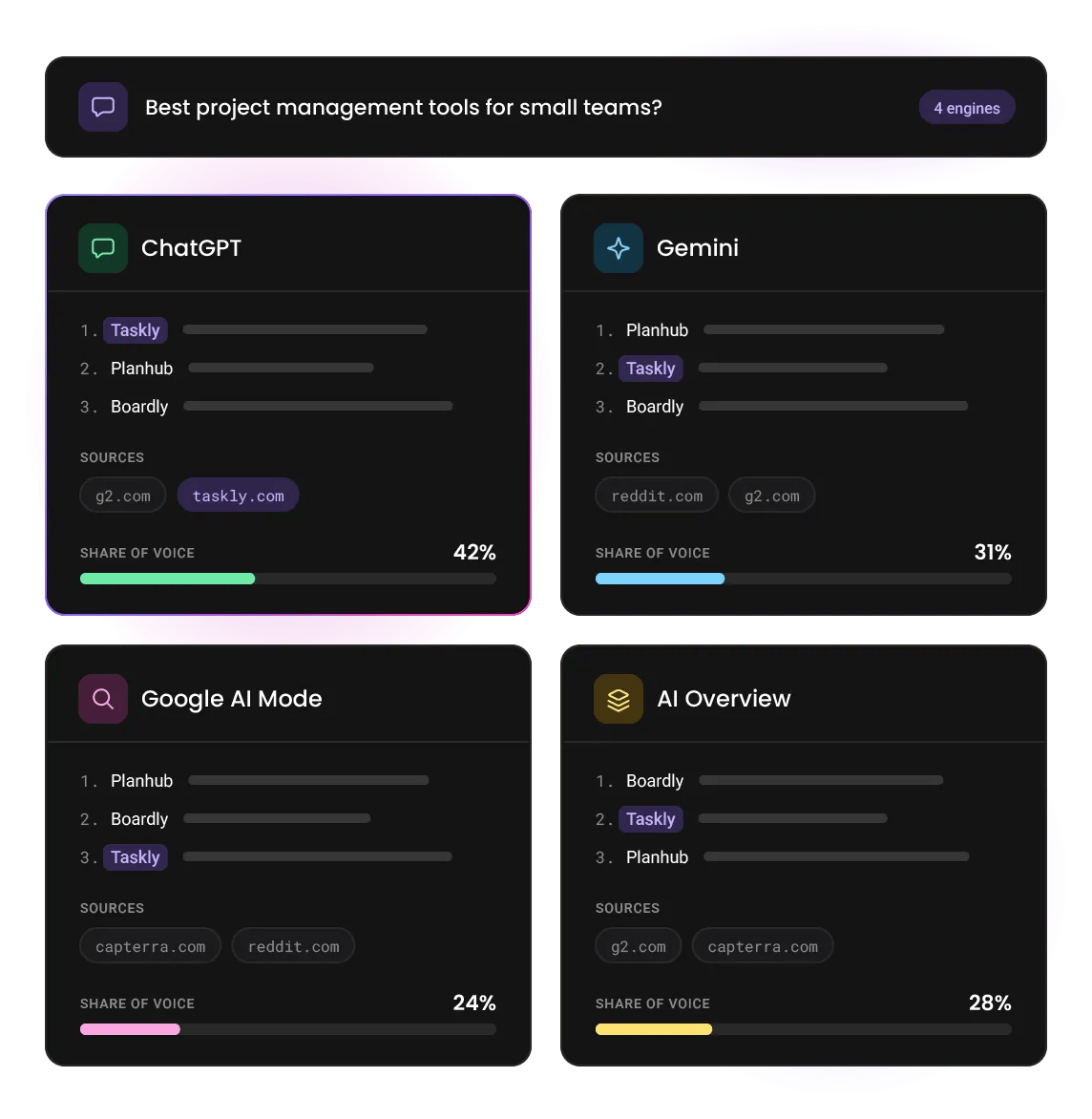
AI search monitoring is checking how AI assistants and Google's AI search features answer your buyers' questions – which brands they mention and which sources they cite. With Decodo's Web Data API, you collect full AI answers and their cited sources from ChatGPT, Gemini, Google AI Mode, and AI Overviews – through 125M+ IPs in 195+ locations.
14-day money-back option
100+
ready-made templates
99.99%
success rate
Up to 200
requests per second
125M+
IPs worldwide
Up to 10K
free requests
Trusted by:


How does AI search monitoring work?
Build AI visibility monitoring around four steps: define the prompts that matter, collect AI-generated answers, extract brand mentions and citations, and measure changes over time. With Decodo's Web Data API, you can automate answer collection and integrate the results into your own analytics pipeline.
Which prompts should you track?
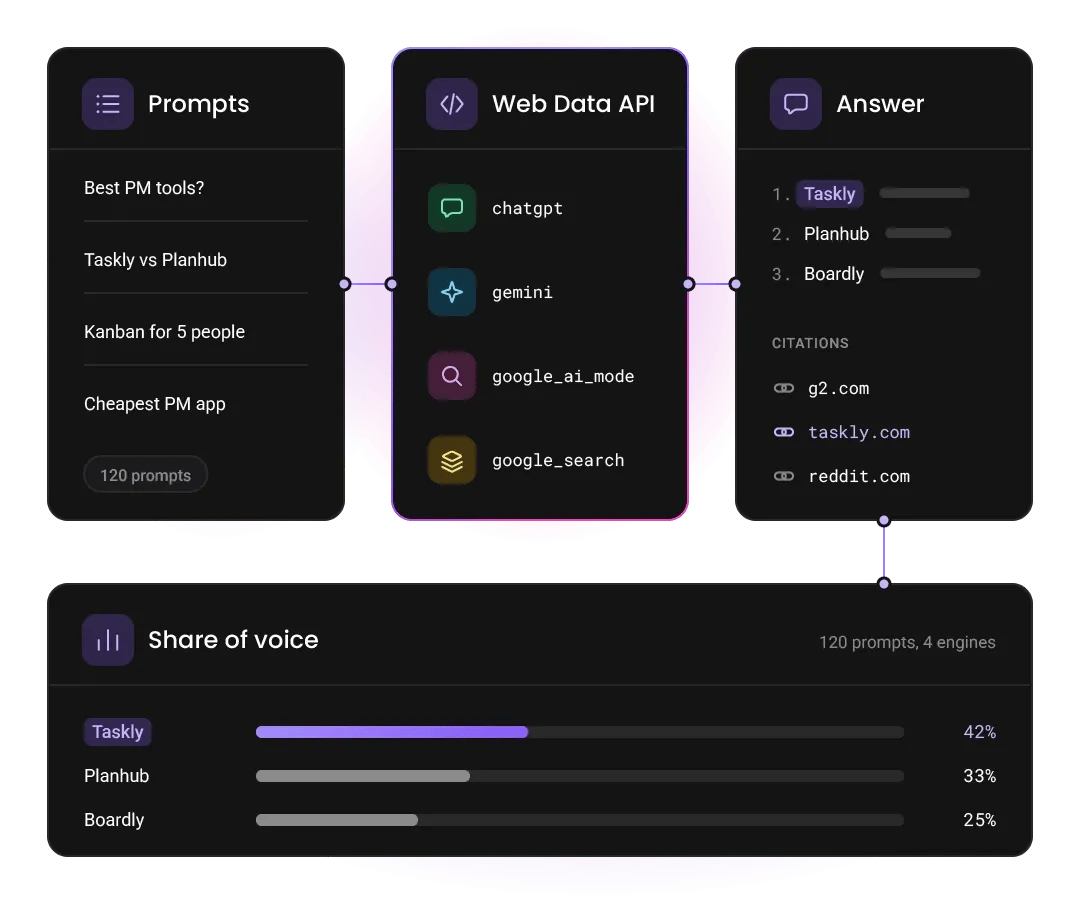
Build a representative prompt set around the questions your potential customers ask, from product comparisons and recommendations to industry-specific problems. Group queries by topic, buyer intent, and product category to create a repeatable monitoring framework. Keep the prompt definitions consistent across runs so your results can be compared over time.
How do you collect the answers?
Use Decodo's ready-made scraping templates for supported AI platforms to submit prompts and retrieve response content. Collect answers from ChatGPT and Google AI Mode, and use the Google Search template to capture AI Overviews when Google displays them. Where supported, extract citations and source URLs alongside the response text, then store the results for further analysis.
How do you find mentions and citations?
Process collected answers to detect your brand, product names, and competitors using keyword matching or NLP-based entity recognition. Extract cited URLs when available, normalize them by domain, and store their relationship to each response. This lets you calculate mention frequency, identify recurring sources, and analyze which websites appear alongside your brand in AI answers.
How do you compare results over time?
Schedule recurring requests for the same prompt set and store each response with its timestamp, platform, and query metadata. Calculate brand mention rates, citation frequency, and competitor visibility in your analytics pipeline. Compare historical runs to identify changes in AI recommendations and measure how your visibility develops over time.
What can you do with AI search monitoring?
Understand how your brand appears in AI-generated recommendations and turn those insights into measurable visibility metrics.

How do I measure AI share of voice?
Collect AI answers for a defined prompt set and calculate how frequently your brand appears compared with competitors, broken down by platform, topic, or buyer intent.

How do I track brand mentions in ChatGPT?
Run recurring prompts through the ChatGPT scraping template and extract mentions of your brand, products, and competitors to track visibility across AI-generated responses.

How do I find which sources AI tools cite?
Extract available citation URLs from AI answers, group them by domain, and identify the publications, comparison pages, and other sources appearing most frequently.

How do I track Google's AI answers?
Collect Google AI Mode responses and available AI Overviews for your target queries, then analyze brand mentions, cited sources, and visibility changes over time.

How do I add AI visibility to my SEO platform?
Integrate collected answers, mention rates, and citations into your SEO dashboards to track AI visibility alongside traditional search rankings and organic performance.

How do I catch wrong information about my brand?
Monitor AI responses for outdated product details, incorrect claims, and missing features, then flag potential inaccuracies for investigation and content updates.
How do I collect AI answers with Decodo?
Send a prompt to Web Data API's /scrape endpoint using a supported AI answer template and retrieve the response for analysis. Enable web search where supported to collect source-backed answers, then store the response text and available citations in your own tracking pipeline. Use the Google Search template to check whether AI Overviews appear for your target queries.
How much does Web Data API cost?
Start with a free starter plan with up to 10K monthly requests, then upgrade to a subscription when you're ready to scale.
With each plan, you access:

JavaScript rendering
99.99% success rate
HTML, Markdown, XHR, plus JSON, PNG where supported
One-click AI integrations
LLM-ready Markdown format
100+ pre-built templates
Single API key for all endpoints
/scrape, /search, /map, /crawl
24/7 tech support
14-day money-back
SSL Secure Payment
Your information is protected by 256-bit SSL

How does AI visibility tracking with an API compare to other options?
Dedicated AI visibility tools provide ready-made dashboards, while manual checks work for occasional research. Decodo's Web Data API lets developers collect AI answer data directly and build custom tracking, benchmarking, and reporting into their own systems.
AI visibility tools
Manual checks
Decodo Web Data API
What you get
Dashboards, visibility scores, and reports
Manually recorded answers and screenshots
AI response data and available citations for your own analytics
Engines covered
Platforms supported by the provider
Platforms you check manually
Supported AI answer templates and Google AI Overviews
Prompt coverage
Depends on plan and prompt limits
Limited by available time
Define your own prompt sets, subject to API limits
Answer data
Processed metrics and selected answer details
Whatever you record manually
Retrieved answer content and available source information
Repeat runs
Scheduled by the provider
Requires manual repetition
Automate recurring requests in your workflows
Cost
Subscription or usage-based pricing
Staff time
Usage-based requests with a free starter plan
Best for
Marketing teams looking for ready-made reports
Occasional AI visibility checks
SEO platforms, agencies, and developers building custom monitoring
How do you get reliable AI search data?
AI-generated answers can vary between requests, platforms, and locations, making consistent data collection essential.
Why does the answer change every time you ask?
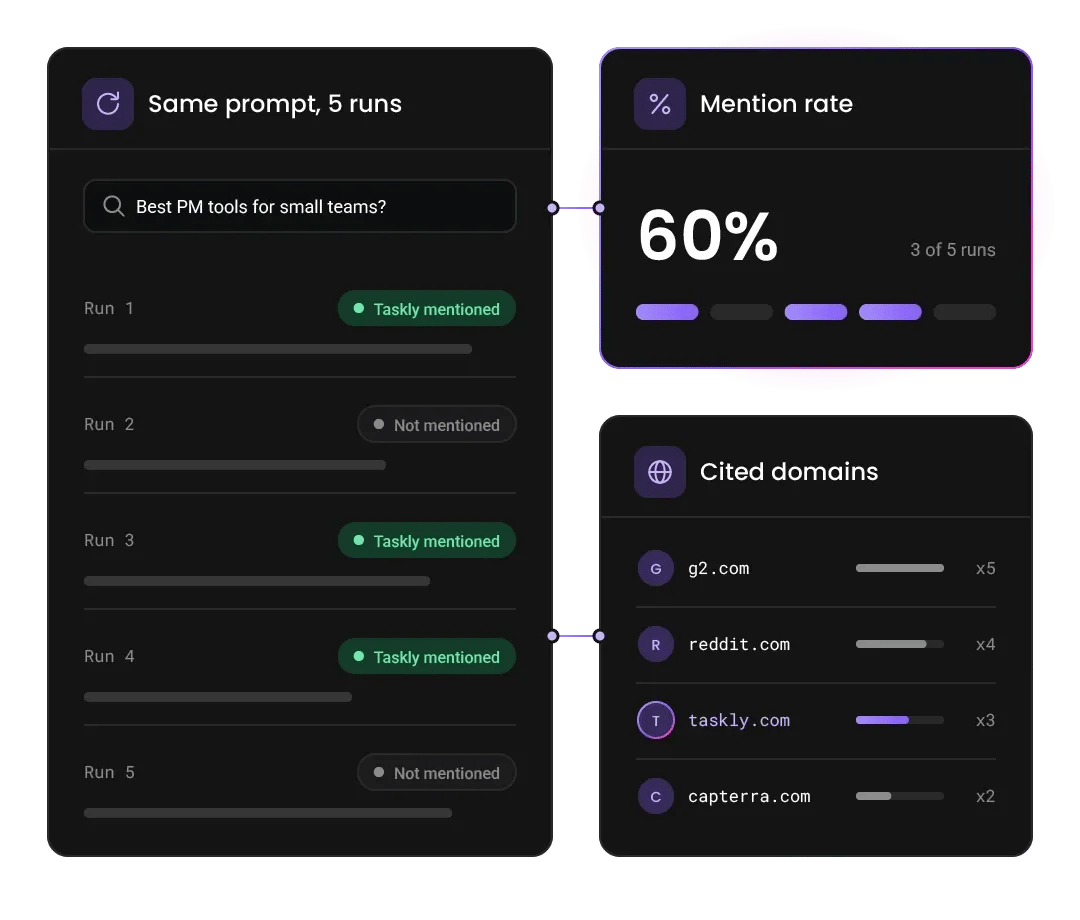
AI assistants generate responses dynamically, so the same prompt can produce different recommendations, wording, and citations across runs. Execute each prompt multiple times and store every response with its platform and collection timestamp. Calculate aggregated mention rates and citation frequencies instead of treating a single answer as representative of your brand's overall AI visibility.
How do you pick prompts that reflect real buyers?
Build your monitoring dataset using questions from search queries, customer conversations, support tickets, and product research. Include informational, comparison, and purchase-intent prompts, then group them by topic and buyer journey stage. Keep a stable benchmark set for historical comparisons while adding new prompts as customer search behavior evolves.
How do you collect answers without getting blocked?
AI platforms may restrict automated requests through rate limits, CAPTCHAs, and other access controls. Decodo's supported AI scraping templates use managed proxy infrastructure, retries, and anti-bot handling backed by a network of 125M+ ethically sourced IPs. This reduces the need to maintain custom scraping infrastructure, although request success and available data depend on the target platform.
What counts as a brand mention?
Define consistent matching rules for your brand name, product names, abbreviations, and common variations before processing AI answers. Use exact matching or entity recognition to identify mentions, then distinguish between passing references, list appearances, and direct recommendations. Apply the same classification logic across runs to produce comparable AI visibility metrics.
Why track citations as well as mentions?
Citation analysis helps reveal which websites AI platforms reference when responding to relevant prompts. Extract available source URLs, normalize them by domain, and track how often your pages, competitors, and third-party publications appear. Use these insights to identify relevant content opportunities and investigate which sources are associated with AI-generated recommendations.
Why doesn't every query show an AI Overview?
Google AI Overviews appear only for certain searches and may vary with query intent, location, and other factors. Collect search results for your monitored keywords, record whether an AI Overview is present, and analyze the content and citations when available. Tracking appearance frequency alongside brand mentions gives you a more complete picture of your visibility in Google's AI search results.
Which tools does Decodo integrate with?
Web Data API plugs directly into the tools SEO, marketing, and data teams already use, so AI answer data lands next to your other reporting.


What else can you build with Web Data API?


Web search for AI agents
Give AI agents access to live search results and relevant web content through Web Data API and MCP Server.


Website content extraction
Extract relevant text and structured information from websites cited in AI-generated answers for further analysis.

Price intelligence
Monitor competitor prices, product availability, and pricing changes across retailers and markets.
How does Decodo keep data collection secure and compliant?

Decodo's proxies and Scraping API are backed by ISO/IEC 27001:2022 certification and aligned with leading data protection regulations. All Decodo's residential IPs are ethically-sourced through transparent opt-in programs.
Decodo has been recognized by G2 as one of the best security products in 2026 and has been awarded as the most innovative proxy infrastructure & web data platform of 2026 at the Global Business Awards.
What do users say about Decodo?
We're thrilled to have the support of our 135K+ users and the industry's best.

Helping us build
Decodo lets us collect data from 10M+ ads every month without throttling, so our small team can focus on building.
S
Skaler.app
Easy to get things done
Decodo provides great service with a simple setup and friendly support team.
R
RoiDynamic
A key to our work
Decodo enables us to develop and test applications in varied environments while supporting precise data collection for research and audience profiling.
C
Cybereg




Frequently asked questions
What is AI search monitoring?
AI search monitoring is tracking how AI assistants answer the questions your buyers ask: whether your brand is mentioned, how it's described, which competitors appear, and which sources the answers cite. It's the AI-answer counterpart of rank tracking.
How do I monitor AI search visibility?
Build a fixed set of buyer prompts, collect the answers from each assistant, and record brand mentions, positions, and cited sources. Repeat each prompt several times per run, then compare mention rates between runs to see whether your visibility is growing.
What is AI share of voice?
AI share of voice is the share of AI answers that mention your brand, compared with competitors, across a set of prompts. If your brand appears in 30 of 100 answers and your top competitor in 45, you're behind on the prompts that matter.
Can I track brand mentions in ChatGPT?
Yes. Collect ChatGPT's answers to your prompts with web search turned on, then search each answer for your brand and save the sources it cites. The ChatGPT scraper page shows what the template returns.
Which AI answer engines can I monitor?
ChatGPT, Gemini, and Google AI Mode through ready-made AI answer templates, and Google AI Overviews through the Google Search template. Each engine leans on different sources, so store the engine with every answer and compare mention rates per engine.
Can I track my brand in Google AI Overviews and AI Mode?
Yes. Collect the results page for each tracked query with the Google Search template, then check whether an AI Overview appears, whether it mentions your brand, and which pages it cites. AI Overviews don't show for every query, so track how often they appear as well as what they say. For AI Mode, send the question through the Google AI Mode template and check the answer and its sources the same way.
Ready to Start Monitoring AI Search?
Collect AI answers and their cited sources for the prompts that matter with Web Data API – without building your own monitoring infrastructure.