AI Web Scraping That Turns Any Website Into LLM-Ready Data
AI web scraping uses language models to read web pages and extract the data you describe, so you don't write or fix CSS selectors when layouts change. With Decodo's Web Data API, any public page comes back as clean Markdown or JSON for your LLMs and agents – collected through 125M+ IPs in 195+ locations.
14-day money-back option
100+
ready-made templates
99.99%
success rate
200
requests per second
125M+
IPs worldwide
Up to 10K
free requests
Trusted by:


How does AI web scraping work?
The job splits into 2: a collection layer gets the page, and a language model reads it. Here's what happens between your request and the data your app receives.
How does Decodo get the page?
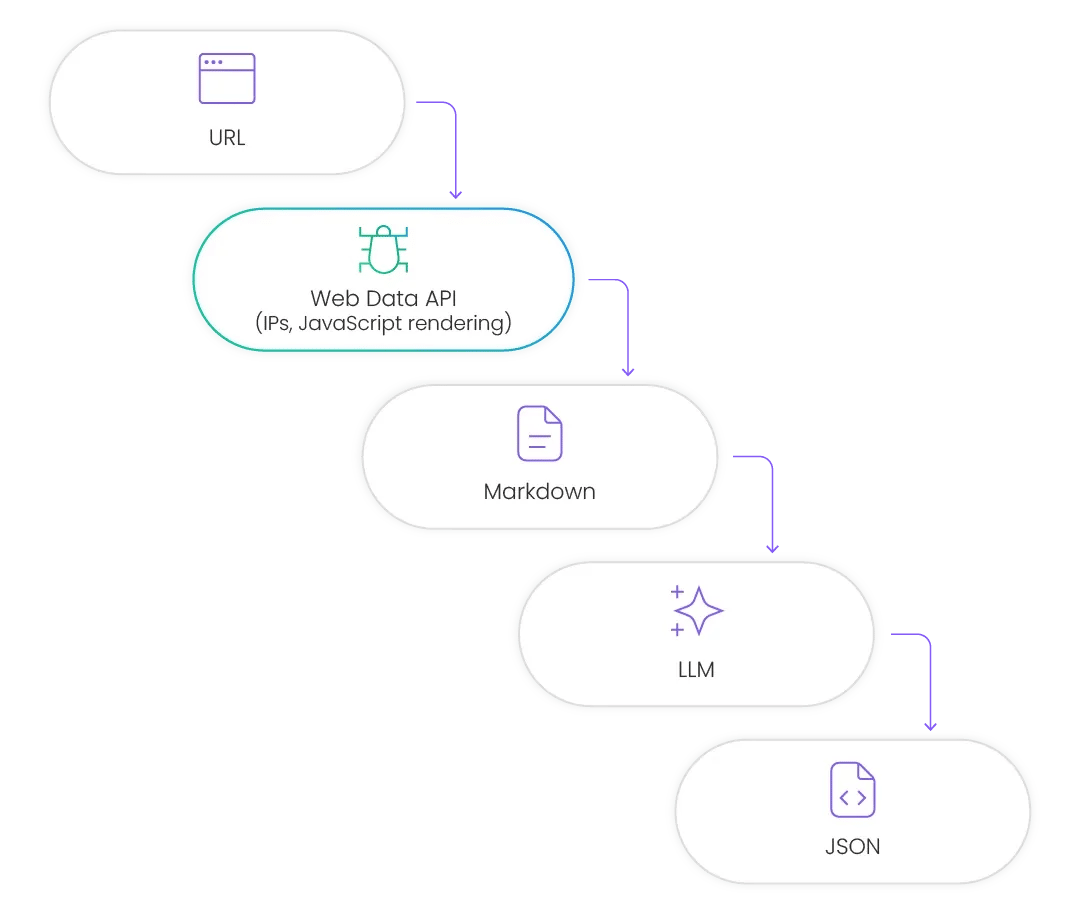
Web Data API requests the page through 125M+ ethically-sourced IPs, with unblocking and JavaScript rendering built in, so content loaded by React, Vue, and other frameworks shows up in the response.
How does the page become LLM-ready?
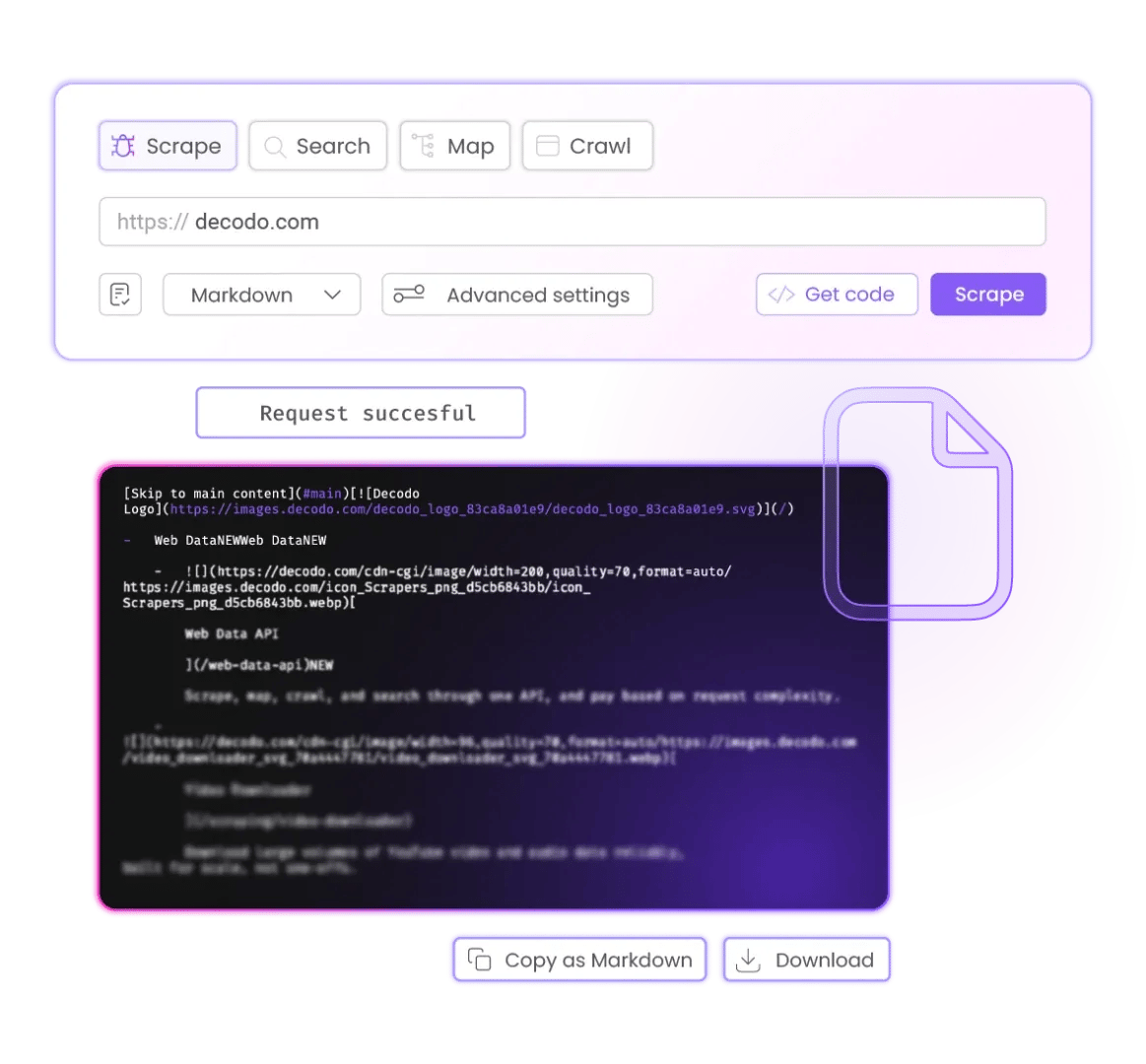
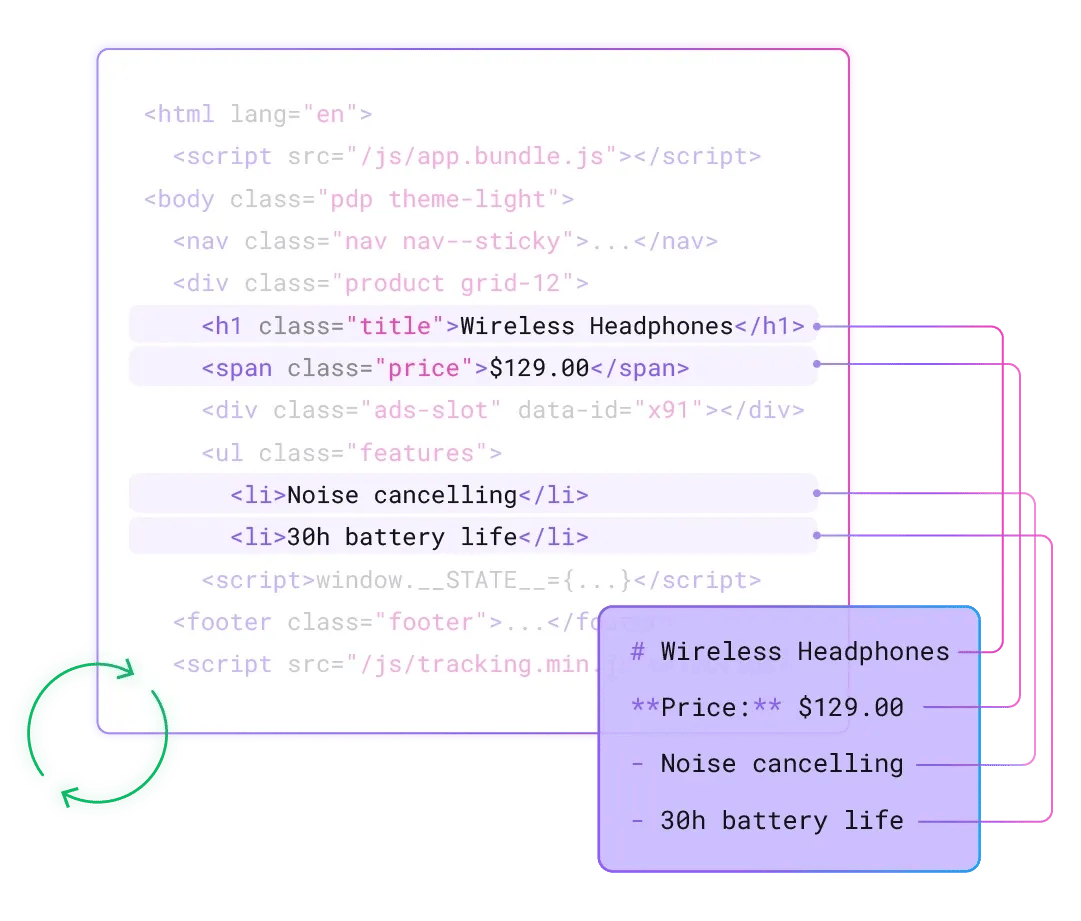
Turn on Markdown output, and the page comes back as clean Markdown instead of HTML – text, headings, links, and tables without scripts or styling, so your model reads less noise.
How do you extract the fields you need?
Send the Markdown to your LLM with a plain-English prompt or a JSON schema, and it returns the fields you asked for. For popular sites, ready-made templates return structured JSON without a model call.
How does the data reach your models?
Call the Web Data API from your code, or connect it to the AI frameworks you already use – see the integrations below.
What can you build with web scraping for AI?
Web scraping for AI fits any workflow where a model needs current data from the web. Here's what teams build with Decodo:

How do I give an AI agent live web access?
Connect your agent through the Decodo MCP Server so it can fetch and read any public page in the middle of a task.

How do I turn web pages into Markdown for an LLM?
Request any URL with Markdown output on and get clean text that uses far fewer tokens than HTML.

How do I extract data without writing selectors?
Describe the fields you need in plain English, and your LLM returns them as structured JSON from the page's Markdown.

How do I build datasets for LLM training?
Crawl a docs site or knowledge base into clean text for pre-training, fine-tuning, and evaluation sets.

How do I automate AI scraping without code?
Drop the Decodo node into an n8n workflow to scrape pages and pass the results straight to an LLM step.

How do I keep a chatbot's answers current?
Re-scrape your source pages on demand and replace the old Markdown in your index, so answers reflect the latest version.
How do I turn a web page into LLM-ready data?
LLM web scraping with Decodo takes 1 request. Send the target URL with markdown set to true, and the response returns the page as Markdown – ready for a prompt, a vector store, or an agent's context.
In Decodo's tests, Markdown output cut a Zillow page from 652K characters of HTML to 10K, about 98% less text for your model to read.
How much does Web Data API cost?
Activate a free starter plan of up to 10K requests, then choose the plan that matches your volume.
With each plan, you access:

JavaScript rendering
99.99% success rate
HTML, Markdown, XHR, plus JSON, PNG where supported
One-click AI integrations
LLM-ready Markdown format
100+ pre-built templates
Single API key for all endpoints
/scrape, /search, /map, /crawl
24/7 tech support
14-day money-back
SSL Secure Payment
Your information is protected by 256-bit SSL

How does an AI web scraper compare to rule-based scraping?
An AI web scraper doesn't replace selectors everywhere. It wins on messy pages and sites that change often, while rule-based parsers stay cheaper on stable, high-volume targets – which is why most production pipelines use both.
Rule-based scraping
AI web scraping
Decodo Web Data API
How data is extracted
CSS selectors or XPath you write and maintain
A model reads the page and returns the fields you describe
Ready-made templates for popular sites, LLM-ready Markdown for every other page
Setup for a new site
Hours to days
Minutes
Minutes
When the layout changes
Breaks until you update the selectors
Usually keeps working
Templates are maintained for you; AI covers the long tail
Cost per page
Lowest – no model calls
Higher – you pay for model tokens
Markdown output cuts the tokens your model reads
Output consistency
Identical on every run
Can vary – validate against a schema
Fixed JSON from templates, plus AI output you can validate
Best for
Stable, high-volume targets
Many sites with different layouts
Workloads that need both
How do you keep AI data scraping reliable at scale?
Most failures happen before the model sees the page – a block, an empty JavaScript shell, or a page too long for the context window.
What happens when a site blocks the request?
Without help, your model reads a CAPTCHA or challenge page instead of content. Web Data API runs requests through 125M+ ethically-sourced IPs with unblocking built in, so the page that reaches your model is the real one.
Why does the HTML come back empty?
The site loads its content with JavaScript in the browser, so a plain request gets an empty shell. Turn on JavaScript rendering, and the page is rendered before it comes back.
How do you keep token costs down?
Full HTML fills the context window with markup you pay for but don't need. Markdown output removes it before the page reaches your model.
How do you stop the model from inventing values?
Models fill gaps with plausible guesses when a field is missing. Use ready-made templates for popular sites, which return fixed JSON fields, and check AI-parsed output against a schema.
How do you get location-specific results?
Prices, rankings, and availability change by country and city. Geo-targeting across 195+ locations, down to city level, returns the version of the page your users see.
How do you handle large jobs?
Send asynchronous or batch requests for long URL lists, or crawl a site to collect many of its pages in one job.
What else can you build with Web Data API?
Web Data API plugs directly into the tools AI teams already use, so scraped pages reach your models without glue code.MCP server
MCP server
Let Claude, Cursor, and other MCP clients fetch any public page as Markdown during a task
LangChain
Load pages as Markdown into chains and agents – Python and TypeScript
n8n
Scrape inside drag-and-drop workflows and pass the results to AI nodes
OpenClaw
Give OpenClaw agents a scraping skill for any public URL
TypeScript SDK
Call Web Data API from TypeScript and Node.js projects
How do I automate scraping with AI in n8n?
Watch how to build an n8n workflow that scrapes pages with Decodo and hands the results to an AI model to summarize and extract.
Which AI frameworks does Decodo integrate with?


LLM training data
Collect clean, diverse web text for pre-training, fine-tuning, and evaluation.


Job data collection
Collect job postings from career sites and job boards in one consistent format.

Review scraping
Pull reviews and ratings from product and app pages for sentiment analysis.

Website content extraction
Pull clean text and structured content from any public page.
How does Decodo keep data collection secure and compliant?

Decodo's proxies and Scraping API are backed by ISO/IEC 27001:2022 certification and aligned with leading data protection regulations. All Decodo's residential IPs are ethically-sourced through transparent opt-in programs.
Decodo has been recognized by G2 as one of the best security products in 2026 and has been awarded as the most innovative proxy infrastructure & web data platform of 2026 at the Global Business Awards.
What do users say about Decodo?
We're thrilled to have the support of our 135K+ users and the industry's best.

Attentive service
The professional expertise of the Decodo solution has significantly boosted our business growth while enhancing overall efficiency and effectiveness.
N
Novabeyond
Easy to get things done
Decodo provides great service with a simple setup and friendly support team.
R
RoiDynamic
A key to our work
Decodo enables us to develop and test applications in varied environments while supporting precise data collection for research and audience profiling.
C
Cybereg




Frequently asked questions
Can I use AI to scrape websites?
Yes. AI can read a web page and pull out the data you describe, but on its own it can't handle IP blocks, CAPTCHAs, or pages that load content with JavaScript. Pair a model with a collection layer that does – for example, Decodo's Web Data API returns the page as Markdown, and your LLM extracts the fields. Here's more on how AI scraping works.
Is AI web scraping legal?
AI web scraping follows the same rules as any other web scraping. Collecting publicly available data is generally legal in most jurisdictions, but you should check each site's terms of service, avoid personal data without a lawful basis, and comply with regulations like GDPR and CCPA. Using AI to parse the data doesn't change those obligations, and Decodo's Web Data API is built for publicly accessible data only – it doesn't support collecting post-login content or private user information. Read more about web scraping legality.
Can ChatGPT do web scraping?
ChatGPT can read pages through its browsing tool, but it isn't built for scraping at scale – it can't rotate IPs, handle CAPTCHAs, or run thousands of requests reliably. To scrape with ChatGPT or another LLM, connect the model to a scraping service through an MCP server or a function call, and let it work with the Markdown that comes back.
What's the difference between an AI web scraper and a traditional web scraper?
A traditional web scraper extracts data with CSS selectors or XPath written for each site, so it breaks when the layout changes. An AI web scraper uses a language model to read the page and return the fields you describe, so it adapts to new layouts but costs more per page in model tokens. Most production pipelines use templates for stable targets and AI for the long tail – see our AI web scraping with Python guide for a working example.
Why do LLMs work better with Markdown than HTML?
Markdown keeps the text, headings, links, and tables a model needs and drops the scripts, styles, and tags it doesn't. That means fewer tokens per page, lower model costs, and more room in the context window. In Decodo's tests, Markdown output turned 652K characters of Zillow HTML into 10K characters.
How do I connect an AI agent to Decodo?
Add the Decodo MCP server to an MCP client like Claude or Cursor, and your agent can fetch any public page as Markdown during a task. For agents built in code, use the LangChain integration, or call the Web Data API directly from the Python, TypeScript, or Go SDK.
Ready to Start AI Web Scraping?
Turn any public page into LLM-ready Markdown with Web Data API – no proxies or browsers to manage.