Review Scraping for Customer Feedback at Scale
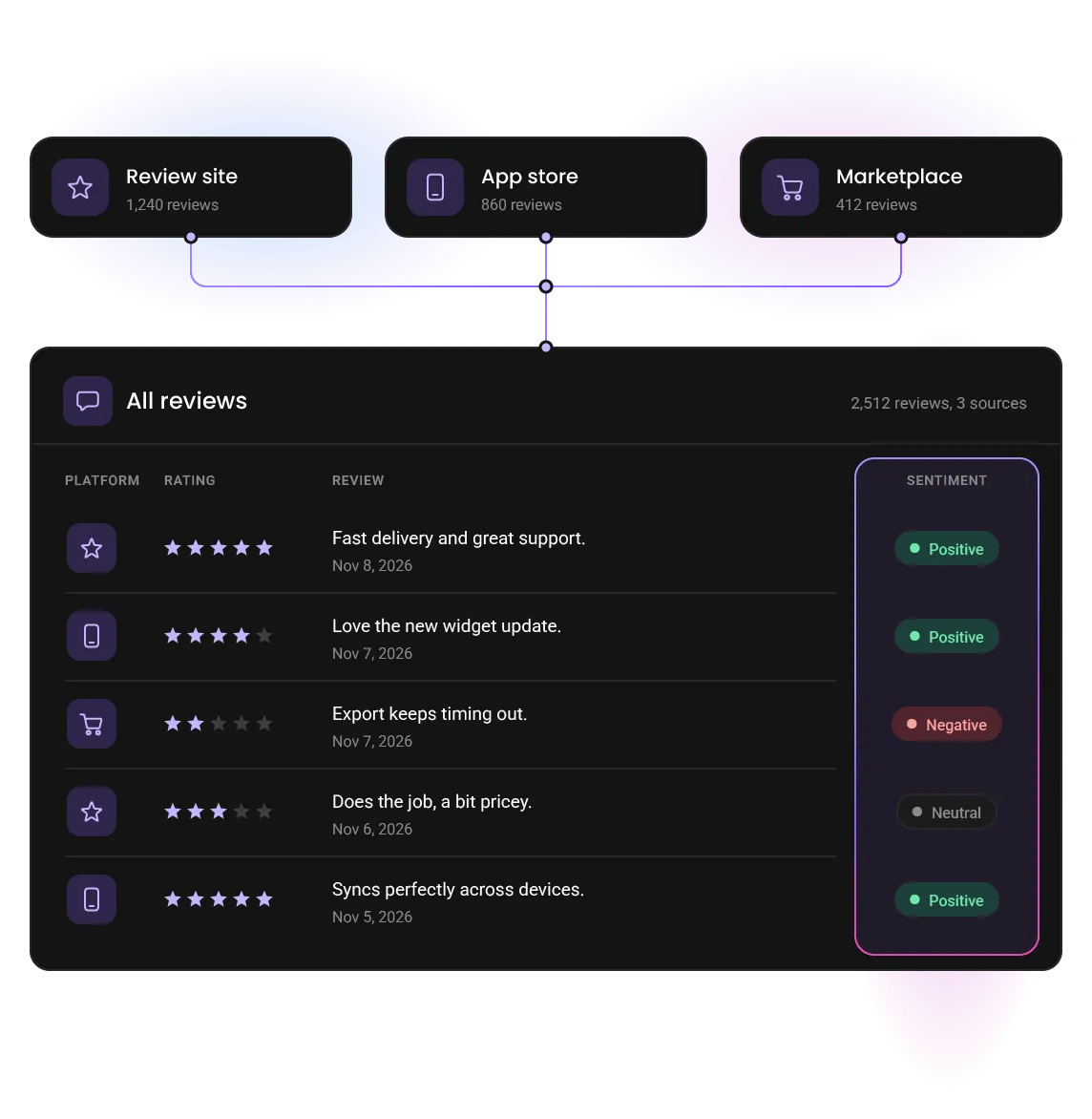
Review scraping is the automated collection of customer reviews, including ratings, text, dates, and replies from review sites and app stores into one dataset you can analyze. With Decodo's Web Data API, you collect public review pages as clean Markdown or HTML, with unblocking and JavaScript rendering built in, through 125M+ IPs in 195+ locations.
14-day money-back option
100+
ready-made templates
99.99%
success rate
Up to 200
requests per second
125M+
IPs worldwide
Up to 10K
free requests
Trusted by:


How does review scraping work?
Collect publicly available reviews, extract relevant fields, and turn customer feedback into actionable insights. Decodo's Web Data API handles web access, rendering, and data retrieval, so you can focus on building the analysis workflows that matter to your business.
Which pages do you collect?
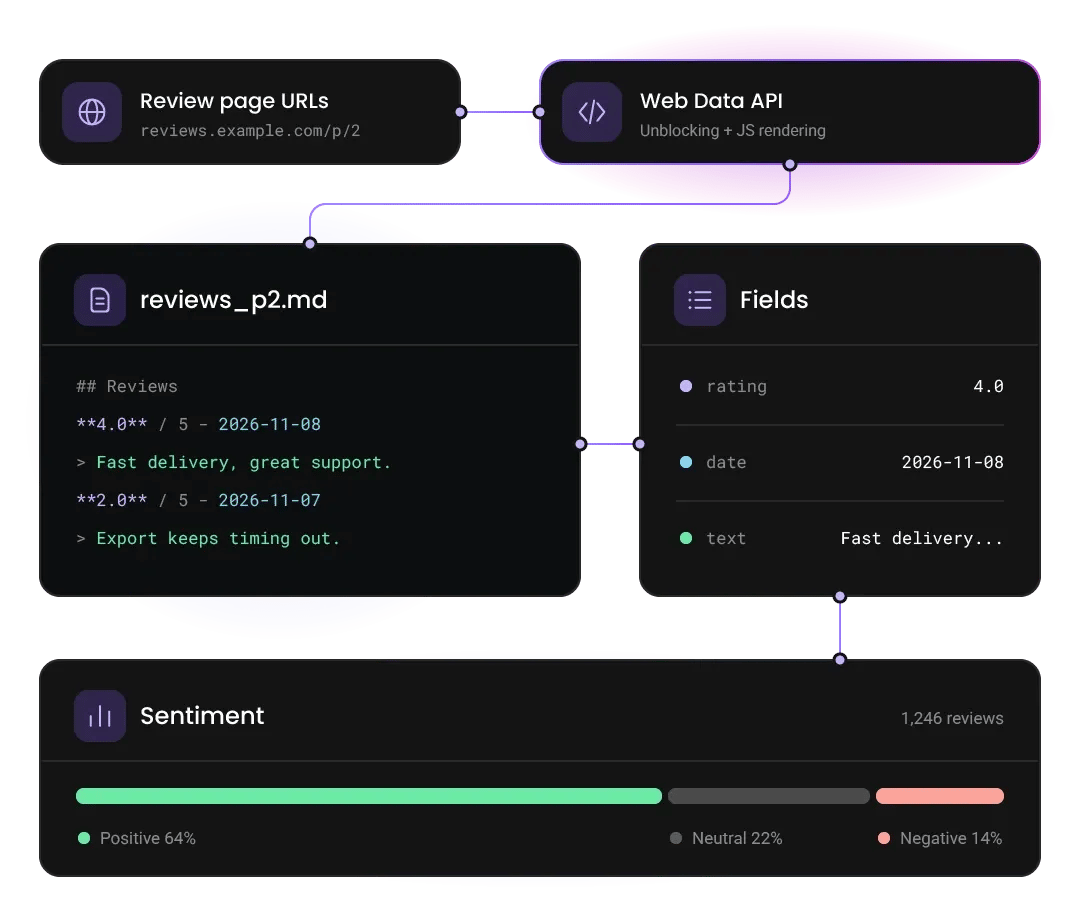
Start with public review pages relevant to your products, competitors, or industry, including business review platforms, software marketplaces, travel websites, and app store listings. Use Web Data API's /scrape endpoint to retrieve known URLs, or /search to discover additional sources. Build a targeted collection pipeline that captures the feedback your team needs without maintaining separate scrapers for every website.
How do you collect more than the first page of reviews?
Collect reviews across multiple result pages by handling pagination in your workflow. Request each available page URL or use site-specific loading logic when reviews appear dynamically. Web Data API supports JavaScript rendering to retrieve browser-loaded content, while built-in proxy management and retries help keep collection running across larger datasets.
How do reviews become structured data?
Retrieve review pages in clean Markdown or HTML, then extract fields such as star ratings, review text, publication dates, and business replies using your own parser or an LLM. For supported websites, ready-made templates can return structured data directly. Normalize the results into a consistent schema so they're ready for analytics, databases, and AI pipelines.
What do you do with the data?
Feed collected reviews into sentiment analysis, topic classification, and competitor benchmarking workflows. Use NLP models or LLMs to identify recurring complaints, emerging feature requests, and changes in customer perception. With a repeatable collection pipeline, you can monitor trends over time and turn unstructured feedback into useful business intelligence.
What can you do with a review scraper?
Turn scattered customer feedback into structured data for product research, brand monitoring, and AI-powered analysis. With Decodo's Web Data API, you can automate review collection and build workflows that reveal what customers think about your products and competitors.

How do I analyze customer sentiment?
Collect review text and ratings, then feed them into NLP models or LLMs to classify sentiment, detect recurring complaints, and identify what customers value most.

How do I benchmark against competitors?
Compare review volumes, ratings, and customer feedback across competing products to uncover recurring weaknesses, emerging trends, and opportunities.

How do I monitor my brand's reviews?
Schedule recurring review collection, detect newly published feedback, and route negative reviews or urgent issues to your support and CX workflows.

How do I find feature requests in reviews?
Extract customer suggestions and product complaints, then use AI classification to group requests by feature, frequency, and customer pain point.

How do I track app store feedback?
Collect publicly available app reviews and ratings from supported sources to monitor user sentiment, recurring bugs, and post-release feedback.

How do I train models on review data?
Build domain-specific datasets from review text and ratings for sentiment classification, aspect-based analysis, or LLM fine-tuning after filtering and labeling.
How do I scrape reviews with Decodo?
Send a public review page URL to Web Data API's /scrape endpoint and retrieve the content in clean Markdown, ready for parsing or LLM-based extraction. Enable JavaScript rendering when needed, handle pagination to collect additional reviews, and process the results into a structured dataset for analysis.
How much does Web Data API cost?
Start with a free plan offering up to 10K recurring monthly requests, then scale seamlessly with a subscription tailored to your data collection needs.
With each plan, you access:

JavaScript rendering
99.99% success rate
HTML, Markdown, XHR, plus JSON, PNG where supported
One-click AI integrations
LLM-ready Markdown format
100+ pre-built templates
Single API key for all endpoints
/scrape, /search, /map, /crawl
24/7 tech support
14-day money-back
SSL Secure Payment
Your information is protected by 256-bit SSL

How does review scraping compare to review monitoring tools?
Online review monitoring platforms help teams manage customer feedback, while official platform APIs provide access within their supported permissions and quotas. Web Data API gives developers greater flexibility to collect publicly available review data from multiple sources and analyze it in their own systems.
Review monitoring tool
Platform APIs
Decodo Web Data API
What you get
Dashboards, alerts, and review management features
Review data exposed by the platform's API
Public review page content and supported structured output
Competitor reviews
Depends on the provider and plan
Limited by API permissions
Collect from supported public competitor review pages
Platforms covered
The tool's supported integrations
Individual platforms with API access
Public review sites you select, subject to target support
Data ownership
Depends on the provider's export policies
Governed by API terms
Process and store collected data subject to source rights and applicable laws
Setup
Usually quick, with some configuration
Authentication and API integration
One API integration plus target-specific parsing where needed
Cost
Subscription, often based on users or locations
Free or paid, with usage limits
Usage-based pricing with a free starter plan
Best for
Managing and responding to reviews
Accessing official platform data
Cross-platform research, competitor analysis, and custom AI workflows
How do you keep review data accurate and complete?
Reliable review analysis depends on collecting the right content, handling dynamic pages, and maintaining consistent records across sources. Web Data API simplifies access and extraction, while your data pipeline handles normalization, deduplication, and quality checks.
Why do some review pages come back empty?
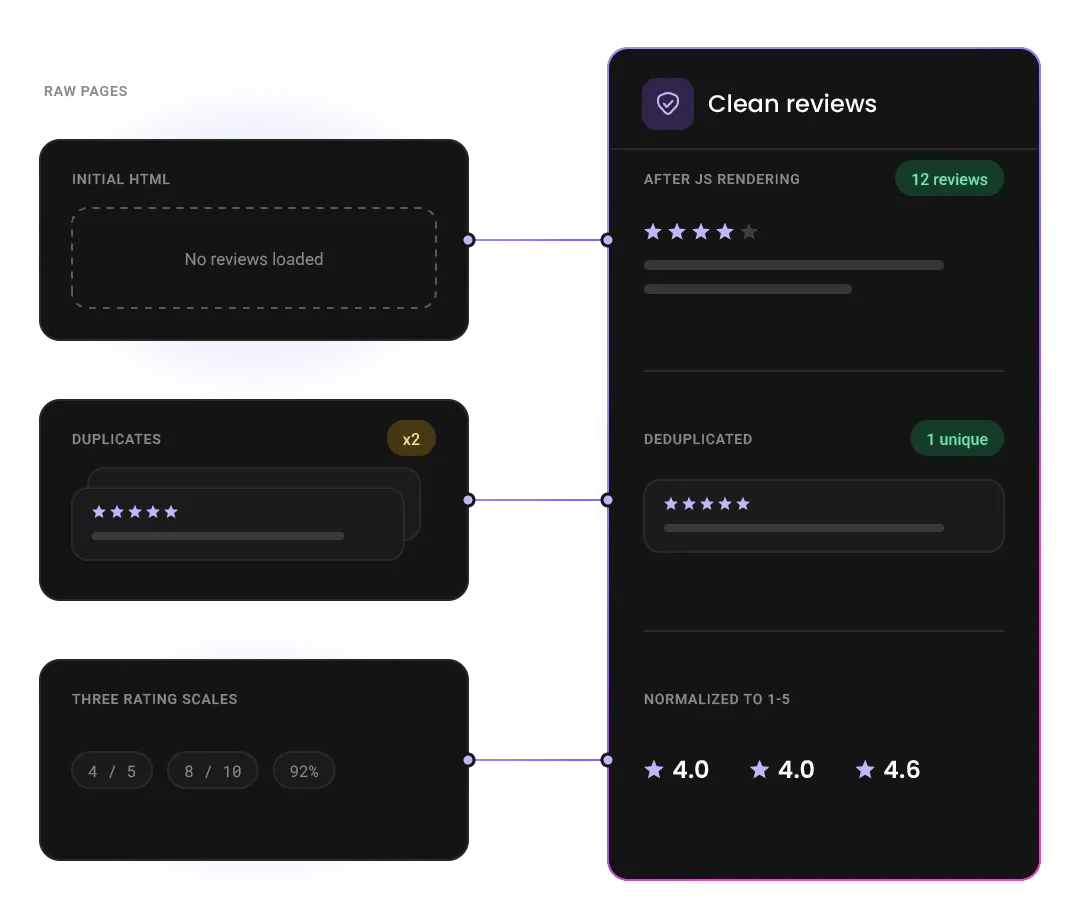
Many review platforms load ratings and review text dynamically after the initial HTML response. Web Data API supports JavaScript rendering to retrieve content from these pages without maintaining your own headless browsers. For more reliable extraction, verify that the expected review elements appear in the response and account for pagination or dynamically loaded content.
What happens when a review site blocks the requests?
Review platforms may rate-limit automated traffic, trigger CAPTCHAs, or block repeated requests. Web Data API manages proxy rotation, retries, and anti-bot challenges through Decodo's network of 125M+ ethically-sourced IPs. This improves collection reliability while reducing the infrastructure developers need to manage, though successful retrieval depends on the target website.
Can you collect reviews behind a login?
No. Web Data API collects publicly accessible pages only. Some platforms show only part of their reviews to visitors who aren’t signed in, so verify what each platform shows publicly before building your collection workflow.
How do you avoid duplicate reviews?
Reviews can appear across multiple result pages, translated versions, and repeated collection runs. Store each record with its source platform, review ID or URL, and publication date, then apply exact-match and similarity-based deduplication in your pipeline. This helps prevent repeated feedback from distorting sentiment scores and review counts.
How do you compare ratings across platforms?
Review platforms use different rating scales, scoring methods, and moderation policies. Normalize extracted ratings into a common scale, such as 1–5, while preserving the original score and source platform as metadata. This makes cross-platform comparisons easier without losing the context needed to interpret differences in ratings.
How do you handle reviewer names and personal data?
Public reviews may contain names, profile images, and other personally identifiable information. Apply data minimization rules during preprocessing, remove unnecessary identifiers, and mask sensitive details before using reviews for AI training or analytics. Store only data you have a lawful basis to process and follow applicable privacy and platform requirements.
Which tools does Decodo integrate with?
Connect Web Data API to your AI and development stack to automate review collection, sentiment analysis, and reporting.


What else can you build with Web Data API?


Job data collection
Collect public job postings from company websites and job boards for recruitment and market analysis.

Web search for AI agents
Connect AI agents to live search results and website content through Decodo's MCP Server.

LLM training data
Collect domain-specific web content for pre-training, fine-tuning, and model evaluation pipelines.

Price intelligence
Monitor competitor prices, product availability, and pricing trends across retailers and markets.
How does Decodo keep data collection secure and compliant?

Decodo's proxies and Scraping API are backed by ISO/IEC 27001:2022 certification and aligned with leading data protection regulations. All Decodo's residential IPs are ethically-sourced through transparent opt-in programs.
Decodo has been recognized by G2 as one of the best security products in 2026 and has been awarded as the most innovative proxy infrastructure & web data platform of 2026 at the Global Business Awards.
What do users say about Decodo?
We're thrilled to have the support of our 135K+ users and the industry's best.

Helping us build
Decodo lets us collect data from 10M+ ads every month without throttling, so our small team can focus on building.
S
Skaler.app
Easy to get things done
Decodo provides great service with a simple setup and friendly support team.
R
RoiDynamic
A key to our work
Decodo enables us to develop and test applications in varied environments while supporting precise data collection for research and audience profiling.
C
Cybereg




Frequently asked questions
What is review scraping?
Review scraping is collecting customer reviews from public web pages automatically – the rating, review text, date, and any owner reply – and storing them in one consistent format. Teams use it to analyze sentiment, benchmark competitors, and find product issues early.
Is it legal to scrape reviews?
Collecting publicly visible reviews is generally legal, but check each site's terms of service and the laws that apply to you, and don't store personal data, such as reviewer names, without a lawful basis. Web Data API is built for publicly accessible pages only. Read more about web scraping legality.
Which sites can I scrape reviews from?
Any review page a public visitor can open, such as business review sites, travel sites, software marketplaces, and app store listings. Some sites need extra setup. For example, the G2 scraper uses premium proxies and JavaScript rendering. Test your target pages on the free starter plan first.
What is the best review scraper?
Pick one that returns data reliably from your target sites, renders JavaScript review panels, handles paginated reviews, and lets you keep the data in your own schema at a predictable cost. See how teams use scraped data in our guide to web scraping for market research.
How do I scrape Amazon reviews?
Amazon shows a selection of top reviews on public product pages, while its full review pages ask visitors to sign in. Web Data API collects the public part only. Our tutorial on how to scrape Amazon reviews walks through the setup in Python.
How is review scraping different from review monitoring software?
Review monitoring software helps you watch and reply to reviews of your own business. Review scraping collects public reviews for any product, including competitors', so you can analyze them in your own tools. Here's how review data fits into brand reputation management.
Ready to Start Scraping Reviews?
Collect public reviews and ratings from review sites and app stores with Web Data API – no proxies or browsers to manage.