LLM Training Data Collected From the Public Web
LLM training data is the text a language model learns from – web pages, documentation, articles, and forums – cleaned, deduplicated, and formatted for pre-training, fine-tuning, or evaluation. Decodo's Web Data API lets you crawl websites of your choice and extract content in clean Markdown, making it easier to prepare datasets for pre-training, fine-tuning, and evaluation. With access to 125M+ IPs across 195+ locations, you can collect web data at scale and feed it into your existing data pipelines.
14-day money-back option
100+
ready-made templates
99.99%
success rate
Up to 200
requests per second
125M+
IPs worldwide
Up to 10K
free requests
Trusted by:


How do you collect LLM training data from the web?
A web data pipeline for LLMs has 4 steps – pick sources, collect pages, clean them, and package the dataset. Here's how it works with Decodo.
How do you choose sources?
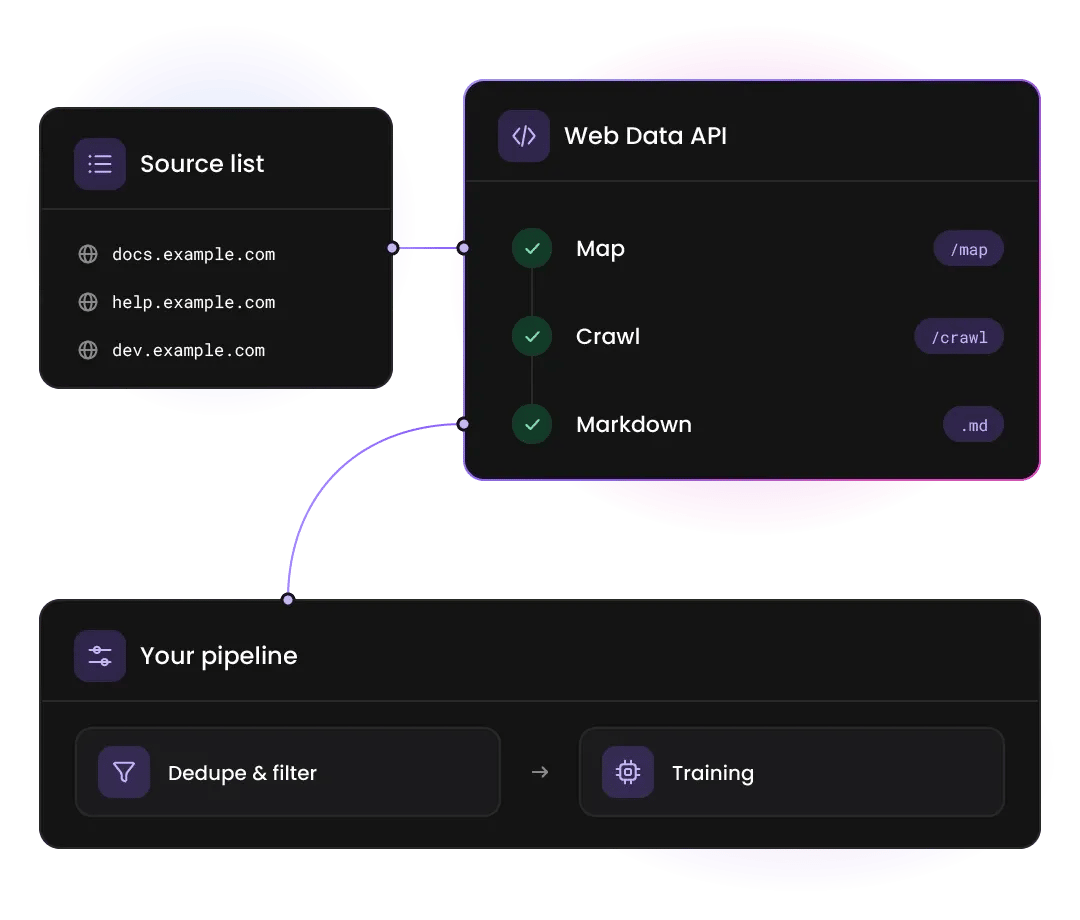
Build a high-quality training dataset by selecting the sources most relevant to your model, from technical documentation and industry publications to forums and knowledge bases. With Decodo's Web Data API, you can use the /map endpoint to discover up to 147K URLs from a website and its sitemap in a single request. Filter URLs by path or domain to focus on valuable content and avoid collecting irrelevant pages, giving you greater control over what goes into your training dataset.
How do you collect the pages?
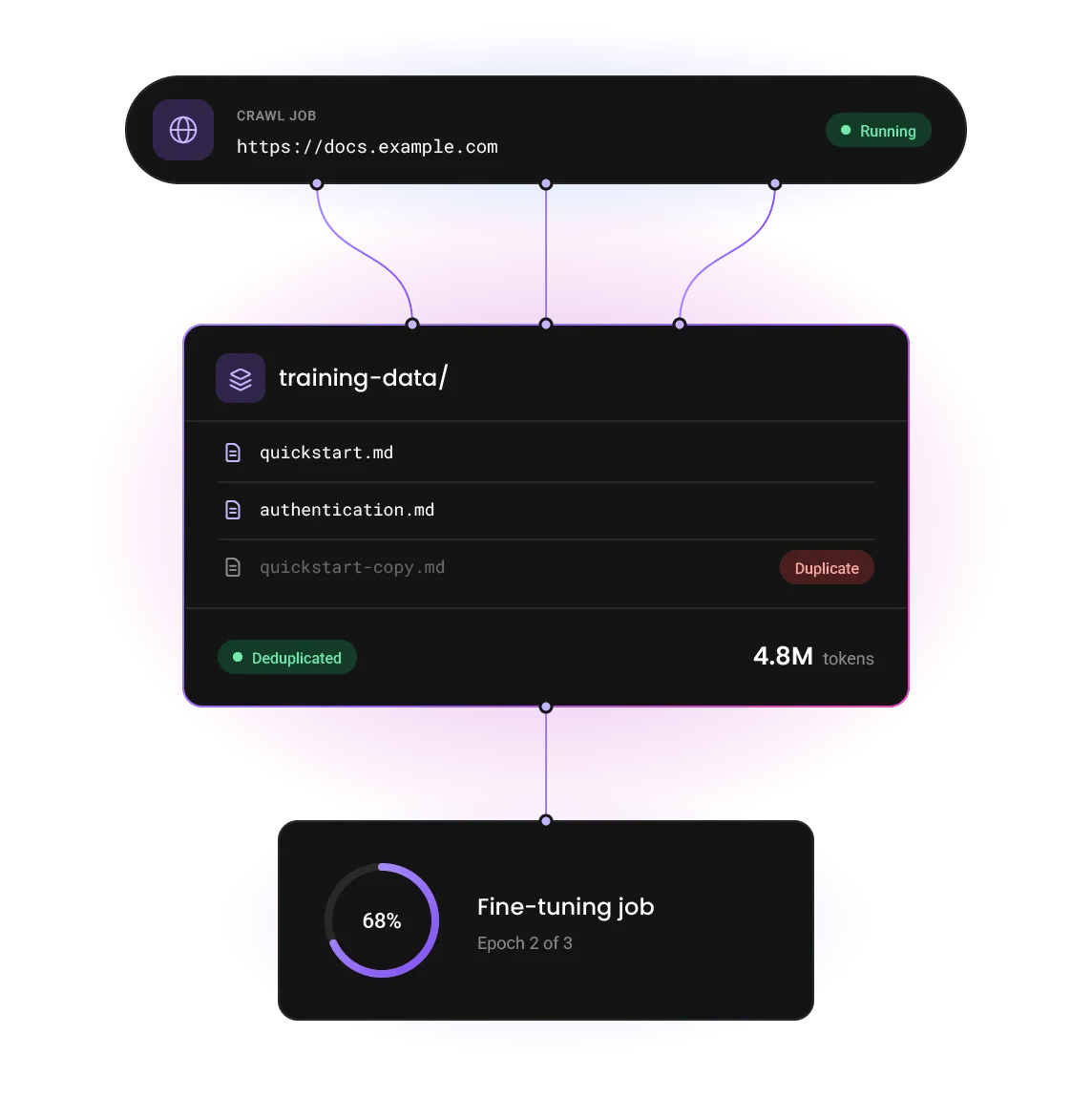
Turn entire websites into training-ready content without building or maintaining your own crawling infrastructure. Decodo's /crawl endpoint automatically discovers and collects up to 10K pages per job, returning content in clean Markdown or HTML. Built-in proxy management, anti-bot handling, and optional JavaScript retries help you access even challenging websites, while customizable crawl parameters let you focus on the sections that matter. Spend less time managing crawlers and more time building better models.
How do you clean the text?
Get cleaner, more structured content from the start with Web Data API's Markdown output. Instead of processing HTML, you receive readable text that preserves useful document structure while reducing unnecessary markup and page clutter. This simplifies downstream preprocessing, so you can focus on removing remaining boilerplate, filtering low-quality content, and eliminating duplicate records. The result is a more consistent dataset with less preprocessing overhead before training begins.
How do you package the dataset?
Prepare collected content for your LLM training pipeline using structured, easy-to-process Markdown output from Web Data API. Split documents into manageable chunks, attach metadata such as source URLs and collection timestamps, and convert the results into your preferred training format.
Whether you're preparing data for pre-training, fine-tuning, or model evaluation, Decodo helps simplify the collection stage so you can move from web content to usable datasets faster.
What can you build with LLM training datasets?
Public datasets cover general knowledge, but most teams need data their model hasn't seen. Here's what teams build with Decodo.

How do I fine-tune a model on my industry?
Collect domain-specific documentation, technical guides, and community discussions to fine-tune LLMs on specialized terminology, workflows, and industry knowledge.

How do I build an evaluation set?
Build evaluation datasets from recently published web content to benchmark LLM accuracy, factual grounding, and performance on real-world queries.

How do I add text in a new language?
Expand multilingual training datasets by crawling region-specific websites and collecting native-language content underrepresented in existing corpora.

How do I train a coding assistant?
Extract API references, SDK documentation, and technical tutorials to train coding assistants on specific frameworks, libraries, and developer workflows.

How do I keep a model current?
Refresh training datasets with newly published or updated web content to support continuous fine-tuning and reduce reliance on outdated information.

How do I build an instruction dataset?
Transform FAQs, troubleshooting guides, and community Q&A into structured instruction-response pairs for supervised fine-tuning and task-specific model alignment.
How do I collect large-scale data for LLM training?
Crawl up to 10K pages per job with Decodo's Web Data API. Set a starting URL, select the paths to crawl, and retrieve LLM-ready Markdown. Run crawls asynchronously and collect results via task polling or webhook callbacks.
How much does Web Data API cost?
Activate a free starter plan with up to 10K monthly requests, then choose the plan that matches your volume as you scale.
With each plan, you access:

JavaScript rendering
99.99% success rate
HTML, Markdown, XHR, plus JSON, PNG where supported
One-click AI integrations
LLM-ready Markdown format
100+ pre-built templates
Single API key for all endpoints
/scrape, /search, /map, /crawl
24/7 tech support
14-day money-back
SSL Secure Payment
Your information is protected by 256-bit SSL

Should you buy LLM training data or collect your own?
Public datasets offer a convenient starting point, while data vendors provide curated, licensed collections. Collecting your own data gives you more control over sources, coverage, and freshness, helping you build datasets tailored to your LLM.
Public datasets
Data vendors
Collect your own with Decodo
Coverage
Defined by dataset creators
Limited to vendor offerings
Public websites you select
Freshness
Depends on release and updates
Follows vendor update schedules
Collect and refresh on demand
Licensing
Varies by dataset
Defined by licensing agreement
Verify source rights and usage terms
Format
Dataset-specific formats
Vendor-provided formats
Markdown or HTML, ready for processing
Cost
Free or paid, depending on dataset
Subscription or licensing fees
Usage-based pricing, with a free starter plan
Best for
General pre-training and benchmarks
Ready-made, licensed datasets
Custom domain, language, and freshness requirements
How do you keep web training data high quality?
Most problems with web training data come from repeated text, missing content, and sources you shouldn't use. Here's how to handle each one.
Why does the same text show up again and again?
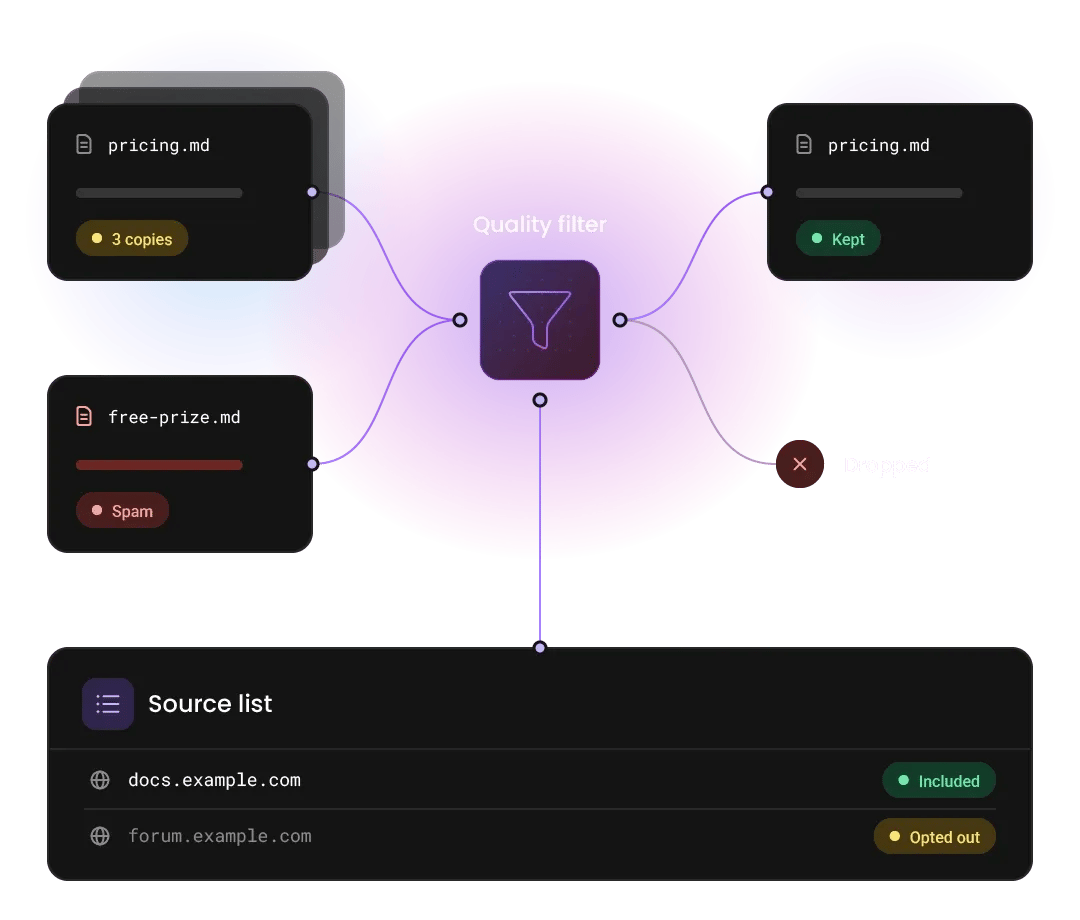
Websites often reuse navigation elements, footers, and syndicated content, creating duplicates that can affect training quality. Collect pages in clean Markdown with the Web Data API to reduce unnecessary HTML clutter, then apply content hashing and similarity-based deduplication in your preprocessing pipeline. This helps prevent repeated content from overrepresenting certain sources during training.
What happens when a site blocks the crawl?
Websites may rate-limit automated requests, trigger CAPTCHAs, or block IP addresses, disrupting large-scale data collection. Decodo's Web Data API handles proxy rotation, retries, and anti-bot challenges using a network of 125M+ IPs. With /crawl, failed pages can also receive an automatic retry with JavaScript rendering, improving data retrieval without maintaining custom unblocking infrastructure.
Why are some pages missing their main content?
JavaScript-heavy websites often load important content dynamically, leaving traditional HTTP scrapers with incomplete HTML. Web Data API supports JavaScript rendering to retrieve dynamically generated content, while /crawl can automatically retry failed pages with rendering enabled. This reduces the need to manage headless browsers and separate extraction workflows for modern web applications.
How do you filter out low-quality text?
Build preprocessing rules to evaluate collected pages by language, content length, relevance, and text quality before adding them to your training corpus. Web Data API provides clean Markdown output to simplify extraction and downstream processing. Apply your own quality scoring, spam detection, and filtering logic to exclude irrelevant or low-value documents from LLM training datasets.
How do you respect site owners' choices?
Review website terms, robots.txt directives, content licenses, and applicable AI training restrictions before collecting data. Use the Web Data API to target approved public sources and configure crawl parameters to limit collection to relevant sections. Maintain source URLs, collection timestamps, and permission records in your dataset metadata to support traceability and compliance audits.
How do you handle personal data?
Public web content can contain names, email addresses, and other personally identifiable information (PII). Integrate PII detection and masking into your preprocessing pipeline before using collected content for LLM training. Limit collection to authorized sources, exclude unnecessary personal data, and apply retention and access controls to meet applicable privacy requirements. And when in doubt, consult a legal professional regarding your data collection use case.
Which tools does Decodo integrate with?
Web Data API plugs directly into the tools ML and data teams already use, so collected pages flow straight into your pipeline.


What else can you build with Web Data API?


Web search for AI agents
Give AI agents live search results and page reading through MCP.

Website content extraction
Pull clean text and structured content from any public page.


Job data collection
Collect job postings from career sites and job boards in one consistent format.

How does Decodo keep data collection secure and compliant?

Decodo's proxies and Scraping API are backed by ISO/IEC 27001:2022 certification and aligned with leading data protection regulations. All Decodo's residential IPs are ethically-sourced through transparent opt-in programs.
Decodo has been recognized by G2 as one of the best security products in 2026 and has been awarded as the most innovative proxy infrastructure & web data platform of 2026 at the Global Business Awards.
What do users say about Decodo?
We're thrilled to have the support of our 135K+ users and the industry's best.

Helping us build
Decodo lets us collect data from 10M+ ads every month without throttling, so our small team can focus on building.
S
Skaler.app
Easy to get things done
Decodo provides great service with a simple setup and friendly support team.
R
RoiDynamic
A key to our work
Decodo enables us to develop and test applications in varied environments while supporting precise data collection for research and audience profiling.
C
Cybereg




Frequently asked questions
Where can I get training data for an LLM?
There are 3 main sources – public datasets such as web crawls and curated collections, data vendors that sell licensed datasets, and data you collect yourself from the web. Most teams combine them – public data for general knowledge, their own collection for domain, language, or recent content. Our guide to web scraping at scale covers the collection side.
What data are LLMs trained on?
Mostly public web text, plus books, code, research papers, and curated conversations. Pre-training uses very large general corpora, while fine-tuning uses smaller, focused datasets built for a specific domain or task, such as instruction and response pairs. For the basics, see our glossary entry on AI training data collection.
How much training data does an LLM need?
It depends on the job. Pre-training a model from scratch takes trillions of tokens, while fine-tuning an existing model often needs only thousands to tens of thousands of good examples. For fine-tuning, quality and relevance matter more than size.
Is it legal to use scraped web data for LLM training?
It depends on the source and where you operate. Copyright, site terms, and data protection laws all apply, and many sites now publish opt-outs from AI training. Collect public pages only, honor opt-outs, avoid personal data, and get legal advice for commercial models. Read more about web scraping legality.
How do I turn web pages into a fine-tuning dataset?
Collect the pages as Markdown, clean and deduplicate them, then convert them into the format your framework expects – plain text for continued pre-training, or prompt and response pairs for instruction tuning. Our guide to AI web scraping with Python shows how to pull structured fields out of pages with an LLM.
Why use Markdown for LLM training data?
Markdown keeps headings, lists, links, and tables while dropping HTML markup, so documents stay readable and use fewer tokens. The clean structure also makes chunking and deduplication easier.
Ready to Build Your LLM Training Data?
Crawl the sources you need into clean Markdown with Web Data API – no proxies or browsers to manage.