MAP Monitoring to Spot Minimum Advertised Price Violations
MAP monitoring is checking the prices resellers advertise online against your minimum advertised price (MAP) policy, so you can spot violations and act on them quickly with Decodo's Web Data API. Access advertised pricing data on demand through 125M+ IPs across 195+ locations, with built-in proxy rotation, retries, and anti-bot handling to simplify large-scale MAP monitoring without maintaining your own scraping infrastructure.
14-day money-back option
100+
ready-made templates
99.99%
success rate
Up to 200
requests per second
125M+
IPs worldwide
Up to 10K
free requests
Trusted by:


How does MAP monitoring work?
MAP monitoring starts with finding reseller listings, collecting advertised prices, comparing them against your pricing policy, and documenting potential violations. Decodo's Web Data API handles web data collection, so you can build reliable monitoring workflows without maintaining your own scraping infrastructure.
How do you find who sells your products?
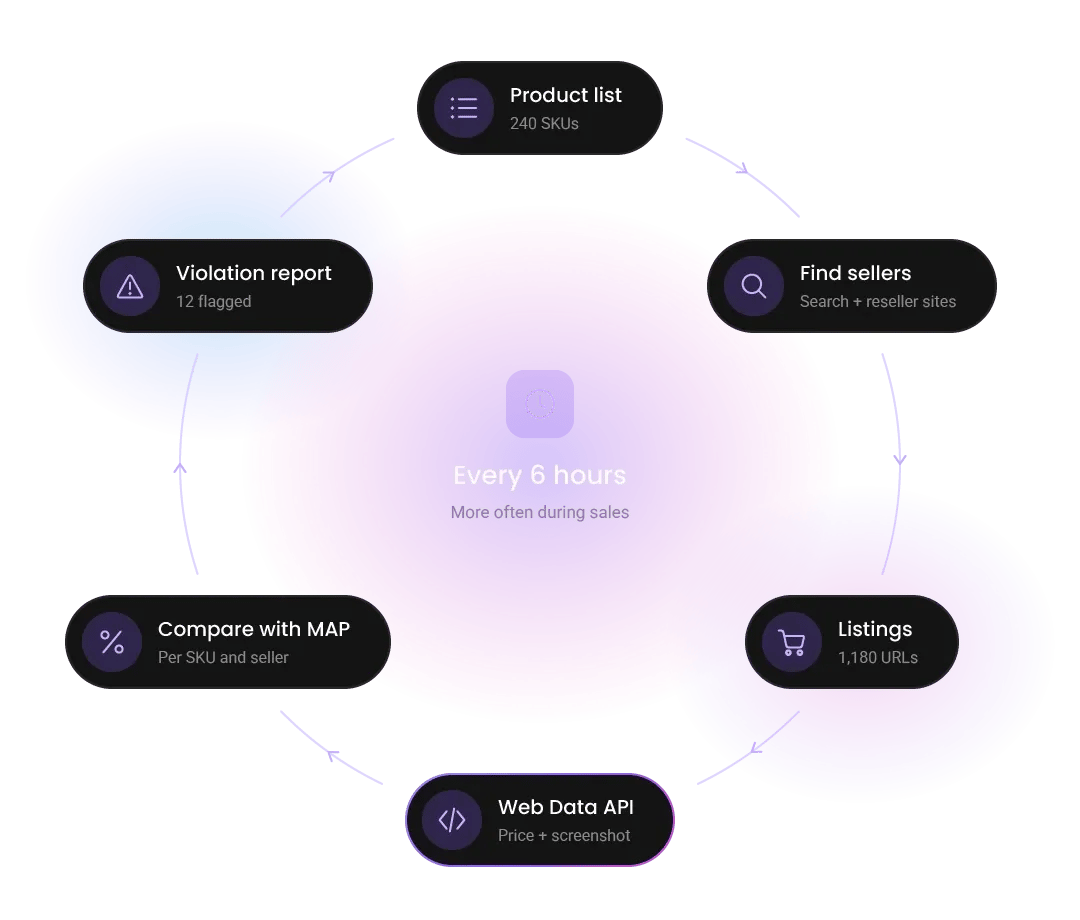
Discover where your products appear online by searching for brand names, SKUs, and model numbers. Use Web Data API's /search endpoint to find relevant public listings, then combine discovered URLs with your existing reseller records to expand your monitoring coverage.
How do you collect advertised prices?
Retrieve current product listings with Web Data API's /scrape endpoint. Extract structured pricing data using ready-made templates for supported marketplaces, or collect Markdown and HTML from other retailer sites for further processing. Built-in proxy rotation, retries, and JavaScript rendering help simplify data collection across different websites.
How do you spot violations?
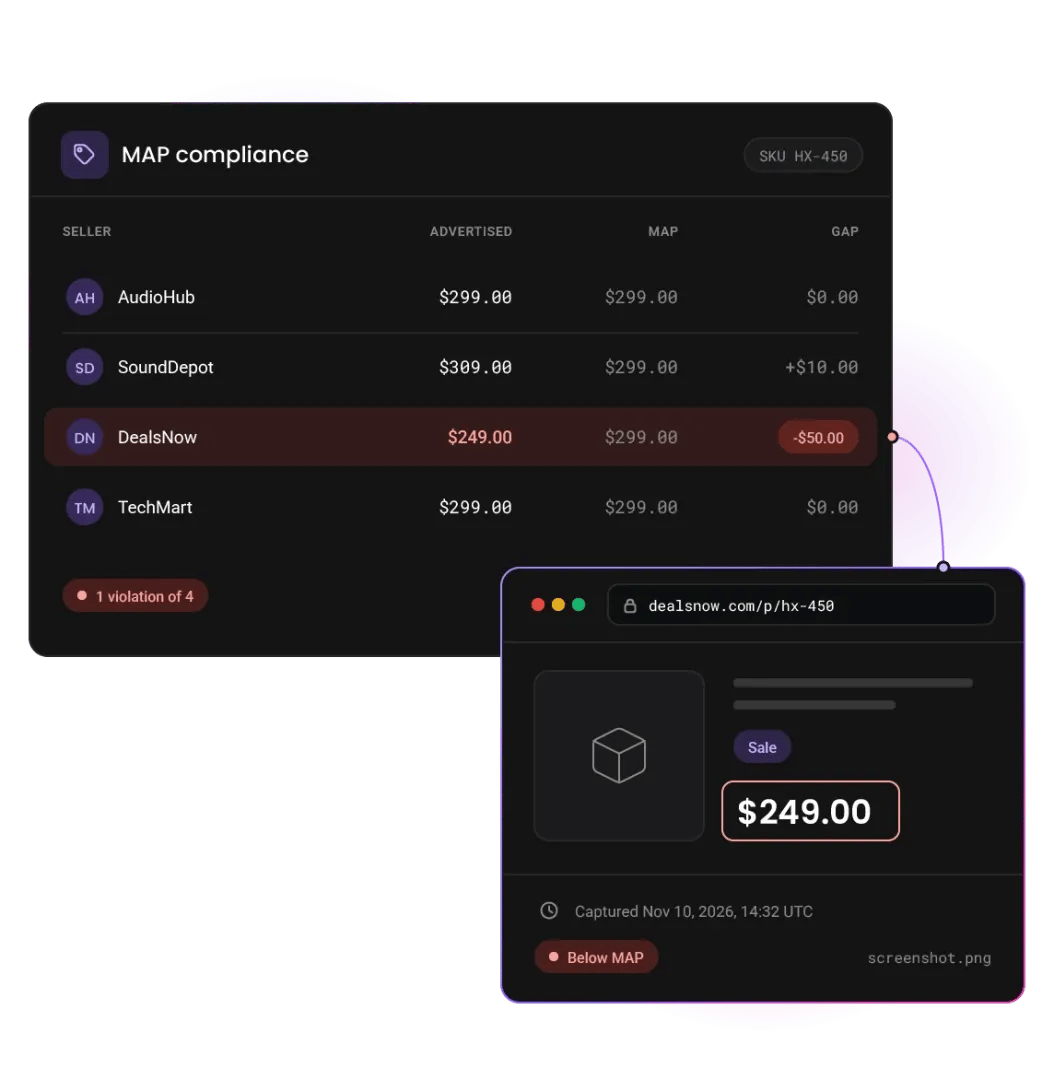
Compare collected prices against your MAP thresholds by SKU, seller, and market. Build automated checks to flag advertised prices below your policy, including discounted offers and promotions. Apply your own rules to coupons, bundles, and other pricing conditions to reduce false positives.
How do you keep proof for enforcement?
Capture screenshots of product listings where supported and store them alongside the advertised price, seller details, source URL, and collection timestamp. Connect these records to your existing reporting or enforcement workflow to support consistent reviews and follow-ups.
What can you do with MAP violation monitoring?
Keep reseller pricing under control across marketplaces, regions, and promotional campaigns. With Decodo's Web Data API, you can automate data collection, detect potential violations, and build MAP monitoring workflows around your existing tools.

How do I find unauthorized sellers?
Discover public product listings across retailer websites and marketplaces, then identify sellers that aren't in your authorized reseller database.

How do I check marketplaces?
Collect advertised prices and seller information from supported marketplaces, including Amazon, Walmart, and eBay, to monitor competing offers.

How do I enforce MAP across regions?
Monitor advertised prices using geo-targeted requests and compare regional offers against market-specific MAP thresholds.

How do I document violations?
Save listing URLs, timestamps, advertised prices, and supported screenshots to create traceable evidence records for reseller reviews.

How do I measure reseller compliance?
Track historical pricing observations by seller and SKU to identify recurring issues and measure compliance over time.

How do I catch violations during sales events?
Schedule more frequent price checks during major shopping events to catch sudden discounts and short-lived MAP violations.
How do I set up minimum advertised price tracking?
Send a product URL to Web Data API's /scrape endpoint and retrieve the listing content for price extraction. Match the advertised price against your MAP threshold in your application, and request a screenshot separately, where supported, to document potential violations.
Tip: For a screenshot of the same listing, send a second request with "headless": "png" and drop "markdown": true - the response returns a base64-encoded PNG.
How much does Web Data API cost?
Start with a free recurring plan offering up to 10K requests per month, with no credit card required. As your MAP monitoring needs grow, choose a usage-based plan that matches your catalog size and data collection volume.
With each plan, you access:

JavaScript rendering
99.99% success rate
HTML, Markdown, XHR, plus JSON, PNG where supported
One-click AI integrations
LLM-ready Markdown format
100+ pre-built templates
Single API key for all endpoints
/scrape, /search, /map, /crawl
24/7 tech support
14-day money-back
SSL Secure Payment
Your information is protected by 256-bit SSL

How does MAP monitoring software compare to building your own?
MAP monitoring software bundles detection and enforcement for the stores it covers, manual checks only reach a few sites, and a web data API lets you check any public listing and keep the evidence in your own systems.
MAP monitoring software
Manual checks
Decodo Web Data API
Coverage
Retailers and marketplaces supported by the vendor
Sites your team has time to check
Public listings you select, subject to target support
Finding new sellers
Often includes seller discovery
Manual research
Discover public listings with /search
Proof for enforcement
Built-in screenshots and reports
Screenshots captured manually
Page data and supported screenshots stored in your systems
Enforcement workflow
Usually includes alerts and case tracking
Emails and spreadsheets
Integrate with existing tools or build custom workflows
Cost
Subscription or usage-based pricing
Staff time
Usage-based pricing with a free starter plan
Best for
Brands seeking a turnkey solution
Small catalogs and limited sellers
Brands and developers building custom MAP monitoring
How do you collect MAP evidence that holds up?
Accurate MAP monitoring requires more than recording the lowest price. You need to account for dynamic content, regional differences, promotions, and changing listings. Here's how to collect reliable pricing data and maintain evidence your team can review.
Why does the collected price differ from the one shoppers see?
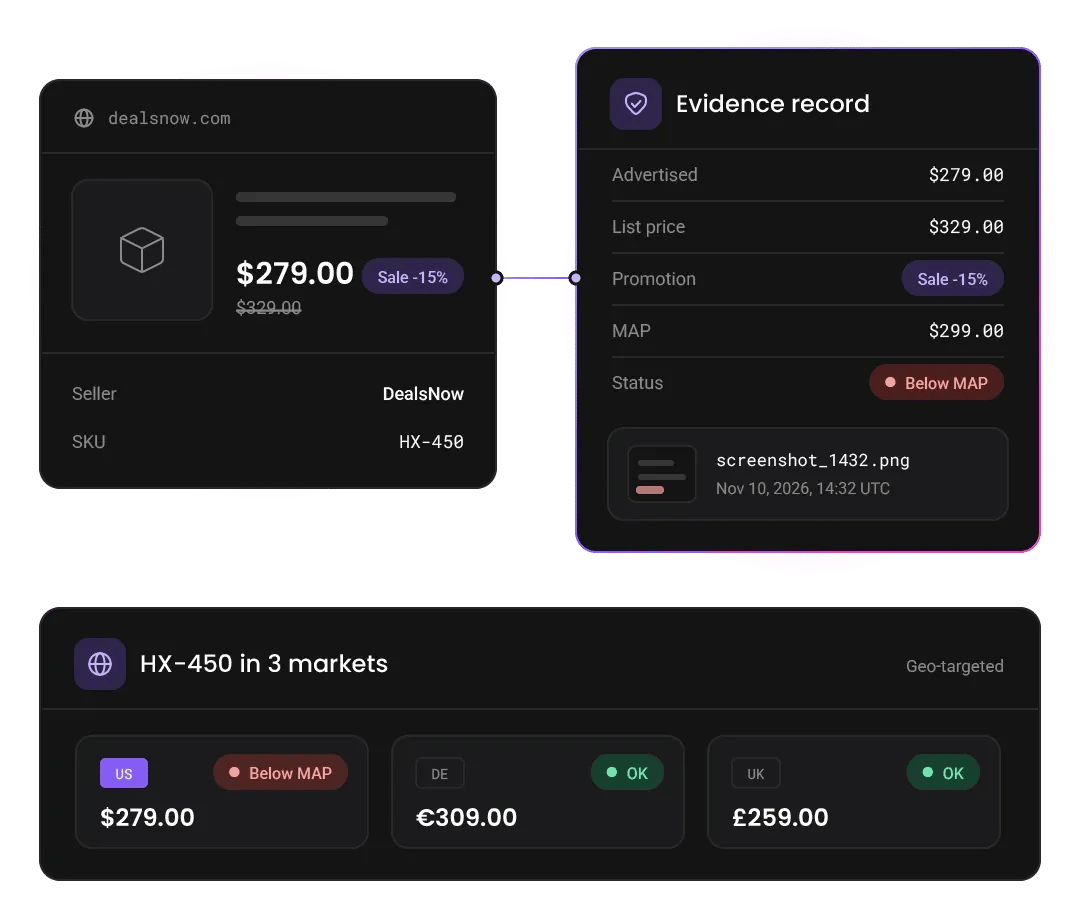
Some retailers load prices dynamically with JavaScript or display different offers depending on the visitor's location. Web Data API supports JavaScript rendering and geographic targeting to help retrieve relevant page content. Validate extracted prices against the rendered listing to reduce mismatches before flagging violations.
How do you tell a violation from a coupon or bundle?
Collect advertised prices alongside visible discounts, coupon conditions, and bundle offers. Keep these fields separate in your data pipeline and apply your MAP policy to determine which promotions qualify as violations. This helps reduce false positives and provides more context for enforcement decisions.
What if a marketplace throttles repeated checks?
Marketplaces may rate-limit requests or trigger anti-bot challenges during frequent monitoring. Web Data API manages proxy rotation, retries, and unblocking through Decodo's network of 125M+ ethically sourced IPs, helping reduce disruptions without requiring developers to maintain their own proxy infrastructure.
How do you prove what was advertised?
Store each flagged listing with its advertised price, seller information, source URL, and collection timestamp. Where supported, capture a screenshot to preserve the visible offer. These records create a traceable history for your team to review when reseller prices change, or a potential violation is disputed.
How do you check prices in different countries?
Use Web Data API's geographic targeting to retrieve public listings from supported locations. Normalize currencies and compare the collected offers with market-specific MAP thresholds. This lets you monitor regional pricing differences within the same data pipeline.
Can you check prices shown only to members?
Web Data API is best suited to collecting publicly accessible product listings. Member-only offers, account-specific prices, and login-protected pages may require additional permissions and collection methods. For standard MAP monitoring, focus on publicly advertised prices covered by your policy.
Which tools does Decodo integrate with?
Connect Web Data API to your existing development stack and automate MAP monitoring from data collection to reporting. Use SDKs, AI tools, and workflow integrations to process listing data, identify potential violations, and send alerts where your team already works.


What else can you build with Web Data API?

Price intelligence
Track competitor prices, product availability, and pricing changes across retailers and markets.


Website content extraction
Pull clean text and structured content from any public page.


Job data collection
Collect job postings from career sites and job boards in one consistent format.
How does Decodo keep data collection secure and compliant?

Decodo's proxies and Scraping API are backed by ISO/IEC 27001:2022 certification and aligned with leading data protection regulations. All Decodo's residential IPs are ethically-sourced through transparent opt-in programs.
Decodo has been recognized by G2 as one of the best security products in 2026 and has been awarded as the most innovative proxy infrastructure & web data platform of 2026 at the Global Business Awards.
What do users say about Decodo?
We're thrilled to have the support of our 135K+ users and the industry's best.

Helping us build
Decodo lets us collect data from 10M+ ads every month without throttling, so our small team can focus on building.
S
Skaler.app
Easy to get things done
Decodo provides great service with a simple setup and friendly support team.
R
RoiDynamic
A key to our work
Decodo enables us to develop and test applications in varied environments while supporting precise data collection for research and audience profiling.
C
Cybereg





Frequently asked questions
What is MAP monitoring?
MAP monitoring is checking the prices that resellers advertise online against a brand's minimum advertised price policy. Brands and their channel teams use it to find violations early, keep pricing consistent across partners, and protect margins and brand value.
What is a MAP violation?
A MAP violation happens when a reseller advertises a product below the brand's minimum advertised price, in a listing, an ad, or an email. MAP covers the advertised price, so whether a lower price at checkout counts depends on the brand's policy.
Is MAP pricing illegal?
In the US, MAP policies are generally legal when a brand sets them on its own and enforces them by choosing which resellers to work with, while agreements that fix resale prices face stricter review. Rules differ in other regions – the EU treats minimum resale price restrictions much more strictly. This isn't legal advice, so check with counsel for your markets.
What is MAP enforcement?
MAP enforcement is what a brand does after finding violations: warning notices, pausing supply, or removing resellers from its program, following the steps in its MAP policy. Reliable evidence – screenshots, URLs, and timestamps – makes each step easier to defend.
What's the best MAP monitoring software?
Look for coverage of the stores where your products sell, a way to find unknown sellers, screenshot evidence, and enforcement steps that match your policy. If you'd rather build checks into your own systems, our guide to minimum advertised price monitoring explains the setup.
How often should you check for MAP violations?
It depends on the product and channel. Check high-risk products and marketplaces more often, especially around sales events when undercutting peaks, and the rest of your catalog less often. See how retailers approach Black Friday pricing.
Ready to Start MAP Monitoring?
Catch sellers advertising below your MAP with Web Data API – live prices and screenshots, no infrastructure to maintain.