Best Proxies for Ad Verification in 2026
Ad verification is the process of checking that an ad was actually served, where it was reported, to real people, in the intended location. The process depends on a non-advertiser vantage point to provide unbiased metrics. Proxies are the strongest infrastructure layer for independent ad verification. By routing requests through real local IP addresses, auditors can view ads as consumers. This article compares the best proxies for ad verification: Decodo, Bright Data, Oxylabs, SOAX, and IPRoyal.

Mykolas Juodis
Last updated: Aug 19, 2026
7 min read

TL;DR
- Residential proxies are the best choice for most verification workflows, while mobile proxies work well for verifying campaigns served in mobile apps and websites.
- When selecting a proxy, prioritize precise geo-targeting, diverse IP pools, responsible IP sourcing, session control, and reliable performance.
- Decodo is currently the strongest overall choice for most ad verification teams.
- A short trial or pay-as-you-go plan shrinks the risk of committing to a service that looks good on paper, but performs poorly against the required sites and locations.
Role of proxies in ad verification
Advertisers need ad verification to see how their campaign looks from the perspective of their target audience, but trying to do this from their own network is usually unsuccessful. IP is one of the signals publishers and networks use to decide which ads to serve, so a known advertiser’s request (as well as the subsequent result) can be notably different from that of an ordinary user. Therefore, it's very difficult to determine if an ad is actually reaching the intended audience.
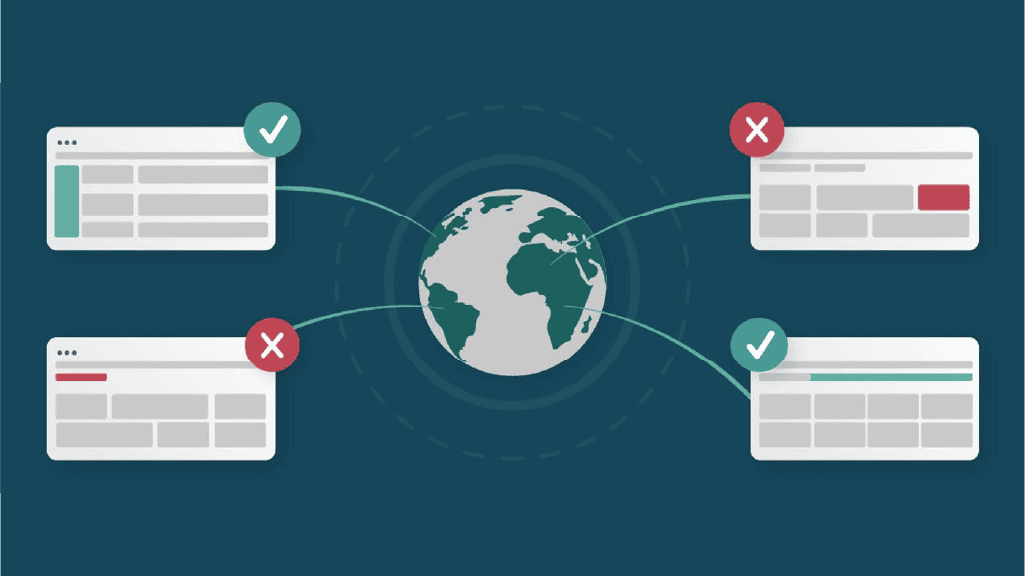
Proxies solve this by routing verification requests through real IP addresses in the advertisers’ target locations. This makes the request look like it’s coming from the market that’s being tested, not an advertiser checking their own campaign. In fact, the same advertiser can inspect their campaign from multiple geographic perspectives.
A key part of this process is the small code snippets called verification tags. This HTML markup deploys alongside an ad to collect information about its placement, content, traffic, and other information, and then reports it all back to the advertising agency or verification provider.
Proxies are also a key tool when verification looks into an ad's redirect chain. An ad could point to a legitimate URL at first, but then it can send users through one (or even several) redirects before reaching that URL. This often happens when malicious advertising exploits these chains to redirect users to unrelated or potentially harmful pages. Yet, only genuine users can see this. A proxy can follow the chain from a user’s perspective to see where it actually goes, instead of just checking the original URL.
To make the distinction clear: the tag provides all the data about what happens when the ad loads, while the proxy provides the network and geographic location from which it can observe what’s happening when that ad loads. The proxy isn’t the verification system, but it provides a realistic network vantage point for it.
How does ad verification work?
Ad verification looks for several types of fraud that work to exploit different parts of the advertising ecosystem. Generally, it will check to see if an ad is reaching humans, if interactions are legitimate, and if ads appear where the advertiser wants them to.
Fake traffic and bot-driven impressions
An impression or a website visit doesn’t automatically mean a real person is behind it. Bots and other automated systems can load pages, view ads, generate traffic at scale, and raise impression counts. All this can easily make it seem a campaign has reached a larger audience than it did.
Verification systems analyze both the traffic and behavioral signals, searching for known, non-human patterns. This way, it can find automated requests in comparison to genuine interactions.
Click fraud
Various automated bots or click farms can repeatedly click on the same ads, particularly on pay-per-click (PPC) campaigns. However, the advertiser might still have to pay for those clicks anyway. This means that the fraud eats up a large chunk of the campaign budget and doesn’t even provide any valuable performance data.
Verification systems work to identify click patterns that aren’t consistent with interactions by legitimate users.
Pixel stuffing
It’s not uncommon for an ad to be rendered inside a very small area, for example, a 1×1-pixel container, or even hidden behind another element. However, even though actual users can’t see it, it’s still counted as an impression.
Verification checks where and how the ad is placed to make sure that a reported impression indeed means actual visibility.
Domain and placement spoofing
Advertisers pay a high sum to have their campaign appear on reputable publishers, but there can be quite a discrepancy between the reported placement and the reality. Domain and placement spoofing make an ad appear as though it was displayed on a legitimate, high-value website. Yet, it was served on an unrelated, low-quality, possibly even fraudulent page.
Verification ensures that the ad is served on the actual page where it was reported.
Geo-fraud
Advertising campaigns assign different values to impressions from different locations, so geographic accuracy is vital. However, location signals can be manipulated or falsified, with impressions appearing as if coming from a more valuable market.
Verification systems complete tests to verify that the reported geographic location matches the user's actual network location.
Best proxy types for ad verification
For most ad verification work, residential proxies are the best choice by far. They route requests through real IP addresses, so that the verification traffic looks like requests from genuine users. Publishers, ad networks, and even fraudsters can’t easily distinguish these proxy IPs from ordinary user traffic, making residential proxies perfect for checking how ads are actually delivered.
Mobile proxies are good for verifying campaigns served in mobile apps or on mobile-only websites. These carry the highest trust scores because mobile IPs are dynamically shared among many real users. The downside is they come at a higher price point. It’s best to leave them for when mobile network verification is truly needed.
ISP proxies (also known as static residential proxies) are a middle ground between residential and datacenter IPs. They combine the trust of a residential proxy with the speed of a datacenter one, serving as a great option for data and automation workflows that demand IP consistency. While it works well to verify ads, geo-location isn’t as granular as it is with residential proxies.
Datacenter proxies are generally unsuitable for ad verification. At most, they can potentially be useful only for low-stakes, non-adversarial checks. These proxies use IP addresses hosted in data centers, so they’re easier for publishers and ad networks to identify. Once datacenter IP ranges are known, they get blocked much more often and treated with greater suspicion because of their use in fraud and monitoring.

Stay under the radar with residential proxies
Access 115M+ ethically-sourced residential proxies across 195 locations. Get past CAPTCHAs, geo-restrictions, and IP bans on infrastructure that delivers a 99.92% success rate and a <0.53s response time.
How to choose proxies for ad verification
Checking the number of available IPs or the price isn’t enough when you’re looking for the right proxy. Your verification traffic must be able to produce real user conditions across as many different target markets as you need, but also stay reliable for automated monitoring. Here’s what you should look into:
- Geo-targeting granularity. Look for providers that support city-level, or better yet ZIP- or ASN-level, targeting. ASN targeting in particular is an ideal option because it enables verification from specific networks or internet service providers.
- IP pool size and composition. A larger and more diverse pool gives the verification system more addresses to work with and shrinks the chance of hitting an already-flagged IP.
- IP sourcing and consent practices. Prefer providers that document consent-based or allow-listed IP sourcing over networks that don't disclose how residential IPs were obtained. This can create reliability and reputational risks if IPs are obtained through questionable methods.
- Session control. Sticky sessions allow multiple requests to use the same IP, and this is useful when you need to follow an ad's redirect chain and complete a multi-step interaction.
- Success rate and response time. Connections that fail often produce incomplete checks, and slow proxies can cause monitoring scripts to time out or miss time-sensitive ad content, messing up the data collection.
- Pricing model. Go with pay-as-you-go (PAYG) pricing for launches, audits, or scheduled monitoring with quiet periods in between, while fixed monthly subscriptions are suitable for ongoing usage.
Key service features for ad verification proxies
There are several proxy service features that can make a major difference, whether it’s functionality or reduced friction in day-to-day operations.
- Protocol support. HTTP(S) proxies cover most web-based verification stacks, while SOCKS5 supports applications that need broader traffic routing. Confirm that the protocols supported by the provider you’re considering work with the monitoring or automation software already in use.
- API access and browser extension availability. An API enables automated systems to obtain proxy connections and incorporate them directly into monitoring instead of needing manual configuration for each check. That said, a browser extension is often more convenient for teams that perform occasional spot checks, because users can switch proxy locations directly from the browser.
- Documentation and support responsiveness. A verification gap during an active campaign is time-sensitive. So, this is where clear documentation is of great help. Users can troubleshoot common issues without waiting for assistance, but responsive customer support is vital when a team can't solve a problem on their own.
- A free trial or money-back window. Providers’ general claims aside, the only way to know how a provider will perform in a particular workflow, with the existing setup and for particular target sites, is to test it.
Leading proxy providers for ad verification
The best proxy provider for ad verification is one that combines a large residential proxy network with reliable performance and smart pricing models.
Here’s a comparison of the best proxy providers, according to Proxyway's independently tested success rates and response times as of July 2026.
Provider
IP pool
Success rate
Response time
Entry pricing (PAYG)
Rank as
Decodo
115M+
99.92%
0.53s
From $4/GB
Best value provider
Oxylabs
175M+
99.93%
0.60s
From $6/GB
Best premium residential proxy provider
Bright Data
400M+
-
-
From $4/GB
Most features and best proxy management tools
SOAX
155M+
99.78%
0.89s
From $3.60/GB
Stable IPs with flexible filtering options.
IPRoyal
64M+
96.11%
1.24s
From $7/GB
Decent proxies with scaling non-expiring packages
Success rate and response time are from Proxyway's independent residential-proxy testing.
Decodo is the strongest overall choice for ad verification. Decodo won Best All-Rounder in Proxyway's Proxy Service Awards 2026 and ranks first as best value provider in its residential proxy roundup. It boasts a strong combination of performance, scale, and reliability, thanks to its 115M+ residential IP pool, 99.92% independently tested success rate, and 0.53s response time.
Other key features include granular geographic targeting (down to ZIP/ASN level), ISO-compliant ethical sourcing of IPs, and flexible pricing plans, including a $4.0/GB pay-as-you-go entry price.
Oxylabs is a strong option for enterprises that prioritize raw success rate, outweighing the cost. Proxyway recorded a 99.93% success rate in its latest benchmark, the highest among the providers it tested. It also comes with a 175M+ advertised pool, but at a steeper entry price of $30 ($6/GB).
Bright Data stands out with its 400M+ advertised residential proxy pool, so it’s a notable enterprise option if the sheer pool size is the primary requirement. Its $4/GB PAYG entry price makes it a competitive option, but scaling comes at a steeper cost if you’re not a big team. Bright Data wasn’t part of Proxyway's latest benchmark, so its performance can’t be compared directly with other independently tested figures.
SOAX has a 155M+ advertised pool with a 99.78% success rate and a 0.89-second response time. The price point per GB is the lowest by comparison, but the entry price is still $90 and the global locations count is lower than with its competitors.
IPRoyal has a 64M+ advertised pool with a 96.11% success rate and a 1.24-second response time, according to Proxyway's latest testing, which puts it behind the other tested providers on performance. While the pricing scales well, its entry fee is steep, coming in at $7/GB.
Decodo remains the strongest all-arounder for teams. Check out our residential proxies and mobile proxies pages, as well as our AdTech page for the full breakdown of how we cater to businesses built on ad verification.
Testing before buying proxies for ad verification
Before buying proxies for ad verification, use the free trial or short pay-as-you-go plan to test it against your campaign's specific requirements. Use it to check the solution’s geo-targeting accuracy and success rates against websites and locations the campaign needs to monitor. Repeat requests against the real target sites to track how often they succeed and compare multiple providers to get a better overall picture.
When you find a proxy service that passes the tests, scale gradually. Don’t commit the entire verification workload at once. This way, as request volume increases, you’ll be able to keep an eye on targeting accuracy and response time, as well as possible connection failures.
Teams running verification across many client campaigns simultaneously should prioritize providers with straightforward proxy user or zone management. This allows different campaigns to be kept separate. By isolating configurations, credentials, locations, and traffic, teams can manage an individual campaign and troubleshoot problems without affecting other campaigns.
Decodo offers a 3-day free trial for all proxy types, which lets you test the quality, speed, and reliability of our proxies, so you know exactly what you’re getting.
For even quicker, no-code testing, there’s the free Chrome proxy extension. It works with a proxy from any provider, allowing users to manage and switch proxy connections directly inside Google Chrome without changing their operating system's global network settings.

Get residential proxies from the best value provider
Plug 115M+ residential proxies from 195 locations straight into your data collection pipelines to scale your projects in the most efficient way possible.
About the author

Mykolas Juodis
Head of Marketing
Mykolas is a seasoned digital marketing professional with over a decade of experience, currently leading Marketing department in the web data gathering industry. His extensive background in digital marketing, combined with his deep understanding of proxies and web scraping technologies, allows him to bridge the gap between technical solutions and practical business applications.
Connect with Mykolas via LinkedIn.
All information on Decodo Blog is provided on an as is basis and for informational purposes only. We make no representation and disclaim all liability with respect to your use of any information contained on Decodo Blog or any third-party websites that may belinked therein.