Are Prices Rising Due to the US-Iran Conflict?
On February 28, 2026, the United States and Israel launched joint strikes on Iran, triggering a series of attacks across the Middle East, closing airspace over the Persian Gulf, and disrupting shipping lanes that carry roughly 12% of global trade. Within days, the effects started showing up in online retail prices. Our pricing infrastructure tracks 120+ eCommerce platforms in 40+ countries, recording prices at four-hour intervals, creating a near real-time view of how global shocks propagate through digital marketplaces.

Benediktas Kazlauskas
Last updated: Mar 12, 2026
8 min read
Moving from seasonal to reactive pricing
To isolate the conflict's impact from seasonal pricing patterns like holiday markups and January clearance, the table below tracks average prices across all monitored products from February 2025 to March 2026. The first 2 columns show the February and March prices from 2025, a year with no comparable geopolitical disruption, as a baseline for comparison.
Region
Feb '25
Mar '25
Sep '25
Dec '25
Feb '26
Mar '26
North America
$189
$186 (-1.8%)
$181
$204
$200
$209 (+4.7%)
Europe
$236
$235 (-0.5%)
$242
$227
$227
$227 (+0.2%)
Asia
$58
$57 (-1.2%)
$61
$51
$42
$42 (-0.5%)
North America stands out. In early 2025, the February-to-March transition saw average prices decline gently from $189 to $186 (-1.8%), the typical post-winter pattern. In 2026, the trajectory reversed. Prices rose from $181 in September to $204 during the holiday season, dipped slightly to $200 in February, then jumped to $209 in the first 10 days of March, a 4.7% increase that pushes prices to their highest point in the dataset and challenges the 2025 seasonal norm.
European and Asian averages appear flat at the regional level, but the interesting movements are hiding inside specific product categories. The regional average masks sharp increases in some categories, offset by continued discounting in others. The 2025 data shows that both regions saw mild February-to-March declines last year ($236 to $235 in Europe, $58 to $57 in Asia), meaning even small upward moves in 2026 represent a departure from normal seasonality.
North America: category-level price surges
The U.S. is the world's most active eCommerce pricing market, with retailers constantly adjusting prices. That infrastructure reacted quickly to the geopolitical disruption, and several categories saw dramatic movement. The prices from February 2025 to February 2026 show what normally happens in this window – a consistent pattern of gentle post-winter declines.
Category
Feb '25
Mar '25
Sep '25
Dec '25
Feb '26
Mar '26
Home appliances
$385
$372 (-3.4%)
$407
$370
$368
$511 (+38.7%)
Computing
$1,050
$1,025 (-2.4%)
$1,136
$1,316
$1,024
$1,178 (+15.1%)
Men's apparel
$82
$78 (-4.9%)
$85
$76
$79
$91 (+16.0%)
Home & furniture
$795
$780 (-1.9%)
$698
$847
$779
$858 (+10.1%)
Meat & seafood
$20.80
$20.45 (-1.7%)
$21.15
$20.64
$22.12
$23.55 (+6.4%)
Footwear
$79.50
$78.86 (-0.8%)
$80.71
$77.36
$80.57
$86.53 (+7.4%)
Fragrance & body
$43.10
$42.63 (-1.1%)
$43.63
$45.73
$44.20
$47.03 (+6.4%)
Lawn & garden
$410
$416 (+1.5%)
$427
$477
$680
$729 (+7.2%)
Home appliances had been steadily declining from $407 in September to $368 in February, a natural post-holiday markdown. In March, that trend reversed violently, jumping 39% to $511. The 2025 columns tell a very different story – prices moved from $385 in February to $372 in March, a mild 3.4% seasonal decline. Many major appliance brands depend on components manufactured in or shipped through Middle Eastern logistics corridors, and with Gulf airspace closed and shipping routes disrupted, lead times and costs spiked almost immediately.
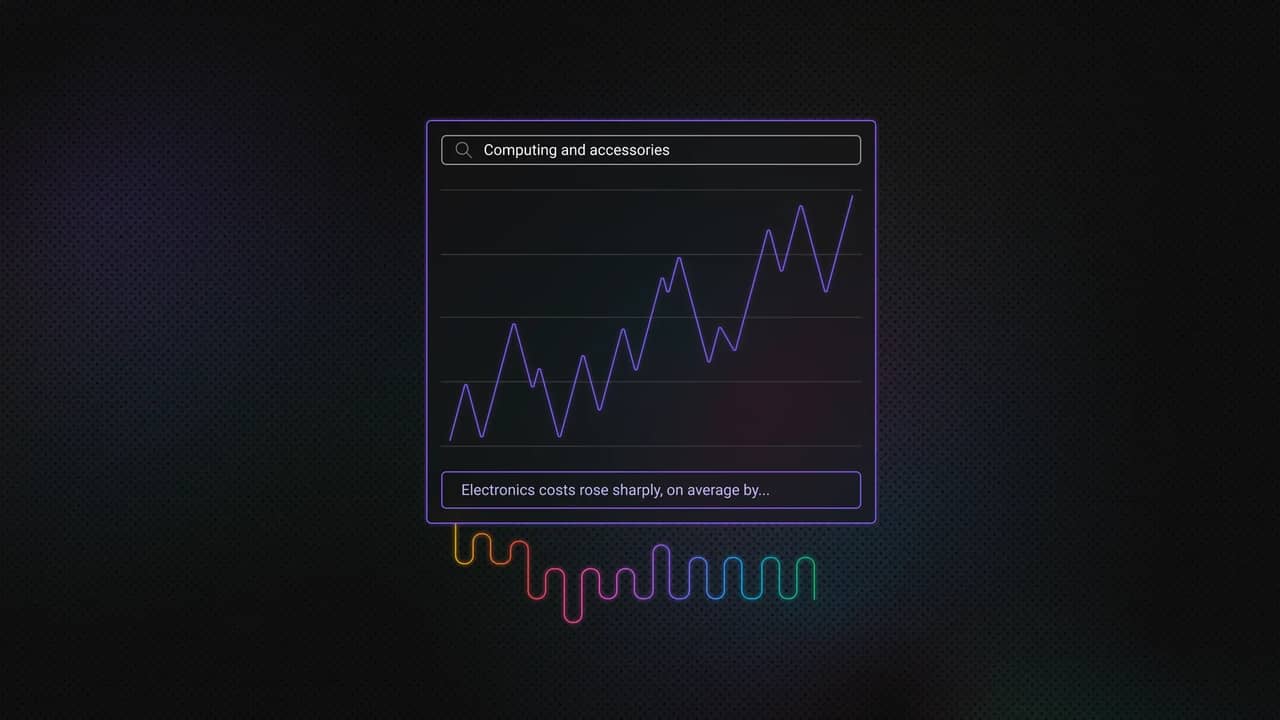
Computing and accessories followed a similar pattern. Prices dropped from their $1,316 holiday peak to $1,024 in February, then bounced back 15% to $1,178 in March. In 2025, the same transition went from $1,050 down to $1,025, a routine 2.4% decline. Semiconductor and electronic component shipments that transit through the region likely faced delays and higher freight costs.
Meat and seafood climbed steadily throughout the dataset, from $21.15 in September to $23.55 in March, an 11% increase over six months, with the steepest acceleration in the most recent period. In 2025, meat prices moved from $20.80 to $20.45 over the same window, a 1.7% dip. This category is sensitive to energy and transportation costs, both of which rose sharply with Middle Eastern disruption.
Grocery staples with primarily domestic supply chains proved more resilient. Frozen foods held steady at roughly $6.80 across all four periods, dairy barely moved, and pantry goods actually declined slightly.
The takeaway from North America’s eCommerce landscape is clear: every major category that spiked in March 2026 was either declining or flat during the same period last year. The pattern appears consistently across appliances, electronics, apparel, furniture, and meat. Together, these movements point to a supply‑chain‑driven price shock, particularly in categories that rely on imported components or logistics routes connected to the Persian Gulf.
Asia: everyday goods push prices higher
Asian eCommerce presents a fascinating split. Overall average prices have been trending downward since September, driven by aggressive discounting on platforms and competitive pressure from marketplaces across India, South Korea, and Singapore. Under that downward trend, however, everyday grocery staples moved in the opposite direction, and the 2025 baseline confirms that these increases have no seasonal precedent.
Category
Feb '25
Mar '25
Sep '25
Dec '25
Feb '26
Mar '26
Pantry & dry goods
$3.10
$3.05 (-1.6%)
$3.17
$3.45
$2.73
$3.43 (+25.6%)
Household essentials
$3.75
$3.70 (-1.3%)
$3.52
$4.34
$3.88
$4.24 (+9.3%)
Home appliances
$98
$95 (-3.1%)
$281
$105
$65
$77 (+18.5%)
Men's apparel
$24.50
$23.80 (-2.9%)
$27.08
$21.06
$21.70
$23.26 (+7.2%)
Fresh produce
$2.85
$2.82 (-1.0%)
$2.70
$3.86
$3.72
$3.61 (-3.0%)
Dairy & refrigerated
$3.40
$3.42 (+0.5%)
$3.46
$4.49
$3.62
$3.69 (+1.9%)
Pantry and dry goods show the clearest pattern. Prices had dropped from $3.45 in December to $2.73 in February, then surged 26% to $3.43 in March. The 2025 baseline shows prices moving from $3.10 to $3.05 in the same window, a quiet 1.6% decline. Household essentials followed a similar pattern, rising 9% from $3.88 to $4.24 against a 2025 trajectory of $3.75 to $3.70 (down 1.3%). Several Asian economies depend heavily on food imports that transit the Persian Gulf and Red Sea, and the conflict's disruption of those shipping lanes appears to have hit these categories directly.
Meanwhile, discretionary categories kept declining. Women's apparel fell from $50.18 in September to $43.32 in March, and footwear dropped from $80.70 to $67.29 over the same period. This divergence reveals how supply chain disruptions selectively target essential goods, categories where demand is inelastic, and retailers have less room to absorb cost increases. At the same time, competitive pressure continues to push down prices on products where consumers have the flexibility to wait or switch. Houthi threats in the Gulf of Aden following the outbreak of hostilities added further risk premiums to shipping lanes that Asian importers rely on.
For Asia, the main story is the gap between essentials and discretionary goods. Every grocery staple that went up in March 2026 was actually declining at the same time last year, showing these increases are tied to the conflict rather than normal seasonal changes. If shipping disruptions continue, shoppers and businesses focusing on essentials can expect prices to stay high, while discretionary items continue to offer bargains.
Europe: only stable on the surface
European eCommerce prices were the most stable at the aggregate level, holding around $227 from December through March. This consistency aligns with broader pricing patterns across the region, where retailers tend toward more conservative price adjustments. The real movements showed up in specific categories, and the 2025 columns in the table below help separate normal spring repricing from conflict-driven shifts.
Category
Feb '25
Mar '25
Sep '25
Dec '25
Feb '26
Mar '26
Men's apparel
$60
$65 (+8.3%)
$91
$65
$56
$81 (+45.6%)
Footwear
$64
$66 (+3.1%)
$76
$62
$59
$71 (+18.9%)
Women's apparel
$40
$42 (+5.0%)
$56
$45
$36
$43 (+18.4%)
Household essentials
$13.90
$13.75 -1.1%)
$14.03
$13.77
$14.44
$15.18 (+5.1%)
Fresh produce
$6.90
$6.75 (-2.2%)
$4.54
$7.67
$7.18
$7.56 (+5.3%)
Beauty & health
$198
$195 (-1.5%)
$244
$180
$189
$195 (+3.1%)
Fashion categories showed the most movement. Men's apparel had dropped from $91 in September to $56 in February as retailers ran seasonal clearance, then snapped back 45% to $81 in March. The year-over-year context is critical – in 2025, men's apparel moved from $60 in February to $65 in March, a normal 8.3% spring repricing as new collections arrive. The 2026 jump of 45% is more than five times the seasonal baseline. Women's apparel rose 18.4% (from $36 to $43) versus a 2025 norm of 5.0% ($40 to $42), and footwear climbed 18.9% (from $59 to $71) against a typical 3.1% ($64 to $66). Supply chain factors are clearly amplifying the seasonal markup far beyond normal levels.
Grocery prices showed modest but consistent upward movement. Fresh produce climbed from $7.18 in February to $7.56 in March (+5.3%), while the 2025 trajectory went from $6.90 down to $6.75 (-2.2%). Household essentials crept up 5.1% from $14.44 to $15.18, against a 2025 decline from $13.90 to $13.75 (-1.1%). These are small absolute numbers, but for budget-conscious shoppers, a 5% increase on everyday essentials adds up over a monthly grocery bill.
In Europe, overall price stability hides some significant category-level changes. Fashion saw a much bigger spring repricing than usual, and grocery essentials moved upward after declining last year. For now, Europe’s cautious pricing approach is keeping things steady, but the year-over-year data shows that even this market is beginning to feel the cost pressures from the conflict. The real question is how long retailers can maintain current prices before passing increases on to consumers.
What this means for shoppers and businesses
The data tells different stories depending on whether you’re buying or selling, and the right response depends on which product categories matter most to your wallet or your business.
For shoppers: timing and category matter
The clearest signal in the data is the divide between essential and discretionary goods. Pantry staples, household essentials, and meat are all trending upward, and the year-over-year comparison confirms that these increases have no seasonal precedent. For non-perishable essentials, the math favors buying sooner rather than later. A 26% increase in Asian pantry goods in 10 days suggests that supply chain cost pressure is still working its way through the system, and prices may not have peaked yet.
"If you're stocking up on pantry staples or household basics, now is probably the right time. These aren't categories that are going to quietly correct themselves while shipping routes are still disrupted," says Gabriele Vitke, Senior Product Marketing Manager and dynamic pricing expert.
Big-ticket items tell a different story. Home appliances ($511 in North America, up from $368 in February), computing accessories ($1,178, up from $1,024), and furniture ($858, up from $779) are all elevated well above both their February levels and their year-ago baselines. These categories have historically corrected downward quickly once supply disruptions resolve, and the current premiums largely reflect logistics costs rather than permanent input price increases. For shoppers who can wait, monitoring these categories over the coming weeks is likely to pay off.
Discretionary goods remain a bright spot. Women's apparel continues to fall in Asia, and competitive pressure across platforms is still driving promotional activity in fashion, beauty, and accessories.
For businesses: the playbook depends on your supply chain
The most actionable insight in this dataset is the tight correlation between supply chain geography and price sensitivity. Categories with direct exposure to Gulf shipping routes and Middle Eastern logistics, such as appliances, electronics, and imported food, moved dramatically. Categories with primarily domestic supply chains, such as frozen foods, dairy, and pantry staples in North America, barely budged. The first step for any eCommerce business is mapping which product lines have the highest exposure to affected trade corridors and prioritizing those for pricing review.
The speed of movement matters as much as the direction. North American home appliances jumped 39% in 10 days. Businesses running periodic manual price checks on a weekly or biweekly cadence would have missed the inflection point entirely, leaving them either overpriced relative to competitors who adjusted faster or underpriced relative to their own rising costs. Automated price monitoring across geographies and competitors is the only way to keep pace with this kind of volatility.
Regional differences create both risk and opportunity. The same product category can behave very differently across continents. Home appliances surged 39% in North America but actually rose only 18.5% in Asia and stayed nearly flat in Europe. Businesses operating across multiple markets should resist the urge to apply blanket price increases and instead calibrate responses to the specific conditions in each region. The data also suggests that retailers who can source from less-affected supply chains, European appliance brands sourcing from Eastern Europe versus Asian-manufactured goods transiting the Gulf, for example, may gain a temporary competitive advantage.
"The businesses most at risk right now are the ones treating this like a normal market cycle. Your supply chain exposure tells you almost everything about where your pricing is vulnerable. If you haven't mapped that yet, that's the first conversation to have internally," says Vitke.
Finally, the year-over-year data provides a framework for distinguishing temporary spikes from structural shifts. Categories where the 2026 increase is many multiples of the 2025 seasonal norm (men's apparel in Europe: 45% versus 8%) are likely experiencing logistics-driven premiums that will partially unwind. Categories where the direction has reversed entirely (fresh produce declining 2.2% in 2025 and rising 5.3% in 2026) may signal a more persistent shift in input costs, particularly if energy prices remain elevated. Tracking both the current trend and the year-ago baseline gives pricing teams the context to make better decisions about which increases to match and which to absorb.
Bottom line
The US-Iran conflict produced measurable eCommerce price increases within its first 10 days, concentrated in supply-chain-dependent categories. North American home appliances jumped 39%, computing accessories rose 15%, and meat climbed to its highest level in six months. Asian pantry staples surged 26% after months of decline. European prices stayed stable at the aggregate level, though fashion bounced 19 to 45% off seasonal lows and fresh produce crept up 5%.
The year-over-year comparison removes any doubt about whether these movements are seasonal. In every region, the categories that spiked in March 2026 were declining or flat in the same window in 2025. The conflict is the most plausible explanation for the deviation.
These are early-stage numbers covering just 10 days of active conflict. If disruptions to Gulf shipping and Middle Eastern logistics persist, the upward pressure will likely spread to more categories and deepen in the ones already affected. Businesses that track these movements in real time, and shoppers who time their purchases strategically, will be best positioned to navigate what comes next.

Try Web Data API for free
Activate your free plan and collect data without CAPTCHAs or IP bans.
This article is intended for informational purposes only and does not constitute financial, investment, or purchasing advice. The pricing data and analysis presented reflect observations from Decodo's Dynamic Pricing Index and are based on information available at the time of publication. Price trends may change rapidly, and past patterns are not indicative of future pricing movements. Readers should conduct their own research before making purchasing or business decisions. Decodo makes no representations or warranties regarding the completeness, accuracy, or timeliness of the information provided
About the author

Benediktas Kazlauskas
Content & PR Team Lead
Benediktas is a content professional with over 8 years of experience in B2C, B2B, and SaaS industries. He has worked with startups, marketing agencies, and fast-growing companies, helping brands turn complex topics into clear, useful content.
Connect with Benediktas via LinkedIn.
All information on Decodo Blog is provided on an as is basis and for informational purposes only. We make no representation and disclaim all liability with respect to your use of any information contained on Decodo Blog or any third-party websites that may belinked therein.