From Concert Tickets to Cart Prices: Can AI-Powered Pricing Be Fair?
Dynamic pricing is everywhere – from the flight you booked last week to the headphones in your cart right now. But as AI-powered algorithms grow more sophisticated, adjusting prices millions of times a day based on demand, competition, and increasingly personal data, a critical question is emerging – is this still fair? We analyzed over 1.5M eCommerce price changes and introduced our second-annual Dynamic Pricing Index to find out what’s really happening beneath the surface.

Benediktas Kazlauskas
Last updated: Feb 19, 2026
6 min read
When pricing algorithms make headlines
In December 2025, FIFA announced that dynamic pricing would be used at the World Cup for the first time in the tournament’s history. The backlash was immediate and fierce. Premium tickets for the July 2026 final at MetLife Stadium in New Jersey were priced at $8,680, and on FIFA’s own resale platform, the same seats were soon listed for over $140,000. Football Supporters Europe called the pricing a “monumental betrayal.”
Fan groups demanded that FIFA halt ticket sales entirely. England’s allocation for a potential final remained thousands of seats short of selling out, with the Football Supporters Association warning that the most loyal fans were being priced out. Even US national team player Timothy Weah spoke out, saying, “I am just a bit disappointed by the ticket prices. It is too expensive. Football should still be enjoyed by everyone.”
The World Cup controversy is only the latest flashpoint. In December 2025, Instacart shut down its AI-powered dynamic pricing experiments after an investigation found its Eversight technology was bumping up grocery costs by as much as 23% for some users, without their knowledge. Shoppers described the practice as “manipulative and unfair.” Earlier in 2025, Delta Air Lines sparked congressional scrutiny after its president described an AI pricing tool as “a super analyst” that could determine “a price that’s available on that flight, on that time, to you, the individual.”
These incidents share a common thread – pricing algorithms that were designed to optimize revenue are increasingly perceived as tools of extraction. And the practice is not limited to tickets and flights. It’s embedded in the everyday commerce that most consumers take for granted – from the price of a sweater on ASOS to a bag of groceries on Kroger.
To understand just how pervasive dynamic pricing has become, we introduced our second-annual Dynamic Pricing Index, analyzing over 1.5M price data points across more than 120 eCommerce platforms in 40+ countries throughout 2025. The findings reveal a pricing landscape that is far more volatile and far more algorithmically driven than most consumers realize.
Understanding how prices actually move
Across 6 major product categories, we tracked prices daily at four-hour intervals on various items. The scale of pricing activity is staggering. For example, Amazon alone registered 116,509 price changes, roughly 319 changes every single day, or 1 every 4 and a half minutes.
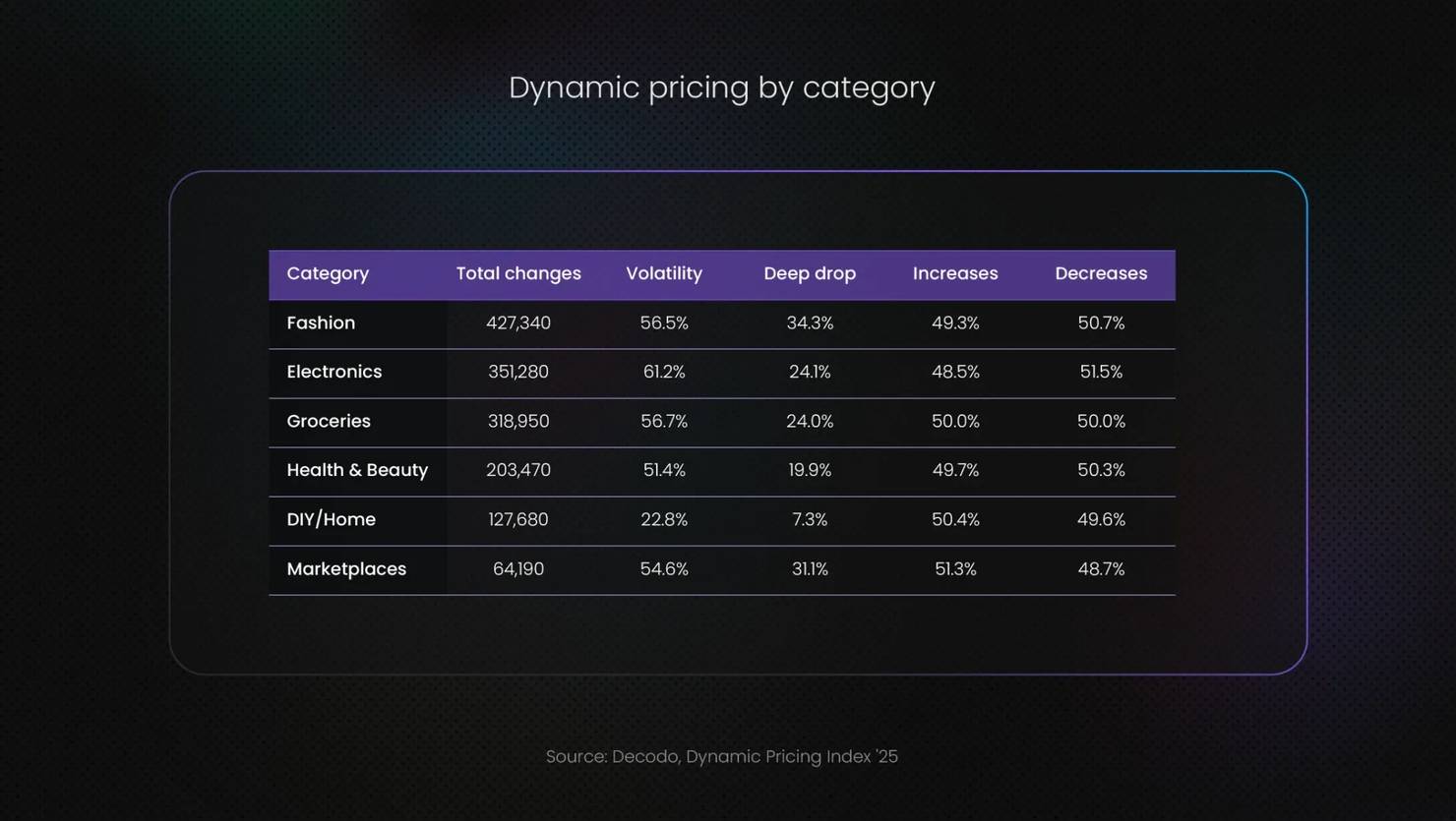
But it is the category-level data that reveals the structural forces behind this volatility.
The shift from dynamic pricing to surveillance pricing
The Dynamic Pricing Index data captures the macro picture – how frequently prices move across industries and regions. But behind these aggregate numbers, a quieter and more consequential shift is underway. Dynamic pricing, where algorithms adjust prices based on market-wide signals like supply, demand, and competitor activity, is increasingly giving way to what regulators now call surveillance pricing – the practice of using personal consumer data to set individualized prices.
In January 2025, the US Federal Trade Commission released preliminary findings from its surveillance pricing investigation. The FTC found that intermediary companies had access to a wide range of consumer data – from precise geographic location and browser history to purchase patterns, device type, and even mouse movements on a webpage – and used it to power pricing tools that could target different prices to different individuals for the same product. The agency identified at least 250 businesses across grocery, apparel, health and beauty, home goods, and hardware retail that had adopted surveillance pricing strategies.
The regulatory response is now accelerating. In November 2025, New York’s Algorithmic Pricing Disclosure Act took effect – the first law of its kind in the United States. It requires any retailer using personal data to set algorithmic prices to display a conspicuous, all-caps disclosure: “THIS PRICE WAS SET BY AN ALGORITHM USING YOUR PERSONAL DATA.” Companies that fail to comply face civil penalties of up to $1,000 per violation. A court challenge on First Amendment grounds was rejected, with the judge ruling the compelled disclosure was “plainly factual.” States including California, Pennsylvania, Texas, and New Mexico are now considering similar legislation.
Meanwhile, in a similar move in December 2025, US Senator Mark Warner led a coalition urging the FTC to reopen its surveillance pricing investigation, warning that “consumers deserve a fair playing field, where they’re not at the mercy of amorphous data brokers capturing their data and using it to determine their maximum financial pain point.” 2 members of Congress have also introduced the Stop AI Price Gouging and Wage Fixing Act, which would ban companies from using AI to set prices or wages based on personal information.
Who benefits and who pays?
The tension in the dynamic pricing debate is this – the same technology that can lower prices for some consumers can systematically overcharge others. And as AI models grow more sophisticated, the boundary between “smart pricing” and “price discrimination” becomes increasingly blurred.
Dynamic pricing advocates argue that this technology makes markets more efficient. Prices fall during low-demand periods, rewarding flexible shoppers. Surge pricing incentivizes supply – more Uber drivers during rush hour, for example.
But the critics raise a few objections:
- Fairness. If two consumers in the same neighborhood see different prices for the same product based on their browsing history or device type, that feels arbitrary. Professor Nitika Garg of UNSW Business School warns that using income proxies, like device type or postcode, to set prices “might entrench inequality.”
- Transparency. Most consumers have no idea that the price they see may be different from the price someone else sees. The FTC’s investigation confirmed that the tools exist and are deployed across at least 250 retailers – but consumers are rarely told.
- Accountability. When an algorithm sets a price that violates consumer protection law, whether by being misleading or discriminatory, who is liable? The company, the algorithm designer, or the third-party intermediary that provided the pricing tool? Current legal frameworks in most jurisdictions don’t have clear answers.
- Algorithmic cooperation. When multiple competitors use similar AI pricing tools, their algorithms can learn to raise prices simultaneously without any human coordination.
What this means for businesses and consumers
Our research makes one thing clear – dynamic pricing is not going away. In categories where volatility exceeds 55%, real-time pricing is a competitive necessity. But the emerging regulatory and reputational risks mean that businesses need to think carefully about where they draw the line.
The brands that will thrive are those that use dynamic pricing to compete on value, offering genuinely lower prices at scale, rather than to extract maximum willingness-to-pay from individual consumers.
Practical steps include being transparent about pricing methodologies, establishing price caps on AI-driven adjustments for essential goods, auditing algorithms for demographic bias, and investing in pricing monitoring infrastructure to ensure competitive but fair positioning.
For consumers, timing is everything – major online retailers typically schedule their steepest discounts on a rotating weekly basis, with price drops hitting their peak on Mondays, Wednesdays, Fridays, and Saturdays (depending on the retailer). In categories with deep drop rates above 20% – fashion, electronics, and marketplaces, patience can deliver substantial savings.
Beyond timing, consumers can protect themselves by comparing prices across devices and browsers, using private browsing to limit tracking, leveraging price-tracking tools or dedicated eCommerce scrapers, like Web Scraping API, and reporting suspicious pricing discrepancies to regulators.
Bottom line
The line between smart pricing and extraction is thin, and in 2025, it was crossed publicly enough to trigger action. New York now requires retailers to disclose when an algorithm uses your data to set your price. Over 100 pricing transparency bills were introduced across 33 US states. Regulators on both sides of the Atlantic have signaled that 2026 will be an enforcement year.
AI-powered pricing is already the norm. The question is whether transparency, regulation, and consumer awareness can keep pace with the algorithms. Based on what the data shows, race is only beginning.
About the author

Benediktas Kazlauskas
Content & PR Team Lead
Benediktas is a content professional with over 8 years of experience in B2C, B2B, and SaaS industries. He has worked with startups, marketing agencies, and fast-growing companies, helping brands turn complex topics into clear, useful content.
Connect with Benediktas via LinkedIn.
All information on Decodo Blog is provided on an as is basis and for informational purposes only. We make no representation and disclaim all liability with respect to your use of any information contained on Decodo Blog or any third-party websites that may belinked therein.