Most Scraped Websites Of 2026: AI Platforms Enter The List
Decodo tracks scraping requests across its user base every year. The most scraped websites of 2026 include ChatGPT and Perplexity for the first time. TikTok, Google, Naver, Make.com, Target, Amazon, GitHub, and Stack Overflow round out the list.

Benediktas Kazlauskas
Last updated: Sep 10, 2026
5 min read

TL;DR
- ChatGPT and Perplexity enter the top 10 for the first time.
- TikTok holds the top spot for a second straight year.
- Naver, Make.com, Target, GitHub, and Stack Overflow round out five new entries.
- Seven of the ten sites on last year's list dropped out this year.
The 2026 Data Collection Trends
This is the third edition of this annual report, following the 2025 edition and 2024 edition. This year's list marks the biggest turnover in the report's three-year history. Seven of the ten spots have changed hands since 2025. The shift points to one trend. Businesses now scrape AI platforms directly as primary data sources.
"Two years ago, businesses scraped the web to see what people were searching for. Now they scrape AI platforms to see what people are being told. The use case for data collection is changing," said Vaidotas Juknys, CEO at Decodo.
The Rise Of AI Answer Engine Scraping
ChatGPT reached 900M weekly active users in February 2026, according to OpenAI itself. Perplexity's user base is smaller, but its answer format sets it apart. Both platforms now answer questions that used to send traffic to Google.
That shift changed what marketers track. Brands used to monitor search rankings. Now they monitor whether ChatGPT or Perplexity cites them at all. This practice goes by a new name – generative engine optimization, or GEO. Teams scrape AI answer engines to check citation frequency and source rankings. They also track how AI responses describe their brand.
Perplexity adds a wrinkle here. Its answers cite sources directly inside the response. That format makes it a specific target for citation tracking, separate from ChatGPT's more conversational output.
Developer And Technical Data Demand
GitHub added 36M new developers in 2025, its fastest growth rate on record. The platform now hosts more than 180M developers and 630M repositories. Code-generation AI models need real repositories to train on, and GitHub remains the largest public source.
Stack Overflow tells a different story. Monthly question volume fell 78% in December 2025 compared to a year earlier. Why? Because developers have switched to AI assistants and tools, asking them directly instead of posting on the forum. Its archive still holds 16 years of technical answers, and AI companies use that publicly available data to train coding models.
"GitHub and Stack Overflow mark a new kind of entry for this list. Both sites hold code and technical answers instead of search results or product listings. Teams pull that content straight into their own AI models," said Gabriele Vitke, Product Marketing Team Lead at Decodo.
Scraping For Agentic Workflows
Make.com's entry breaks the usual pattern. Every other site on this list holds content. Make.com holds workflows. Back in 2025, the platform launched its very own AI agents. These let users build goal-driven automations that reason through steps instead of following fixed rules.
Teams scrape Make.com to monitor integrations and track scenario templates. They feed that publicly available data into automation pipelines that connect apps without manual work. This use case didn’t exist in prior editions of this report.
Major Changes From 2025 To 2026
This year's list turned over more than any before it. Only three sites kept their spot from 2025: TikTok, Google, and Amazon. And Amazon still dropped five spots, from third to eighth. Everything else on the list is new.
New entrants:
- ChatGPT
- Naver
- Perplexity
- Make.com
- Target
- GitHub
- Stack Overflow
Left the top 10:
- YouTube (previously #4)
- Walmart (previously #5)
- Coupang (previously #6)
- eBay (previously #7)
- ScienceDirect (previously #8)
- Crunchbase (previously #9)
- Airbnb (previously #10)
Scraping Trends By Category
Six categories now define most scraping activity. They're AI answer engines, search, social video, eCommerce, developer platforms, and automation tools. Three of these categories didn't appear in either prior edition of this report.
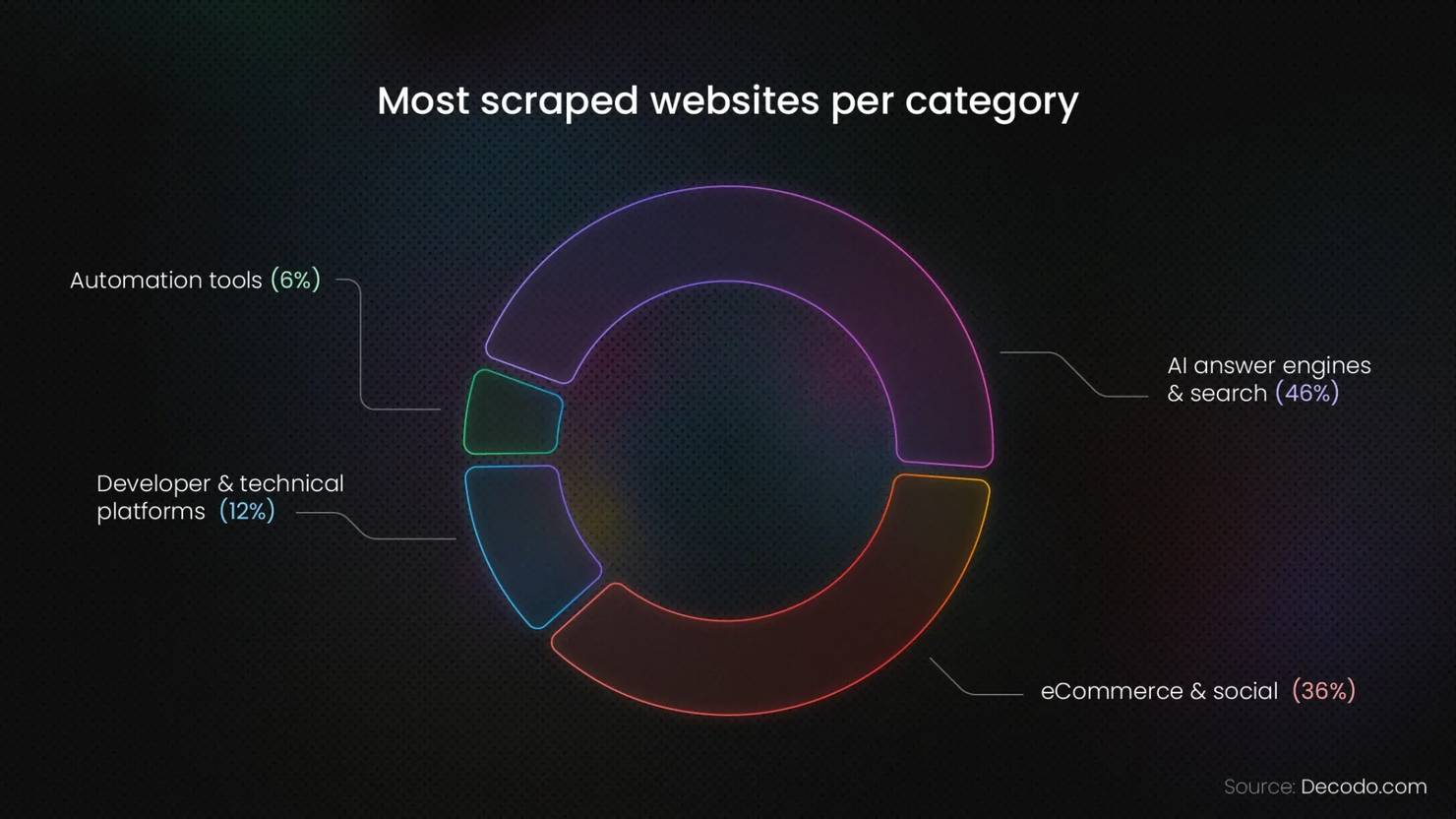
AI answer engines and search together account for the largest share of requests. GEO tracking and SEO monitoring both drive that volume. Developer and technical platforms form a new cluster on their own. That group is separate from the eCommerce and social categories that led 2024 and 2025. Automation tools form the smallest category on this list, represented by Make.com alone.
The Most Scraped Websites Of 2026
The list below ranks the ten most scraped websites based on Decodo's anonymized user usage data.
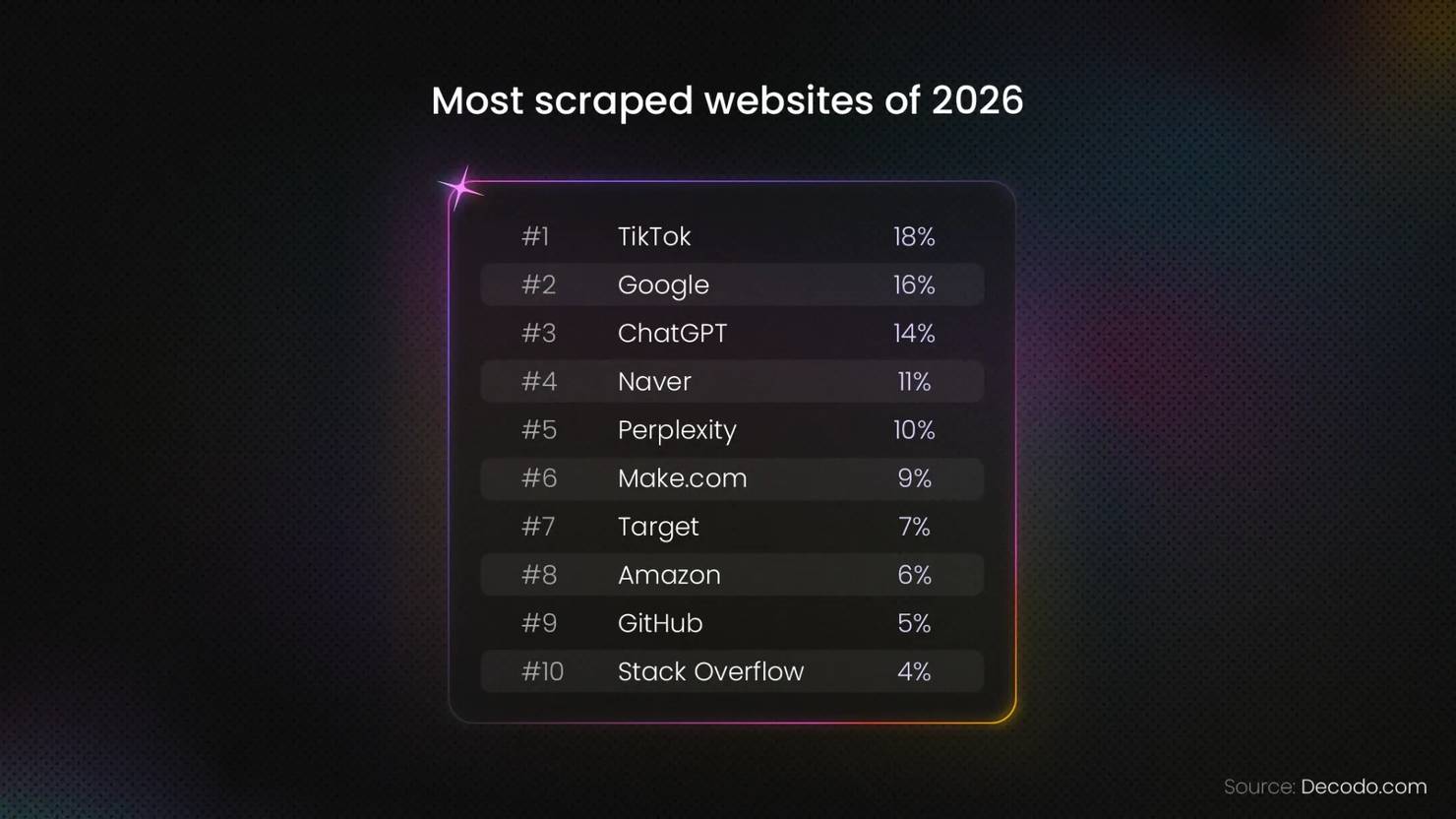
#1 TikTok
TikTok holds the top spot for a second consecutive year. The platform counts close to 2B monthly active users worldwide. Its short-form video format feeds AI training that needs video, audio, and text together.
Key data points collected by our users:
- Video content and metadata
- Hashtag and trend data
- Engagement metrics
- Creator analytics
- Comment sentiment
#2 Google
Google holds 89.2% of global search market share in 2026. That hasn't changed with AI in the mix. Ranking #1 on the main keyword for your brand used to be the goal. Now AI Overviews answer the question before anyone scrolls down. A top ranking doesn't guarantee a click anymore. Teams scrape Google to see both the classic results and the AI Overview above them. That's the only way to track how a brand actually shows up on the page. Public SERP data also feeds a second use case – teams pull it to train and fine-tune their own AI models on real search behavior.
Key data points collected by our users:
- Search result rankings
- AI Overview content
- Local business listings
- Image search results
- Auto-suggest keyword data
#3 ChatGPT
ChatGPT enters this list for the first time. OpenAI reported 900M weekly active users in February 2026. That's more than double the figure from a year earlier. Businesses scrape ChatGPT for several distinct reasons. Product and marketing teams check how ChatGPT ranks them against named competitors inside a category. Some track how it describes their pricing, features, or policies. A wrong answer can shape a buying decision before anyone visits the company's site. Others collect prompt and response pairs to train or fine-tune their own models on conversational data. A fourth group tracks which sources ChatGPT cites most often. They then work to get published on those same sources.
Key data points collected by our users:
- Response text and structure
- Citations and source links
- Brand mention frequency
- Prompt and response pairs
- Ranking of cited sources
#4 Naver
Naver holds 63.8% of South Korea's search market as of March 2026. Google trails at 28.7%. For years, most businesses built their search strategy around Google and stopped there. That approach misses a market where the dominant search engine isn't Google at all. Naver's entry follows Coupang's appearance on last year's list, and the pattern is the same. Businesses expanding into South Korea are learning that ranking on Google doesn't mean much if shoppers are searching on Naver. Teams now collect publicly available data from Naver to localize listings, track pricing against Korean competitors, and see how their brand shows up on a platform.
Key data points collected by our users:
- Search rankings and results
- Shopping listings
- News aggregation data
- Local business data
#5 Perplexity
While most users who use AI tools might not say that Perplexity is their first choice, it managed to climb to #5 in our list. Perplexity's answers cite sources directly inside each response. That format sets it apart from ChatGPT's more conversational output. Businesses scrape Perplexity for various reasons. Product and marketing teams check how it ranks them against named competitors inside a category. Some track which sources it cites most often. That list doubles as a roadmap for where to get published. Others pull exact source rankings straight from the response instead of a results page. A fourth group collects query and response pairs. They use that data to train or fine-tune their own models on citation-backed answers.
Key data points collected by our users:
- Cited sources and links
- Answer text and structure
- Source ranking order
- Query and response pairs
- Follow-up question patterns
#6 Make.com
Make.com connects thousands of apps through visual workflows. Its AI Agents let users build automations that reason through steps on their own. Businesses scrape Make.com for several distinct reasons. Some track integration availability to see which apps and platforms get support first. Others monitor scenario templates to understand which automations are gaining adoption across the market. That data works as a competitive signal, showing which workflows competitors are building around.
Key data points collected by our users:
- Integration and app availability
- Scenario template structures
- Automation trigger patterns
- API endpoint data
- Workflow documentation
#7 Target
Target's online sales keep growing as a share of total revenue. Its Target Plus marketplace has added more third-party sellers every quarter. That growth means more listings, more sellers, and more prices to track. Retail teams track pricing and promotions against Target's private-label and national brands. Others monitor Target Plus listings to see which third-party sellers are gaining shelf space. Inventory data helps teams spot stock-outs and restocks before competitors do. And there are also competitors that track seasonal pricing patterns to time their own campaigns and adjust prices where their offerings are more expensive.
Key data points collected by our users:
- Product listings and pricing
- Inventory availability
- Target Plus marketplace data
- Promotional and seasonal pricing
- Customer reviews
#8 Amazon
Third-party sellers account for most of the products sold on Amazon. The platform's drop from #3 to #8 doesn't mean the demand for eCommerce data is shrinking. It means teams now split that demand across more retail targets. Sellers track pricing and Buy Box ownership against thousands of competing listings. Others monitor customer reviews to catch product issues before they escalate. Category teams track best-seller rankings to spot which products are trending. And there are also retailers that watches new seller activity to see who's entering their category.
Key data points collected by our users:
- Product listings and specifications
- Pricing and Buy Box data
- Customer reviews
- Seller information
- Best-seller rankings
#9 GitHub
GitHub now hosts more than 180M developers and it even added 36M new users in 2025. That scale makes it the largest public source of real code. Businesses scrape repositories to track how open-source projects evolve and which ones gain traction. Others map use cases across repositories to see how developers build with new frameworks. Commit histories and documentation get pulled into training pipelines for code-generation models. That data teaches AI models how real developers write, structure, and document code.
Key data points collected by our users:
- Repository code and structure
- Commit and pull request history
- Issue and documentation content
- Contributor activity
- License and dependency data
#10 Stack Overflow
Stack Overflow's monthly question volume fell 78% in December 2025. That's compared to the year before. Falling question volume doesn't mean the data lost its value. Its archive holds 16 years of technical answers, and AI companies use that history to train coding models. Others track question and tag volume as a pulse check on where developer interest is heading, which languages are rising, and which tools are falling out of use. These trends double as an early signal for where the broader developer market is moving.
Key data points collected by our users:
- Question and answer text
- Code snippets and tags
- Vote and reputation data
- Topic and language trends
- Historical archive content
What This Means For 2027
GEO tracking is likely to grow past ChatGPT and Perplexity. Gemini and Copilot are strong candidates for next year's list as their user bases catch up. Naver's entry may open the door to other regional search engines, including Baidu. More businesses are expanding into markets where Google isn't the default search engine. Businesses could use that data to build country-specific intelligence, as they start to understand that one global search strategy won't cover every market.
Make.com's appearance probably isn't a one-off. As agentic AI adoption grows, expect more automation platforms on next year's list. Zapier and n8n are two likely candidates. The bigger shift might be in who's doing the scraping. Right now it's mostly people and their tools. In 2027, AI agents may start pulling this data themselves. That means agent workflows triggering scraping requests without a person in the loop.
"Every year this report gets less about websites and more about where decisions get made," said Vaidotas Juknys. "In 2025 that was search. In 2026 it's AI answers and automation. Next year the agents might be doing the deciding instead of just reading the answers."
Collecting Data Without Getting Blocked
The web is getting harder to read at scale. More sites now run bot detection that flags data collection attempts throughout a browsing session. Some AI platforms add further limits through paywalls, login screens, or rate limits.
That shift changes what open access to public data actually means. Ten years ago, most of this list would have been simple HTML pages. Now half of it is AI-generated answers, highly dynamic marketplaces, or workflow platforms with their own rules. Reaching that data still takes purpose-built infrastructure.
Building that infrastructure in-house means maintaining proxy pools, solving CAPTCHAs, and rewriting parsers every time a target changes its layout. Most teams don't have the headcount for that, and it pulls focus from the actual analysis. Decodo's Web Data API handles that layer instead, covering every target on this list through one interface teams can plug into directly. Decodo's MCP Server works differently: it connects straight to AI tools like Claude or Cursor, so they can pull live web data on their own, right inside the tool, without a separate integration step.

Collect publicly available data faster
Activate your free Web Data API plan with up to 10K recurring requests.
Bottom Line
The most scraped websites of 2026 reveal how fast the answer to "where's the data" keeps changing. Ten years ago, this list would have been mostly search engines and online stores. Now AI answer engines sit at the top alongside them. Developer platforms entered as a new category. An automation tool appeared for the first time too, a preview of agents pulling their own data instead of people doing it for them. Seven of ten spots turned over in a single year. The websites businesses build their strategy around now change faster than most teams can track. The advantage in 2027 will come from knowing where to look next.
About the author

Benediktas Kazlauskas
Content & PR Team Lead
Benediktas is a content professional with over 8 years of experience in B2C, B2B, and SaaS industries. He has worked with startups, marketing agencies, and fast-growing companies, helping brands turn complex topics into clear, useful content.
Connect with Benediktas via LinkedIn.
All information on Decodo Blog is provided on an as is basis and for informational purposes only. We make no representation and disclaim all liability with respect to your use of any information contained on Decodo Blog or any third-party websites that may belinked therein.