Best US Proxies in 2026: Top Providers Compared
The best US proxies let you access US-only websites, scrape local web data, manage US-targeted accounts, and verify digital ads from different locations. They route your internet traffic through an IP address located in the United States, making websites recognize your requests as coming from an American user so you don’t get blocked. This guide compares the best US proxies using US-specific performance metrics.

Kotryna Ragaišytė
Last updated: Jul 31, 2026
16 min read

TL;DR
- The best US proxies combine a large, clean US IP pool with fast response times and reliable access to various websites.
- Residential proxies handle protected US sites, ISP proxies hold stable sessions, mobile proxies beat the toughest anti-bot systems, and datacenter proxies move fast on easy targets.
- When comparing proxy providers, consider tested US performance more than advertised global IP pool size.
- Residential proxies remain the best option for most scraping and automation tasks because they're harder for websites to detect than datacenter proxies.
- Decodo pairs a near-top US pool and success rate with the lowest pricing among the top-tested providers, with pay-as-you-go included.
- To reduce block rates and improve long-term scraping reliability, you need to choose ethically-sourced US IPs.
Types of US proxies
Not all US proxies work the same way. Each proxy type offers different levels of anonymity, performance, session stability, and detection resistance.
Pick the wrong type for a US target and your scraping project stalls before it collects a single row of data. Here are the types of US proxies on the market today.
US residential proxies
Residential proxies route through real household IP addresses issued by US internet providers. Because these IP addresses belong to genuine residential devices, websites typically treat requests as legitimate user traffic rather than automated activity.
This makes them the most popular option for performing web scraping, accessing geo-restricted US content, market research, localized SEO, and ad verification.
Residential proxies are particularly effective against websites protected by sophisticated anti-bot systems.
Many eCommerce platforms, travel websites, online marketplaces, and search engines monitor incoming traffic for suspicious behavior. Requests coming from residential IP addresses blend naturally with normal browsing patterns, which reduces the likelihood of CAPTCHAs, temporary blocks, or rate limiting.
Residential proxies also support both rotating and sticky sessions. Rotating sessions automatically assign a new IP address after each request, which makes them ideal for large-scale web scraping.
Sticky sessions keep the same IP address for an extended period, which works better for authenticated browsing and account management.
The tradeoff is cost and speed variance. Traffic rides on real US home connections, so latency isn't as tight as a datacenter IP, and pricing runs by the gigabyte rather than by the IP.
Residential proxies are worth the premium whenever the target actively checks IP reputation, and they're the only sensible option for accessing US streaming catalogs, or checkout flows that fingerprint the connection type behind an IP.
Pros
- Difficult for websites to detect
- Excellent success rates on protected websites
- Supports state, city, ZIP code, and ASN targeting
- Suitable for rotating and sticky sessions
- Ideal for long-term data collection
Cons
- Higher cost than datacenter proxies
- Slightly slower than server-based proxies
- Bandwidth limits may apply depending on the provider
US ISP (static residential) proxies
ISP proxies, also known as static residential proxies, combine a US IP registered under a major American provider, AT&T, Verizon, or T-Mobile, with hosting on stable datacenter infrastructure. You get the residential trust signal without the connection jitter of a real home network, and the IP doesn't rotate away mid-session.
Unlike rotating residential proxies, ISP proxies provide a static IP address issued through an internet service provider while being hosted in professional data centers.
This combination makes them particularly useful for workloads that require a consistent online identity. They’re the preferred option for businesses managing multiple seller accounts, advertising platforms, social media profiles, or long-running browser sessions because they maintain the same US IP address throughout the session while still appearing as legitimate residential traffic.
Compared with rotating residential proxies, ISP proxies offer greater session stability. They're also less likely to trigger anti-bot systems because websites recognize them as residential internet connections.
Another advantage is predictable performance. Since ISP proxies operate from high-performance hosting environments, they generally deliver faster speeds than rotating residential networks while preserving much of the trust associated with household IP addresses.
Pros
- Static residential IP addresses
- Lower detection rates than datacenter proxies
- Faster and more stable than rotating residential proxies
- Excellent for authenticated sessions
- Suitable for long-term account management
Cons
- More expensive than datacenter proxies
- Less anonymity than rotating residential proxies
- Not necessary for short scraping tasks
US mobile proxies
US mobile proxies route internet traffic through IP addresses that US carriers assign to phones and tablets. Since thousands of users often share the same mobile IP addresses through carrier-grade NAT (CGNAT), websites generally view mobile traffic as highly trustworthy. This makes mobile proxies one of the most reliable options for accessing websites with strict anti-bot protections.
These types of proxies are the preferred option for businesses managing social media accounts, testing mobile applications, verifying mobile advertisements, and accessing platforms that prioritize mobile traffic. Because mobile IP addresses change naturally as users move between network towers, they blend seamlessly with legitimate user behavior.
Compared with residential proxies, mobile proxies typically achieve similar or even higher trust levels on heavily protected platforms. However, they usually come at a higher cost due to the limited availability of mobile IP addresses and the infrastructure required to maintain carrier connections.
Unless your project specifically requires mobile traffic, residential or ISP proxies often provide a better balance between performance and cost. Still, for applications that depend on authentic mobile identities, mobile proxies remain an excellent option.
Pros
- Extremely difficult to detect
- High trust on mobile-first platforms
- Natural IP rotation
- Excellent success rates
- Ideal for mobile traffic simulation
Cons
- Higher pricing than other proxy types
- Smaller IP pools
- Not necessary for most standard web scraping projects
US datacenter proxies
US datacenter proxies use IP addresses hosted in professional data centers rather than residential internet connections. Because they aren't tied to internet service providers or mobile carriers, datacenter proxies deliver exceptional speed and low latency, which makes them ideal for high-volume automation and public web scraping.
These types of proxies can process thousands of requests quickly, which makes them a popular choice for website testing, uptime monitoring, public data collection, and brand protection.
However, websites can often identify datacenter IP addresses more easily than residential or mobile IPs. Many platforms maintain databases of known hosting providers and apply stricter rate limits or additional verification to traffic originating from datacenter networks.
For websites with minimal anti-bot protections, this usually isn't a concern. But for platforms that actively detect automated traffic, residential proxies typically deliver higher success rates.
To optimize both speed and reliability, you need to combine datacenter and residential. This way, you can scrape public pages using fast datacenter proxies and residential or ISP proxies for more heavily protected websites.
Pros
- Fastest proxy type
- Low latency
- Excellent scalability
- Cost-effective for high-volume requests
- Easy deployment
Cons
- Easier for websites to detect
- Lower success rates on protected websites
- Less suitable for account management
Which type of US proxies should you choose?
When choosing the best US proxies, you need to select the right proxy type for your workload. While every option routes traffic through a US IP address, each one offers different strengths depending on whether you prioritize speed, anonymity, or session stability.
Here’s a quick decision table to guide you:
Proxy type
Best for
Detection resistance
Speed
Residential
Web scraping, SEO, ad verification
Excellent
High
ISP
Account management, persistent sessions
Excellent
Very high
Mobile
Mobile apps, social media account management
Excellent
Moderate
Datacenter
Websites with low protection, testing, automation
Moderate
Excellent
If you're scraping protected websites, use residential proxies because they closely resemble genuine consumer traffic. They also offer the most flexible location targeting, which makes them ideal for collecting localized search results or monitoring regional pricing.
If your workflow depends on maintaining the same online identity for extended periods, ISP proxies are the better option. They combine residential trust with static IP addresses, which makes them suitable for business dashboards, seller accounts, and authenticated sessions.
Mobile proxies are ideal for projects that specifically require traffic originating from mobile carrier networks, while datacenter proxies offer the best value for high-speed automation on public websites.
Ultimately, the best US proxies aren't determined by a single feature. The right solution depends on your workload, target websites, and the level of detection resistance you need.
Why use US proxies?
US proxies do much more than hide your IP address. They allow you to browse the web as if you’re physically located in the United States, which makes it possible to access geo-restricted content, collect localized data, verify advertisements, and automate online tasks with greater reliability.
Unlike VPNs, which primarily focus on privacy for individual users, proxies are designed to route large volumes of requests efficiently. Premium US proxy providers also offer features such as rotating IP addresses, sticky sessions, granular location targeting, and ethically sourced residential IPs; all of which help reduce detection while improving request success rates.
Access US-exclusive websites and content
Many websites display different content depending on a visitor's location. Streaming platforms, eCommerce stores, travel websites, financial services, and software providers frequently customize their products, pricing, and promotions based on a user's IP address.
A US proxy allows you to browse these websites using an American IP address so you view pages exactly as a user in the United States would see them.
Collect localized web data
US proxies allow you to collect accurate location-specific data. Many websites personalize information based on where a visitor appears to be browsing from.
For example, search engines display different rankings depending on the user's city, while retailers may adjust prices based on location, inventory, or regional promotions.
Using localized US proxies allows you to collect data that's far more representative of what real American users see.
Improve web scraping success rates
Web scraping is one of the primary reasons organizations purchase US proxies. Sending thousands of requests from a single IP address can lead to CAPTCHAs, rate limits, or temporary blocks.
Residential US proxies distribute requests across many legitimate IP addresses, which makes automated traffic appear much more like normal user activity.
Premium proxy providers also support:
- Automatic IP rotation
- Sticky sessions
- Session persistence
- Concurrent connections
- High request volumes
These capabilities allow users to scrape websites more efficiently while reducing interruptions caused by anti-bot systems.
Verify localized advertising campaigns
Digital advertising platforms often display different advertisements depending on a visitor's location.
Marketing teams use US proxies to verify that campaigns appear correctly across different states, cities, and metropolitan areas without physically traveling to each location.
This helps businesses validate geo-targeted ads, detect ad fraud, review localized creatives, monitor competitor advertising, and test campaign delivery.
Manage multiple business accounts
Many organizations operate multiple online accounts across marketplaces, advertising platforms, customer support systems, and social media networks.
Accessing numerous accounts from a single IP address may trigger security checks or temporary restrictions.
Using sticky residential or ISP proxies allows each account to maintain a consistent US IP address, which creates browsing behavior that more closely resembles genuine users.
Test localized user experiences
Businesses launching products in the United States often need to verify how their websites perform across different locations.
US proxies make it possible to test regional pricing, shipping calculations, currency displays, language settings, personalized recommendations, and store availability.
Geographic coverage and IP pool size
When comparing the best US proxies, it's easy to focus on the total number of IP addresses a provider advertises. However, global network size doesn't always reflect the quality of its US infrastructure.
What matters more is the number of unique US IP addresses, the diversity of those IPs, and how accurately they can be targeted to specific locations.
A provider with hundreds of millions of global IPs may still offer a relatively small US network, while another provider with fewer overall IPs could deliver broader US coverage and better performance. That's why it's important to evaluate US-specific benchmarks rather than marketing claims.
Why advertised pool size misleads
Advertised global pool size is close to useless for a US project. Providers publish enormous worldwide totals, but independent testing regularly shows the real US-serving slice is a fraction of that number, and part of it is already flagged or duplicated across customers. The count that predicts success is the tested unique US IP figure, not the headline on the homepage.
US targeting granularity
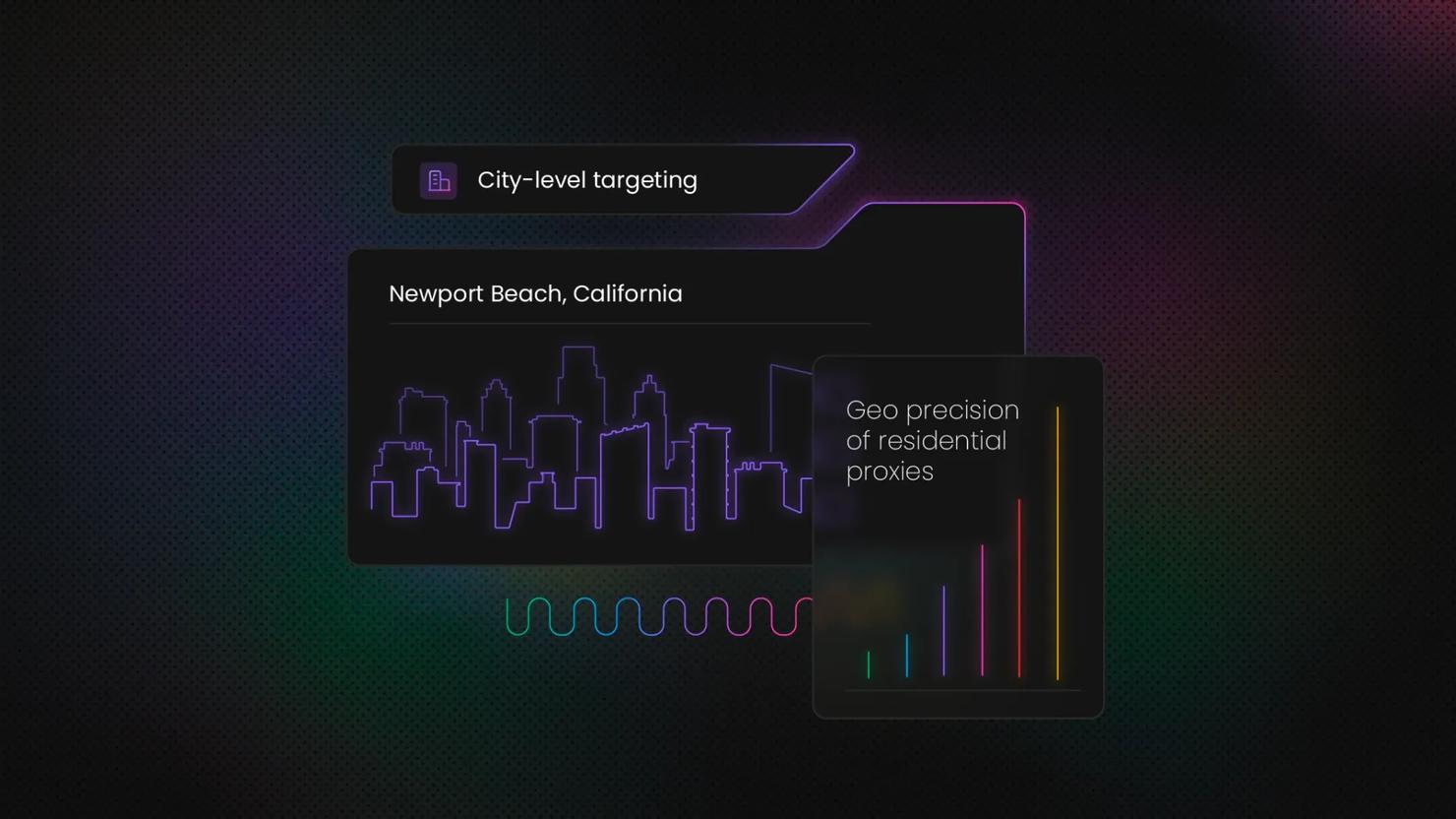
US targeting granularity is a real decision axis.
- Webshare filters by country only
- Decodo, Oxylabs, and Bright Data proxies go down to state, city, ZIP, and ASN
That precision matters for anything localized: an ad-verification check in Ohio needs an Ohio IP, not a random location within the US, and ZIP-level SEO or pricing work needs the same specificity.
US ISP and ASN coverage
US ISP and ASN coverage adds another layer of credibility. A provider with IPs spread across AT&T, Verizon, and T-Mobile ranges gives a more believable US residential and ISP footprint than 1 concentrated on a handful of networks.
Why a cleaner pool matters
A larger, cleaner US pool simply means fewer collisions with an IP that's already been flagged on your target, which is the difference between a scrape that finishes and 1 that stalls on block pages. Decodo US proxies offer a large US pool and state/city/ZIP targeting.
Best US proxy providers compared
Several providers offer high-quality US proxy networks, but their strengths vary depending on pool size, response time, success rate, and location targeting. These are the best US proxies ranked on Proxyway's US-specific residential test.
Provider
Tested unique US IPs
US success rate
US response time
US targeting
Best for
Decodo
466,068
99.82%
0.60s
Country, state, city, ASN, ZIP
Best value; near-top US pool, faster US latency, PAYG, cleanest pool
Oxylabs
489,032
99.83%
0.68s
Country, state, city, ASN, ZIP, coords
Largest tested US pool; enterprise scale
SOAX
340,126
98.25%
0.55s (fastest)
Country, state, city, ISP
Fastest US response; flexible targeting
Massive
222,513
99.87% (highest)
0.67s
Country (US-only network)
Highest tested US success rate; smaller pool
Webshare
278,836
99.27%
1.36s (slowest)
Country only
Cheapest entry; free tier, but no sub-country US targeting
Bright Data
392,272
99.14% (2024)
1.00s (2024)
Country, state, city, ASN, ZIP, coords
Deepest tooling; enterprise
#1 Decodo: Best overall US proxy provider
Decodo ranks among the best US proxies thanks to its powerful proxy network that covers all 50 states with residential, ISP, mobile, and datacenter IPs, plus a Web Scraping API and Site Unblocker for harder US targets.
Decodo is also rated among the cleanest tested US pools, meaning fewer of its IPs carry a prior block history on major US sites.
The network is built for teams that want enterprise-level US performance without enterprise pricing or a lengthy sales process.
Every US proxy type ships with the same dashboard, the same documentation, and the same flexible subscription options, so switching between residential for a hard scrape and ISP for a stable session doesn't mean you’ll need to rebuild your workflows from scratch.
Unlike providers that focus primarily on network size, Decodo emphasizes usability as well. Users can access residential, ISP, mobile, and datacenter proxies from a single dashboard, making it easy to switch between proxy types as project requirements evolve.
Combined with flexible session management and granular location targeting, the proxy provides a solution that works equally well for developers, digital marketers, and enterprise data teams.
Compared with Oxylabs, Decodo offers a slightly smaller US IP pool but faster average response times. It also provides significantly deeper location targeting and a broader range of proxy products than Webshare, which makes it a stronger long-term investment for growing businesses.
Key features:
- US response time. 0.60s, faster than Oxylabs despite a similarly sized tested pool
- US targeting depth. State, city, and ZIP code across all 50 states, matching the deepest granularity in this comparison
- 3-day free trial. 100MB of traffic to test out proxy performance on real targets before committing
- Protocol support. HTTP(S) and SOCKS5 on every plan
Pricing:
- Residential proxies start from $2/GB
- ISP proxies start from $0.27/IP
- Mobile proxies start from $2.25/GB
- Datacenter proxies start from $0.02/IP
Pros:
- Near-top tested US IP count at the lowest price among comparable providers
- Fastest response time of the large-pool providers tested
- State, city, and ZIP-level targeting across all 50 states
- 24/7 tech support
- ISO/IEC 27001:2022 certificate for proxies and Scraping API
- 3-day free trial for all proxy types
Cons:
- Datacenter proxies offer fewer dedicated US locations than the residential and ISP lines
- Some US targets require ID verification before access
- Mobile proxy pool is smaller than the residential and ISP networks
#2 Oxylabs: Best for enterprise-scale data collection
Oxylabs runs proxies for the US market, alongside a web scraper API and web unblocker.
It leans toward enterprise buyers, with published country-level and city-level targeting and the largest tested unique US IP count in Proxyway's most recent residential test.
The US network draws from millions of American households and covers all 50 states, which gives it the deepest bench for high-volume, hard-target US scraping.
Setup runs through a self-service dashboard or an Endpoint Generator that outputs ready proxy strings by state, city, or session type.
Oxylabs also publishes per-country IP counts on its location pages, so US buyers can check exactly how deep the American slice of the network runs before committing, rather than relying on the global headline figure.
Compared with Decodo, Oxylabs offers a larger US IP pool but slightly slower response times. Organizations handling millions of requests each month may benefit from its additional scale, while businesses focused on balancing speed, usability, and cost may find Decodo is a more practical choice.
Key features:
- US residential proxies. State, city, ZIP, and ASN targeting across a pool built from millions of American households
- US ISP and dedicated ISP proxies. Premium American ASNs for stable, high-performance sessions
- US mobile proxies. Targetable down to coordinates for the toughest mobile-first blocks
- US datacenter proxies. Sub-second response times for high-volume, lenient targets
Pricing:
- Residential proxies start from $4/GB
- ISP proxies start from $1.60/IP
- Datacenter proxies run from $0.44/GB shared
Pros:
- Largest tested unique US IP pool among the providers compared here
- Full US targeting depth down to ZIP and ASN
- ISO 27001 and SOC 2 certified infrastructure
- Strong published US success rate and uptime figures
- Wide integration support across scraping frameworks and anti-detect browsers
Cons:
- Highest entry pricing of the group, which adds up fast on smaller US projects
- ID verification is required for advanced targeting and most trials beyond the datacenter offer
- Entry-tier bundle pricing runs above the advertised per-GB headline rate
#3 SOAX: Best for speed
SOAX is for businesses looking for the best US proxies, particularly if response speed is a top priority. In independent US benchmark testing, it recorded the fastest average response time among the providers compared, making it well suited for high-frequency scraping, SEO monitoring, and real-time data collection.
Beyond speed, SOAX offers a well-balanced proxy platform that includes residential, ISP, mobile, and datacenter proxies. Users can target traffic at the country, state, city, and ASN levels while customizing proxy rotation to match different workloads.
Its intuitive dashboard and flexible filtering options make it easy to deploy localized proxy sessions without extensive technical configuration.
Compared with Decodo, SOAX delivers slightly faster response times but has a smaller US residential IP pool and a lower benchmark success rate. Businesses prioritizing speed over maximum IP diversity may find SOAX an excellent choice, while larger scraping operations may benefit from providers with broader US coverage.
Key features:
- Unified credit pool. Residential, mobile, and ISP traffic on 1 subscription covering several US proxy types
- US targeting. City, state, and ISP-level targeting on higher plans
- US datacenter proxies. 99.95% advertised success rate
- Session control. Sticky and rotating sessions across all proxy types
- Protocol support. HTTP(S), SOCKS5, and UDP
Pricing:
- Tier 1 pricing, which covers the US, runs from $5/GB on entry plans down to $0.85/GB on enterprise tiers
- A 3-day, 400MB trial costs $1.99
Pros:
- Fastest tested US response time among the providers compared
- One credit pool covers residential, mobile, and ISP US traffic
- City and ASN-level targeting on higher-tier plans
- Ethically-sourced IP network with consent-based collection
- Low-cost paid trial for testing before a full commitment
Cons:
- US datacenter coverage excludes Texas
- Smaller tested US pool than Oxylabs, Decodo, or Bright Data
- Billing runs on monthly credit tiers with no straightforward per-IP option for datacenter proxies
#4 Massive: Best for reliability
Massive runs a US-only ISP proxy network built on real American ISP ranges, including AT&T-registered IPs concentrated on the US East Coast. The pool is smaller than the other providers in this comparison, but it posted the highest tested US success rate in Proxyway's benchmark and some of the fastest response times of any provider tested.
That combination makes it a strong option for smaller-scale US work where reliability per request matters more than raw pool size, sneaker and limited-release retail tasks in particular.
Massive’s IPs are concentrated near major East Coast data centers, which keeps latency low for anything targeting US East Coast infrastructure. Still, the tradeoff is thin coverage outside that region and no proxy locations outside the US at all.
Every plan includes unlimited bandwidth and concurrent sessions with no overage fees, which is unusual in a market where most providers meter by the gigabyte, and it makes cost predictable for teams running steady, high-frequency requests against a small number of stable US targets.
Key features:
- US ISP proxies. Registered under major American carriers for residential-grade trust with datacenter stability
- Unlimited bandwidth and concurrency. No overage charges on any plan
- Compliance. SOC 2 and AppEsteem certification alongside GDPR and CCPA compliance
- Speed. Sub-100ms response times reported in independent testing.
Pricing:
- ISP proxies start from $3/IP for 10 IPs
- Drops to around $2/IP at 50 IPs and $1.80/IP at 100 IPs
- A 1 GB trial is available for new customers
Pros:
- Highest tested US success rate among the providers compared
- Consistently fast response times under real load
- Unlimited bandwidth and concurrent sessions on every plan
- SOC 2 and AppEsteem certified, with GDPR and CCPA compliance
- No caps that force a plan upgrade mid-project
Cons:
- Smallest tested US pool in this comparison, which limits volume
- US-only network with no international ISP coverage
- Higher entry price per IP than Oxylabs or Webshare
#5 Webshare: Best for smaller projects
Webshare runs rotating residential, static residential (ISP), and datacenter proxies (branded Proxy Server) for the US market, with over 6.6M US datacenter IPs listed on its location page. It's built around low entry pricing and a permanent free tier rather than sales calls, which makes it the easiest provider here to start on without a commitment.
While it doesn't provide the advanced targeting capabilities or enterprise tooling found in providers such as Decodo or Oxylabs, it remains a practical solution for smaller scraping projects, software testing, and general US browsing.
The self-service model runs through Webshare's whole US lineup: no KYC is required to get started, plans can be adjusted or canceled from the dashboard without contacting support, and the pricing tables are published in full rather than gated behind a sales call.
That transparency is a real advantage for smaller teams and solo developers who want to know the exact cost of a plan before signing up. Webshare filters by country only, with no state, city, or ZIP-level targeting for US work, and mobile proxies aren't offered at all.
For projects that only need a generic US IP, that's rarely a problem. For anything that needs to prove it's coming from a specific American city or ZIP code, it rules Webshare out on its own.
Key features:
- Rotating residential proxies. Country-level US targeting
- Static residential (ISP) proxies. Shared, private, and dedicated tiers
- Datacenter proxies (Proxy Server). A large US-based IP count with HTTP(S) and SOCKS5 support on every plan
- Self-service dashboard. Transparent, published pricing tables with no sales calls
Pricing:
- Datacenter proxies start from $0.03/IP
- Residential proxies start from around $1.40 to $3.50/GB depending on volume
- Static residential (ISP) proxies start from $0.23/IP
- A permanent free tier includes 10 proxies and 1GB of bandwidth, no credit card required
Pros:
- Lowest entry price among the providers compared here
- Genuinely free permanent tier with no expiry
- Fully transparent, self-service pricing with no sales calls
- Largest advertised raw US datacenter IP count in this comparison
- Simple dashboard that's fast to set up
Cons:
- Country-only targeting, with no state, city, or ZIP-level US filtering
- No mobile proxy product
- Support runs on email and chat only, with no dedicated account management
#6 Bright Data: best enterprise ecosystem
Bright Data runs residential, ISP, datacenter, and mobile proxies for the US market, alongside scraping APIs and datasets, and it lists 7M+ advertised US residential IPs on its location page.
It's built for enterprise commitments, with the deepest published US targeting (state, city, ZIP, and coordinates) among the providers here.
Bright Data's product range goes further than proxies alone. It includes a Scraping Browser that handles JavaScript-heavy US targets through a hosted, fingerprint-managed Chromium instance, and a Web Unlocker that charges only for successful responses, which shifts the cost risk away from the buyer on the hardest anti-bot-protected US sites.
Every residential IP is described as opt-in and independently audited. The network supports session durations from 1 to 60 minutes for workflows that need to hold a US identity briefly rather than for a full sticky session.
Compared with Decodo, it provides additional enterprise tooling but may be more complex for smaller businesses that simply need high-quality US proxies.
Key features:
- US residential proxies. State, city, ZIP, and coordinate-level targeting
- US ISP proxies. Real American ISPs for fixed-session work
- US datacenter proxies. Published sub-second response times
Pricing:
- Residential proxies start from around $5.88 to $8.40/GB depending on the offer, with committed plans dropping closer to $3/GB
- ISP proxies start from $1.30/IP
- Datacenter proxies start from around $0.60/IP
Pros:
- Largest advertised US residential IP count among the providers compared
- Deepest published US targeting, down to coordinates
- Enterprise-grade compliance and account management
Cons:
- Premium pricing that requires monthly commitments of several hundred dollars for the best rates
- New accounts start in limited access mode pending KYC, especially for residential and mobile proxies
Which is the best US proxy for you?
The best US proxies depend on what you're trying to achieve. Some providers excel at large-scale web scraping, while others prioritize response speed, session stability, or enterprise tooling.
Instead of choosing the provider with the biggest advertised network, focus on the features that directly support your workload, such as US IP pool size, geographic targeting, proxy rotation, and success rate. Here are our recommendations to help you narrow down the right solution.
If you need...
Recommended provider
Why?
Best overall US proxies
Decodo
Best balance of speed, US IP pool size, targeting, and value
Largest US residential proxy network
Oxylabs
Largest independently tested US IP pool
Fastest US proxy
SOAX
Lowest average response time
Highest request success rate
Massive
Highest benchmark success rate
Best for beginners
Webshare
Simple interface and affordable entry point
Best enterprise ecosystem
Bright Data
Advanced tools and enterprise integrations
Key features and qualities
Beyond raw pool size and headline speed, a handful of features separate the best US proxies from the rest of the field. These are the details worth checking before you commit to a plan.
Granular US location targeting
Not every project requires nationwide US traffic. Many businesses need to appear as users browsing from specific locations.
Look for providers supporting state, city, ZIP, and ASN targeting
This level of precision is particularly valuable for local SEO, ad verification, price monitoring, regional testing, and market intelligence
Compared with providers offering only country-level routing, city- and ZIP-level targeting produces significantly more accurate localized data.
Rotation and session control
Rotation and session control decide whether a proxy survives the workflow it's assigned to:
- Per-request rotation suits scraping, where a fresh IP on every call keeps any single address from building a flagged history
- Sticky sessions suit account management, where the same US IP needs to hold for the length of a login or checkout
Most providers let you set a sticky session duration, anywhere from a few minutes to several hours, and switch back to rotating traffic on the same account without changing plans.
Confirm the maximum sticky duration against your longest workflow: a checkout flow that takes 12 minutes to complete will fail on a proxy that only holds a session for 5 minutes.
Protocol support
The best US proxies support both HTTP(S) and SOCKS5 protocols.
HTTP(S) remains the standard for browser automation, APIs, and web scraping tools. Meanwhile, SOCKS5 provides additional flexibility for custom applications and software requiring broader network protocol support.
This flexibility makes it useful for custom applications, desktop software, and specialized networking environments.
Choose a provider supporting both protocols to simplify future integrations.
Pay As You Go availability
Pay As You Go is a must for users who run one-off projects. A fixed monthly commitment makes sense for steady, predictable US scraping. For a bursty project, a 1-week ad-verification sprint, or a seasonal price-tracking push, the Pay As You Go option is far better, since there's no unused allowance to write off at the end of the month.
It's also the cheapest way to test a provider's real US performance before signing up for a recurring plan, which is worth doing regardless of how convincing the marketing page looks.
Clean, ethically-sourced US IPs
Clean, ethically-sourced US IPs reduce block rates, improve request success rates, lead to fewer CAPTCHAS, and cut legal exposure at the same time. IPs collected without informed consent tend to be overused and already flagged on major sites, which drags down success rates before a single request goes out.
Before buying, check whether a provider discloses how it sources residential IPs at all. A provider that won't explain its sourcing method is a provider whose pool history you can't verify.
Developer tools and documentation
Modern proxy services increasingly provide more than IP addresses.
Many platforms now include:
- REST APIs
- Browser extensions
- Proxy management dashboards
- Authentication management
- Integration guides
- Code examples
- Technical documentation
These tools reduce deployment time and simplify proxy management, especially for development teams integrating proxies into existing scraping or automation workflows.
Comprehensive documentation also shortens onboarding, helping developers configure rotation, authentication, and location targeting with fewer implementation challenges.
Popular use cases for US proxies
Choosing the right proxy type for each workload is just as important as choosing the right provider. Below are some of the most common applications for US proxies.
- Accessing US-only content and services. Streaming catalogs, US-only pricing pages, and sites gated to American visitors all need a real US IP to get in. Residential proxies fit this best, since they read as ordinary household connections rather than a flagged datacenter range, and a session only needs to hold long enough to load the page.
- Scraping US eCommerce, SERP, and marketplace data. Datacenter proxies handle high-volume, lenient targets at low cost for pricing intelligence and market research, while residential proxies take over once a site starts checking IP reputation closely. Large-scale SERP monitoring in particular tends to mix both: datacenter proxies for the bulk of low-risk queries, residential for the subset of searches that trigger a CAPTCHA.
- US ad verification. Confirming how ads render for real local IPs across different states depends on granular targeting. A campaign can look fine from a national dashboard and still show up broken or in the wrong region on the ground, so state and city-level US proxies matter more here than raw pool size. A single misconfigured geo-targeting rule can waste an entire regional ad budget before anyone notices from the dashboard alone.
- Managing US-targeted social and marketplace accounts. This calls for a stable, believable identity per account. ISP proxies deliver 1 fixed US IP per account without the session resets that come with rotating residential, which is why multi-accounting setups tend to favor them. Pair each account with its own consistent US IP to keep a platform's account-linking detection from connecting profiles that are meant to stay separate.
- Sneaker and limited-release retail. A very common US-proxy use case on its own. These drops move fast, punish any latency, and reward whichever setup can hold multiple clean US sessions at once, which is part of why speed-focused providers like SOAX and Massive show up often in that community. For ongoing price tracking work, the same targeting logic applies: match the proxy type to how aggressively the target site checks for bots, and scale up to residential only once a datacenter pool starts getting blocked.
- Market research and consumer sentiment tracking. Pulling US reviews, forum discussions, and public social posts at scale needs a pool large enough to avoid rate limits across thousands of pages without the same handful of IPs hitting the same domain repeatedly. Rotating residential proxies spreads that load across a wide enough set of addresses that no single IP accumulates the request volume that triggers a block.
How to choose and buy US proxies
Selecting the best US proxies isn't simply about choosing the provider with the biggest advertised network. Instead, evaluate the factors that directly influence real-world performance, including US IP quality, response speed, targeting capabilities, and session management.
Match proxy type to task
Different proxy types solve different problems. Before choosing a provider, identify how you'll primarily use your US proxies.
Residential proxies are useful when working with websites that actively detect automated traffic. They closely resemble genuine users, which makes them the preferred choice for protected websites.
ISP proxies combine residential trust with static IP addresses. They're particularly useful when maintaining a consistent online identity is more important than frequent IP rotation.
Datacenter proxies prioritize speed and scalability.
Although they're easier to detect than residential proxies, they’re highly effective for websites with minimal anti-bot protection.
Mobile proxies provide some of the highest trust levels available because they route traffic through mobile carrier networks. Because they're generally more expensive, they're best reserved for specialized workloads.
Prioritize tested US performance over advertised pool size
Many providers advertise enormous global proxy networks, but those numbers don't always reflect the quality of their US infrastructure.
Instead, evaluate providers based on unique US IP addresses, US response time, US success rate, network stability, and geographic coverage.
These metrics have a much greater impact on real-world performance than total global IP counts.
Confirm the targeting granularity you actually need
Country-level targeting covers a lot of scraping work, but state, city, or ZIP and ASN-level targeting is required for localized US ad verification, SEO, and pricing tasks.
Check this against your real target list, not a generic use case. It's easy to overpay for ZIP-level precision on a project that only ever needed a generic US IP, and just as easy to underbuy a country-only plan for work that turns out to need city-level accuracy 3 months in.
Check pricing model fit, not just headline rate
Residential and mobile proxies typically bill by the gigabyte, since usage scales with how much data moves through the connection. ISP and datacenter proxies typically bill per IP per month, since you're paying for a dedicated address rather than metered traffic.
A per-GB plan usually wins for low-session, high-data scraping, while a per-IP plan usually wins for high-traffic, low-session-count work like holding a handful of stable accounts. Compare plans on the pricing model that matches your actual usage pattern, not just on whichever number looks smallest on the homepage.
Start with a free trial
A trial lets you test-drive US proxies' performance on your actual targets before signing up for a monthly plan. This step catches mismatches a spec sheet never will, since a provider's tested figures reflect Proxyway's target set, not necessarily the specific US sites in your own project.
Avoid free US proxy lists
Free proxy lists are slow, insecure, and frequently already flagged by the sites you're trying to reach, and some operators log or inject into the traffic that passes through them.
They're worth knowing about only as a cautionary example, not as a real option for any US project that matters. You can use Decodo's free trial as a starting point before you buy proxies.

Bottom line
Choosing the best US proxies means looking past marketing claims and focusing on metrics that affect real-world performance. US IP pool size, response time, success rate, geographic targeting, and IP quality all shape how well a proxy network supports your workload.
Decodo stands out for its strong overall balance of network size, performance, geographic targeting, and usability, making it a solid fit for most US proxy needs.
The right proxy type still depends on your specific use case. Prioritizing independently tested US performance over advertised global figures will help you choose a service built for consistent, long-term results.
About the author

Kotryna Ragaišytė
Head of Content & Brand Marketing
Kotryna Ragaišytė is a seasoned marketing and communications professional with over 8 years of industry experience, including 5 years specialized in tech industry communications. Armed with a Master's degree in Communications, she brings deep expertize in brand positioning, creative strategy, and content development to every project she tackles.
Connect with Kotryna via LinkedIn.
All information on Decodo Blog is provided on an as is basis and for informational purposes only. We make no representation and disclaim all liability with respect to your use of any information contained on Decodo Blog or any third-party websites that may belinked therein.