Google Jobs Scraper API
Turn Google Jobs results into structured data, even without the official API. Decodo’s Google Jobs Scraper API* extracts job titles, salaries, employers, and posting dates at scale, powered by 125M+ IPs in 195+ locations with 99.99% uptime. Start with a free plan today.
* This scraper is now a part of Web Data API.
14-day money-back option

99.99%
uptime
99.99%
success rate
100+
ready-made templates
JavaScript
rendering
Free
starter plan
Trusted by 135K+ users:


What is a Google Jobs API scraper?

What does it do?
A Google Jobs scraper API extracts publicly visible job listings from Google's job search results, including job titles, employer names, locations, salary ranges, posting dates, and job descriptions. Once the data is extracted, the Google Jobs scraper API returns structured output for recruitment analytics, labor market research, and competitive intelligence. It operates on Google Jobs SERP data without requiring an official API key or partner access.

Does Google have a public Jobs API?
Google doesn’t offer a public API for extracting job listings from Google Jobs search results. Google Cloud Talent Solution is a separate enterprise product that lets companies embed job search into their own applications – it doesn’t provide access to google.com/jobs listing data. Third-party SERP APIs exist, but are priced per request at a significant scale cost. Decodo's Google Jobs scraper API provides direct programmatic access to publicly visible job listing data with a flexible pricing model, where you only pay for what you actually use.
How does a Google Jobs scraper API work?
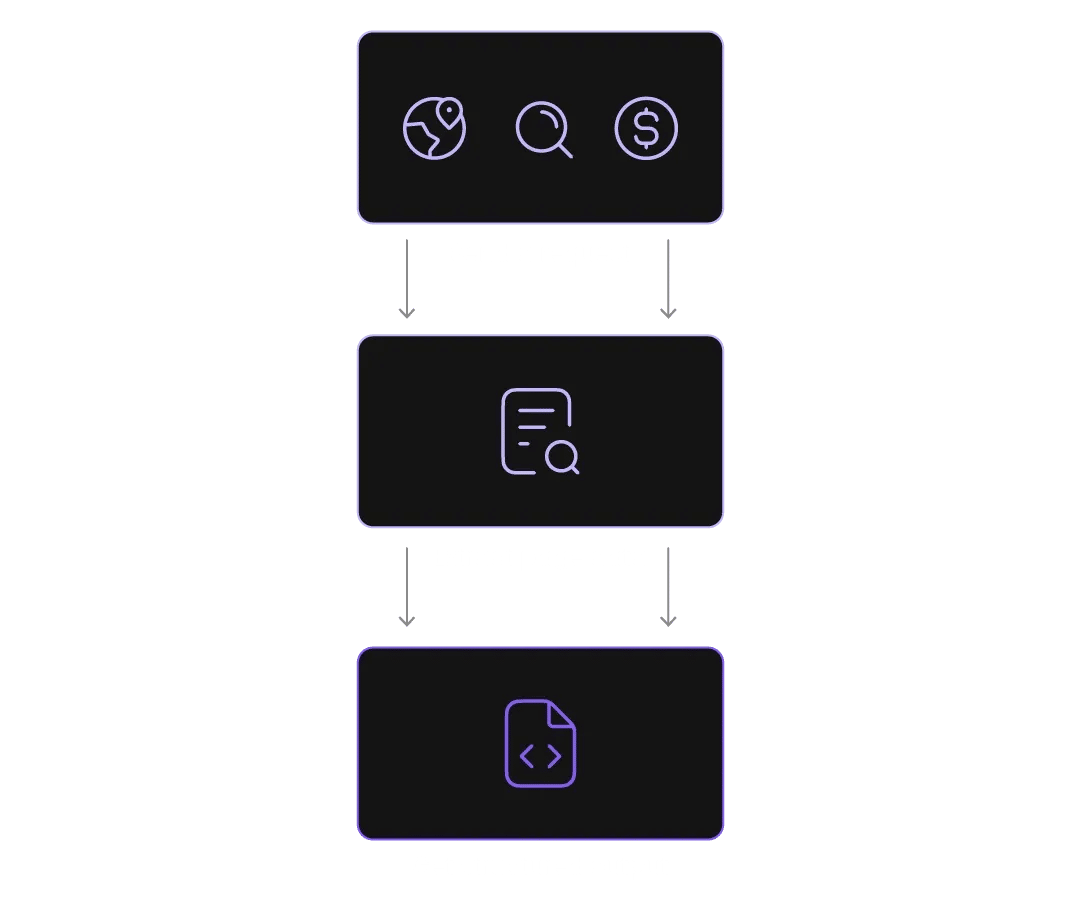
Behind the scenes, Google Jobs pages rely heavily on JavaScript and dynamically loaded content, which makes them difficult to scrape with traditional tools. A Google Jobs scraper API handles these complexities for you and returns the job data in a structured format. Here's how the process works:
- Send a scraping request. Submit job search queries, location parameters, or direct Google Jobs result URLs through Web Data API.
- Process job listings. Web Data API renders JavaScript, resolves dynamically loaded job listings, and extracts all visible job elements from the search results page.
- Get your data. Get ready-to-use job data in JSON, CSV, HTML, XHR, PNG, or Markdown.
What data can you extract from Google Jobs?
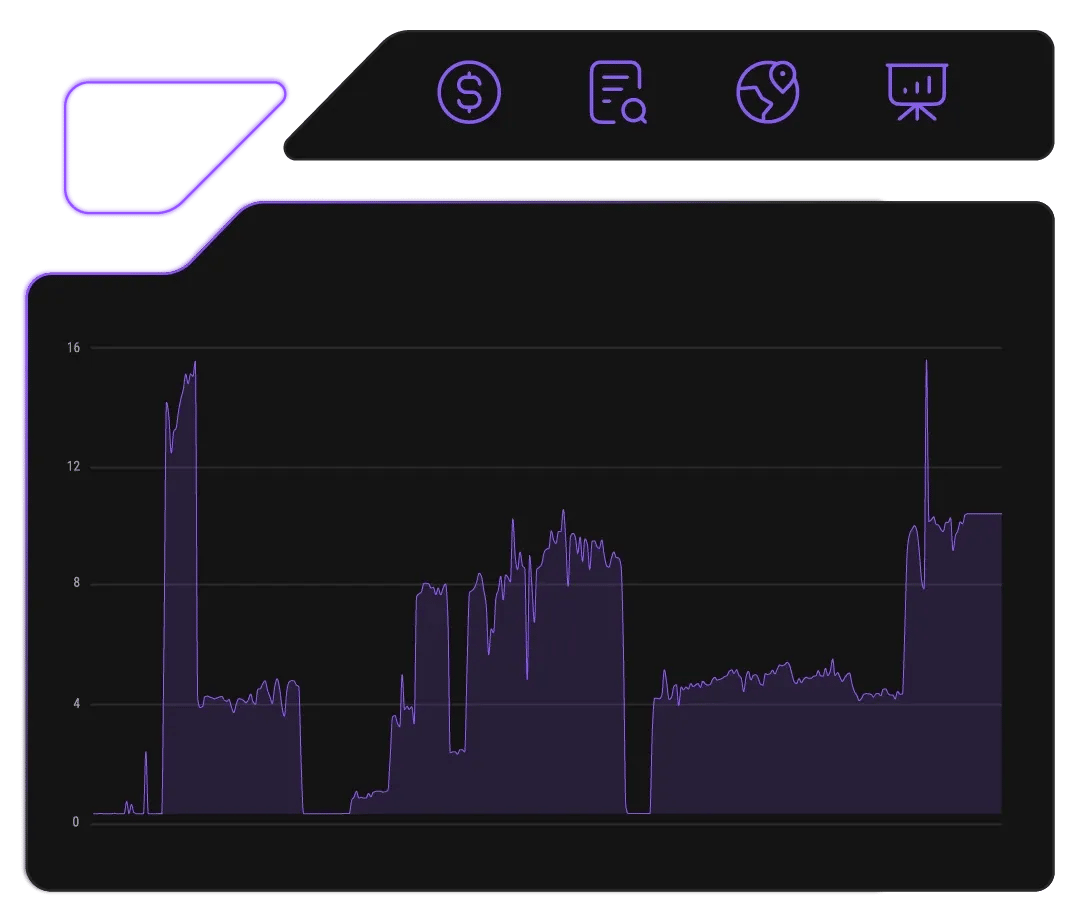
With a Google Jobs scraper API, you can extract valuable employment data from job listings and search results. This information can be used for job aggregation, recruitment analytics, labor market research, and hiring trend monitoring.
Here’s what data points you can extract:
- Job titles and role descriptions
- Employer names and company details
- Job locations and remote work indicators
- Job type (full-time, part-time, contract, internship)
- Application source and redirect URLs
- Required qualifications and experience
- Industry and category classifications
- Related job suggestions and similar postings
Why use Decodo's Google Jobs scraper instead of building your own?
Manual scraping
Decodo
Access model

Manual setup

Authentication token, instant access
Free tier
Not available
Up to 2K free requests included
Pricing
Infrastructure costs
Pay per successful request
JavaScript rendering
Manual setup required
Automatic
Anti-bot handling
Manual configuration
Built-in
Structured output
HTML
JSON, CSV, HTML, XHR, or Markdown
Maintenance
Your responsibility
Managed
Uptime
No guarantee
99.99%
What makes Decodo's Google Jobs scraper API different?

99.99% uptime
Dependable infrastructure that keeps job data collection running consistently.

125M+ ethically-sourced IPs
Decodo offers a vast proxy network with automatic IP rotation for reliable access to Google Jobs data.

195+ locations
Localized job listings from cities, regions, and countries around the world.

Pay per successful request
Costs apply only to successful requests – you won’t pay for what you don’t use.

Real-time extraction
Live job listings and salary data on every request.

Multiple output formats
JSON, CSV, HTML, XHR, PNG, and Markdown – ready for any downstream system.

100+ pre-built templates
Ready-made templates for Google searches and listing pages to accelerate deployment.

Integration-ready
Decodo’s Web Data API connects seamlessly with MCP, LangChain, n8n, OpenClaw, and custom workflows.

Free starter plan
Up to 2K requests to validate job data quality before committing.
What are the use cases for a Google Jobs scraper API?
How do I monitor job market trends and hiring demand by location?

Extract job listing volumes across roles, industries, and locations over time to identify hiring surges, regional demand patterns, and emerging skill requirements. Track which companies are actively recruiting in specific markets and correlate job posting frequency with sector growth signals for labor market intelligence reports.
How do I track competitor hiring activity and team growth?
Scrape Google Jobs results filtered by employer name to monitor which roles specific companies are posting, at what seniority levels, and in which locations. Identify strategic hiring shifts, team expansion directions, and new market entries before they appear in public reporting.
How do I build a job aggregation platform or a salary intelligence tool?
Collect structured job listing data, including titles, descriptions, salary ranges, and employer details from Google Jobs results at scale. Combine job listings from different sources, remove duplicates, and organize the data in a consistent format. This helps power job boards, salary insights tools, and career platforms. Decodo’s SERP Scraping API can be used to collect data from multiple job searches automatically.
How do I extract Google Jobs data for AI and machine learning models?
Google Jobs listing data – job titles, required skills, salary ranges, location attributes, and employer classifications – is well-suited for training job recommendation models, skills gap analysis tools, and salary prediction systems. Extract structured job datasets via the Web Data API for AI pipeline ingestion at scale.
How do I scrape Google Jobs listings across multiple countries?
Submit job search queries with location parameters targeting specific countries, cities, or regions. Decodo routes requests through residential IPs in 195+ locations, returning locally relevant results matching what users in that geography would see. Collect and compare job listings across multiple markets in a single workflow to build cross-regional labor market datasets.
How do you integrate the Google Jobs scraper API with Python, Node.js, or cURL?
See how easy it is to integrate the Google Jobs scraper API into your workflow using Python, Node.js, or cURL.
How do you get started with the Google Jobs scraper API?
Can I extract Google Jobs data without writing code?
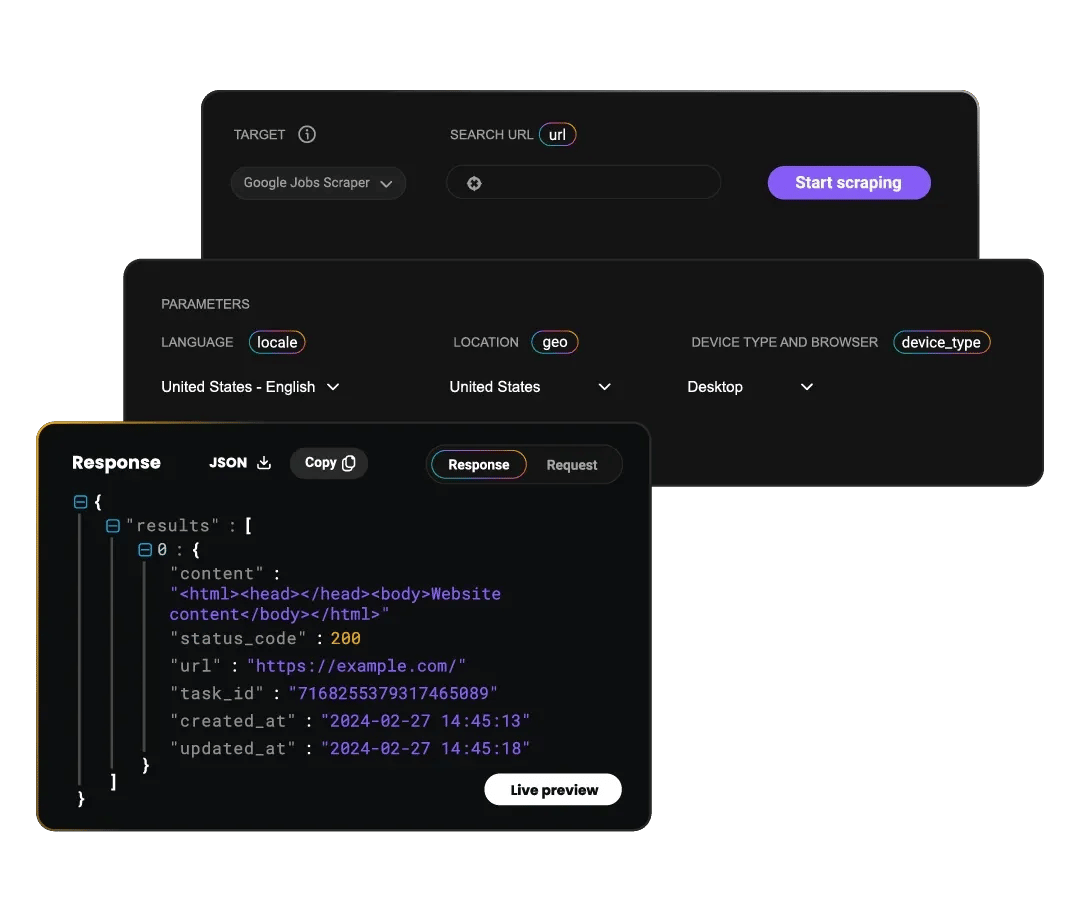
With Decodo’s Web Data API, you don’t need to write any code. Just enter your job search query and location, click extract, and download the results instantly in your preferred format (JSON, CSV, HTML, XHR, PNG, or Markdown).
How do I connect the Google Jobs scraper API to my data pipeline?
Start by obtaining an API key from the developer documentation, then make a POST request using your chosen Google Jobs search URL. The API returns structured results, and you can follow code samples in 8+ languages.
Is there a free trial for the Google Jobs scraper API?
Yes, Decodo offers a free starter plan. Get up to 2K free requests to test the data and verify extraction quality before choosing a paid plan. No credit card needed.

How is the Google Jobs scraper API priced?
You’ll only pay when data is successfully extracted. Decodo includes JavaScript rendering, rotating IPs, and all output formats in every request, with no additional setup required. You can start with up to 2K free requests each month and scale seamlessly.
What does Web Data API cost?
Choose a plan based on your data collection volume. All plans include the same powerful features – you only pay for what you use. Start with the free plan to test before committing.
See full pricing details in the documentation.
With each plan, you access:

JavaScript rendering
99.99% success rate
HTML, Markdown, XHR, plus JSON, CSV, PNG where supported
One-click AI integrations
LLM-ready Markdown format
100+ pre-built templates
Single API key for all endpoints
/scrape, /search, /map, /crawl
24/7 tech support
14-day money-back
SSL Secure Payment
Your information is protected by 256-bit SSL

What are people saying about Decodo?
We're proud to support a thriving community of 135K+ users and the industry’s best.

Attentive service
The professional expertise of the Decodo solution has significantly boosted our business growth while enhancing overall efficiency and effectiveness.
N
Novabeyond
Easy to get things done
Decodo provides great service with a simple setup and friendly support team.
R
RoiDynamic
A key to our work
Decodo enables us to develop and test applications in varied environments while supporting precise data collection for research and audience profiling.
C
Cybereg






Where can I learn more about scraping travel and hospitality data?
Most recent

JavaScript Web Scraping Tutorial (2026)
Ever wished you could make the web work for you? JavaScript web scraping allows you to gather valuable information from websites in an automated way, unlocking insights that would be difficult to collect manually. In this guide, you'll learn the key tools, techniques, and best practices to scrape data efficiently, whether you're a beginner or a developer looking to streamline data collection.

Zilvinas Tamulis
Last updated: Oct 12, 2026
13 min read
Most popular

How to Scrape Indeed for Job Data: A Comprehensive Guide
Indeed hosts millions of job listings across industries and locations, making it a valuable data source for analysts, recruiters, data engineers, and founders who need real-time job intelligence. Scraping job data is challenging because sites change and anti-bot defenses evolve. This guide walks you through a resilient, modern approach that works reliably today – and scales when you need it to.
Justinas Tamasevicius
Last updated: Sep 12, 2025
14 min read

The Ultimate Guide to Web Scraping Job Postings with Python in 2026
Since there are thousands of job postings scattered across different websites and platforms, it's nearly impossible to keep track of all the opportunities out there. Thankfully, with the power of web scraping and the versatility of Python, you can automate this tedious job search process and land your dream job faster than ever.
Vilius Sakutis
Last updated: Mar 31, 2026
5 min read
How to Scrape Google Search Data
Google search results are one of the essential ways to track rankings, ads, SERP features, and shifts in search intent at scale. The hard part is collecting that data reliably, because modern SERPs vary by query, location, device, and result type. In this guide, you'll learn 3 practical ways to scrape Google search results: lightweight extraction, a custom-built scraper, and a managed SERP API.
Dominykas Niaura
Last updated: Mar 30, 2026
5 min read

What Is SERP Analysis And How To Do It?
SERP (Search Engine Results Page) analysis involves examining search engine results for specific keywords to understand website rankings. It helps identify the content, format, and optimization strategies used by top-ranking pages and uncovers opportunities for improving rankings. In this blog post, we’re exploring what SERP analysis is, how to conduct it, and how it can help you.
James Keenan
Last updated: Feb 20, 2023
7 min read

Web Scraping at Scale Explained
Scraping projects usually start simple: a Python script, the Beautiful Soup parsing library, and a list of URLs. That's enough for small jobs. Once you're past a few hundred thousand pages, you start hitting problems: timeouts, IP bans, parsers returning empty fields because someone changed a div to a span. At that point, it's not a coding problem anymore, it's an infrastructure problem. This guide covers the architecture, proxy management, anti-bot evasion, pipelines, costs, compliance, where the industry is headed, and build vs. buy decisions.
Justinas Tamasevicius
Last updated: Feb 18, 2026
10 min read
Frequently asked questions
Does Google offer a free Jobs API for extracting listings?
Google doesn’t offer a public API for extracting job listings from Google Jobs search results. Google Cloud Talent Solution is a separate enterprise platform designed for embedding job search into company-owned products – it doesn’t provide access to google.com/jobs SERP data.
Decodo's Web Data API extracts publicly visible Google Jobs listings directly, and you can try it for free with up to 2K requests.
How much does a Google Jobs API cost?
No official Google Jobs SERP API exists with public pricing. Third-party SERP API providers charge per request at varying rates. Decodo's Google Jobs scraper API offers pay-per-request pricing with no minimum commitment – pricing details are on the pricing plans page.
How do I scrape Google Jobs results for a specific location?
Include the location in your Google Jobs search URL query string before submitting to Decodo’s Web Data API. For example, pass q=data+analyst+jobs+in+london with the Google Jobs SERP parameter (ibp=htl;jobs) to return location-filtered listing results.
Decodo routes requests through residential IPs matching the target region to return geographically relevant results.
How do I extract salary data from Google Jobs listings?
Target Google Jobs SERP pages containing salary estimate data. Google displays salary ranges on listings where the employer or third-party source provides this information. Each request returns available salary fields in the structured JSON output. Just keep in mind that salary visibility varies by listing and isn’t guaranteed on every job posting.
How do I scrape Google Jobs listings across multiple search queries?
Submit separate API requests for each search query and location combination you want to monitor. Results return in the same JSON schema for each query, enabling direct comparison across roles, markets, and time periods. Use webhook automation to receive new listing data automatically when running multiple queries.
How do I scrape Google Jobs and Indeed listings in the same workflow?
Use the same Decodo API credentials to scrape Google Jobs search results and Indeed job listings simultaneously. Both targets return structured output in compatible JSON schemas, enabling cross-platform job data comparison and deduplication in a single pipeline.
Start Extracting Google Jobs Listings Data Today
Start with up to 2K free requests and see how quickly you can turn Google Jobs listings into usable data.
14-day money-back option