Tumblr Scraper API
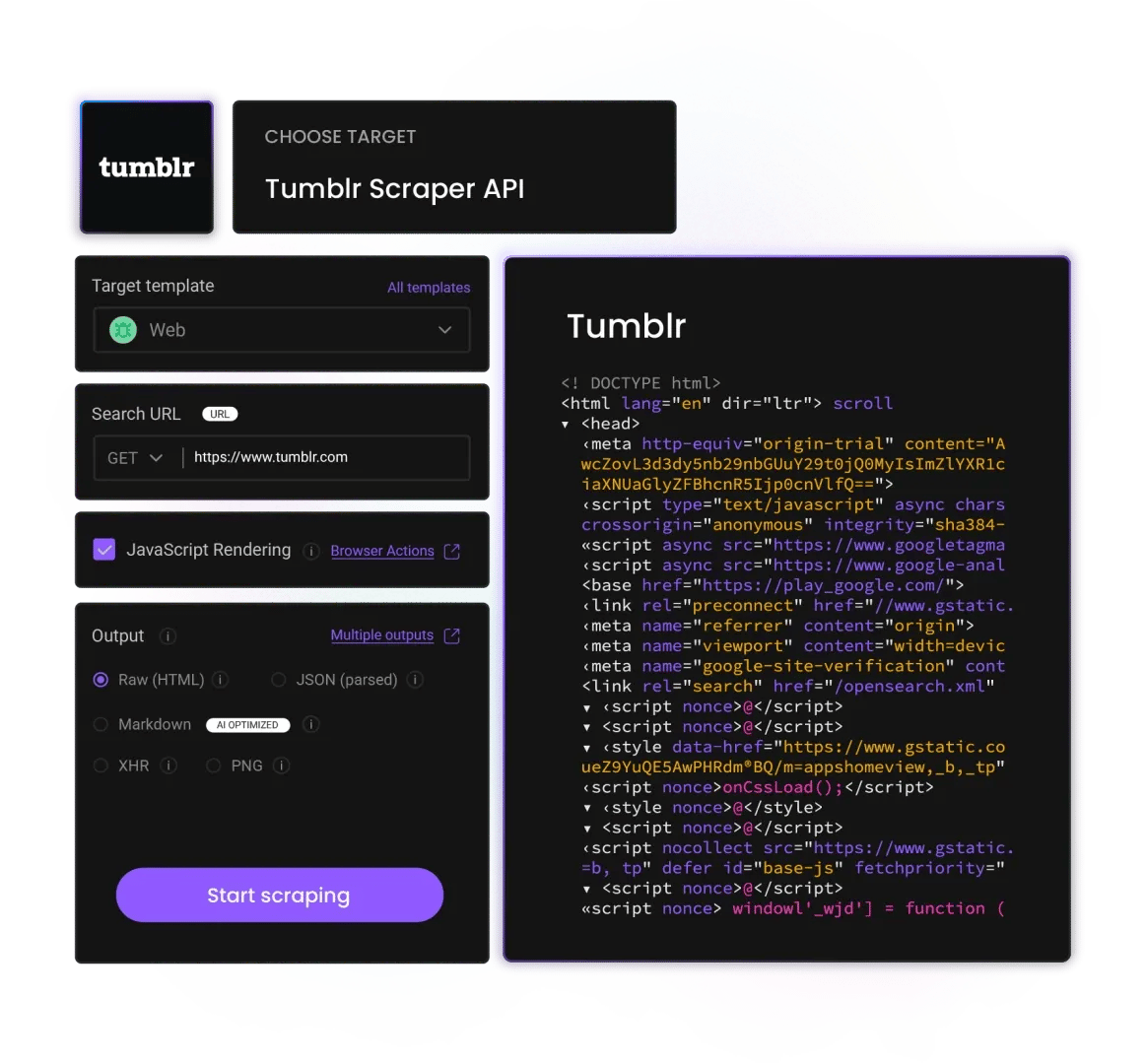
Trends surface on Tumblr while they're still just tags. A Tumblr scraper picks them up at that stage – ours collects public posts, tag pages, notes, and blog metadata at scale, with filtering hooks so adult-flagged material stays out of your dataset.
* This scraper is now a part of the Web Scraping API.
125M+
IPs worldwide
99.99%
success rate
200
requests per second
100+
ready-made templates
Free
starter plan
Be ahead of the Tumblr scraping game
What is Tumblr scraper API?
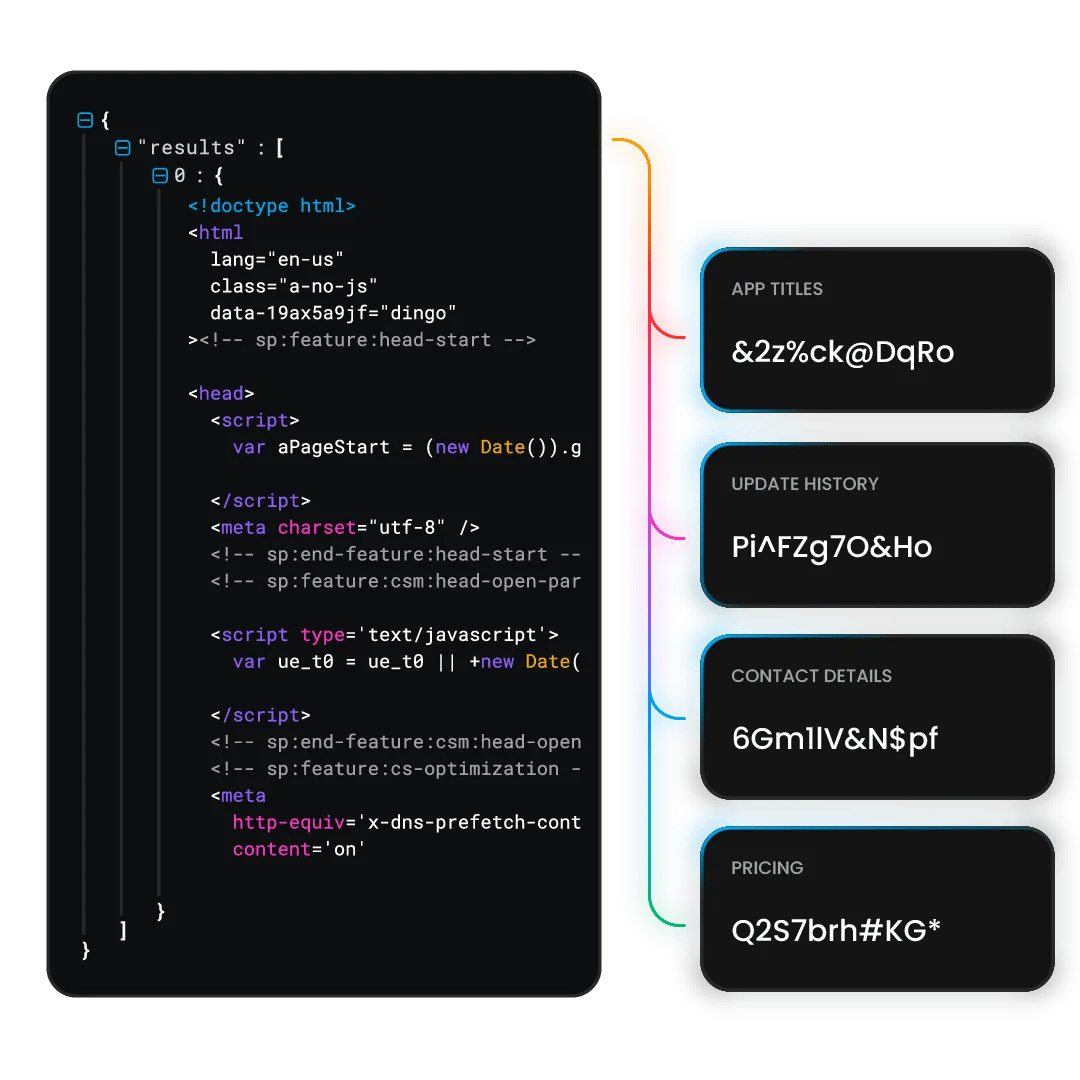
Tumblr scraper API reads the platform's public surface – tag pages, blog URLs, and search results – and returns:
- Post content, types, and timestamps
- Tags and tag-page result sets
- Note counts as an engagement signal
It also captures blog-level metadata such as titles, descriptions, and post cadence, which is where fandom analytics and trend research usually begin. Image-heavy dashboards and endless-scroll tag pages come back complete because the Web Scraping API underneath does the fetching and rendering.
Collect Tumblr data
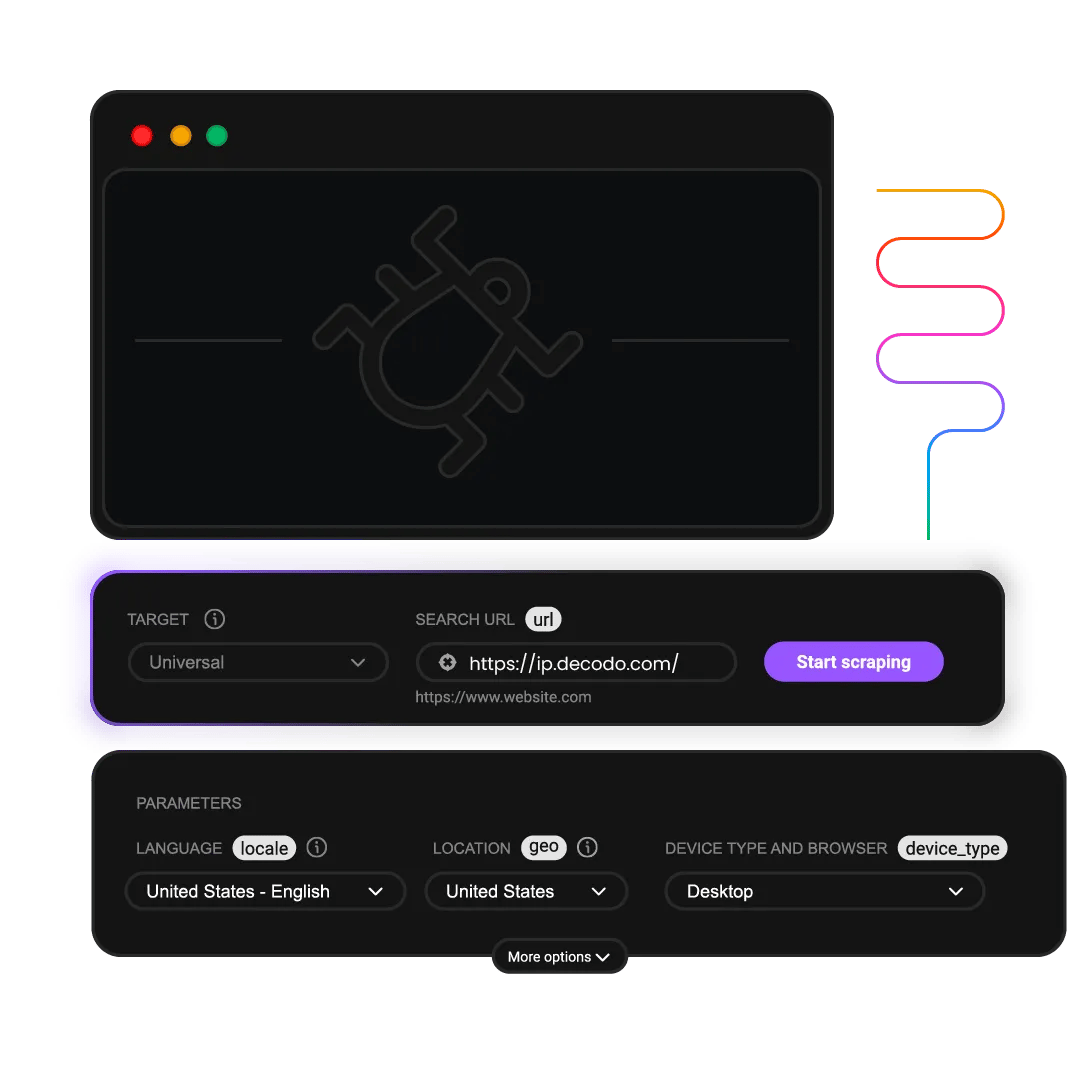
Tumblr's variety rewards per-request configuration, and that's the model here. JavaScript rendering toggles per URL – on for scripted dashboard views, off for fast static blog themes. Output is set per request too: HTML for archiving, JSON for analysis, PNG screenshots when a post's visual layout is the data. Content filtering is the one parameter worth planning around, since Tumblr flags adult material and most research datasets need it excluded. When a study spans several platforms, the Social Media Scraping API carries the same per-request model across them.

Built-in scraper
JavaScript rendering
Easy API integration
195+ geo-locations, including country-, state-, and city-level targeting
No CAPTCHAs or IP blocks
Scrape Tumblr with Python, Node.js, or cURL
Our Tumblr Scraper API supports all popular programming languages for smooth integration with your business tools.
Get more from the Tumblr scraper API
Scrape Tumblr using an API that handles JavaScript rendering and proxy integration for you, so you get the data you need without blocks or CAPTCHAs.

100% success rate
Pay for delivered Tumblr responses and nothing else – failures are our cost, not yours.

Advanced anti-bot bypass
Rotation and browser-grade fingerprints keep tag-page crawls from tripping platform rate limits.

Real-time or on-demand results
Watch a fast-moving tag in near real time, or archive a set of blogs on a weekly cycle.

125M+ proxy pool
Collect region-visible content through local IPs across 195+ geo-locations when geography shapes the feed.

JavaScript rendering
Endless-scroll tag pages and scripted post embeds render fully before capture.

Easy integration
Python, Node.js, and cURL snippets plus an API playground make the first Tumblr pull a short job.
What does Web Scraping API cost?
Choose a plan based on your scraping volume. All plans include the same powerful features – you only pay for what you use. Start with the free plan to test before committing.
Plan prices
+VAT / Billed monthly
Rate limit
All prices shown are per 1K req.
Plan price
$0
+VAT / Billed monthly
Request type
Price per 1k req.
2K req.
$0.50
1K req.
$0.75
1K req.
$1.00
667 req.
$1.50
Rate limit
10 req/s
Plan price
$19
+VAT / Billed monthly
Request type
Price per 1k req.
38K req.
$0.50
25K req.
$0.75
19K req.
$1.00
12K req.
$1.50
Rate limit
10 req/s
Plan price
$49
+VAT / Billed monthly
Request type
Price per 1k req.
163K req.
$0.30
75K req.
$0.65
54K req.
$0.90
39K req.
$1.25
Rate limit
25 req/s
Plan price
$99
+VAT / Billed monthly
Request type
Price per 1k req.
707K req.
$0.14
165K req.
$0.60
116K req.
$0.85
82K req.
$1.20
Rate limit
50 req/s
Need more?
Request type
Price per 1k req.
Custom
Custom
Custom
Custom
Rate limit
Custom
For low-security sites and simple access
For accessing guarded or sensitive pages
With each plan, you access:
99.99% success rate
Results in HTML, JSON, CSV, XHR or PNG
MCP server
JavaScript rendering
AI integrations
100+ pre-built templates
Supports search, pagination, and filtering
LLM-ready markdown format
24/7 tech support
14-day money-back
SSL Secure Payment
Your information is protected by 256-bit SSL

Why the scraping community chooses Decodo
135K+ developers, SEOs, and data teams rely on Decodo to collect public web data at scale – including from Tumblr. Whether you're shipping a side project or running production pipelines, our infrastructure is built to keep your Tumblr scraper running while you focus on what to do with the data.
Decodo
Manual data collection
Other APIs
125M+ residential, mobile, datacenter, and ISP proxies
Manage proxy rotation yourself
Limited proxy pools
Advanced browser fingerprinting
Build CAPTCHA solvers
Frequent CAPTCHA blocks
Only pay for successful requests
Handle retries manually
Pay for failed requests
100+ ready-made scraping templates
Maintenance overhead
Complex documentation
Data in JSON, CSV, HTML, and Markdown formats
Days to implement
Limited output formats
Why the scraping community chooses Decodo
135K+ developers, SEOs, and data teams rely on Decodo to collect public web data at scale – including from Tumblr. Ship a side project or run production pipelines – our infrastructure keeps your Tumblr scraper running while you focus on what to do with the data.

Attentive service
The professional expertise of the Decodo solution has significantly boosted our business growth while enhancing overall efficiency and effectiveness.
N
Novabeyond
Easy to get things done
Decodo provides great service with a simple setup and friendly support team.
R
RoiDynamic
A key to our work
Decodo enables us to develop and test applications in varied environments while supporting precise data collection for research and audience profiling.
C
Cybereg





Trusted by:


Decodo blog
Build knowledge on our solutions and improve your workflows with step-by-step guides, expert tips, and developer articles.
Most recent

AI Firms Are Destroying Rare Books for Training Data: Scraping Is the Alternative
Book scraping is the process of collecting public book data, such as titles, ratings, reviews, metadata, and available text, from online sources. It has taken on new relevance as AI companies buy and destructively scan physical books for training data. For material that already exists online, scraping offers a lower-friction, non-destructive way to collect some of the same kind of human-written data.

Justinas Tamasevicius
Last updated: Sep 14, 2026
8 min read
Most popular
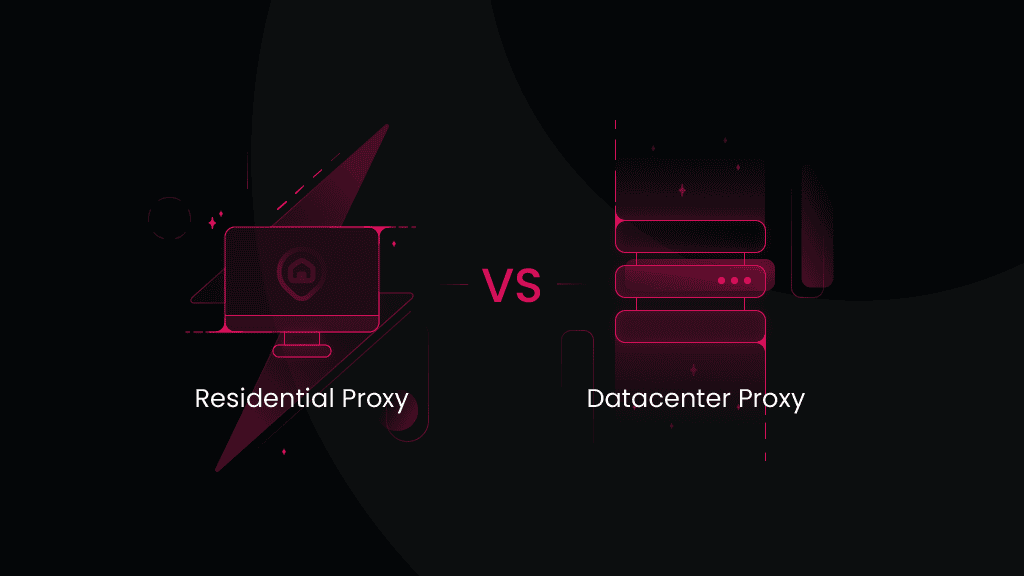
Residential vs. Datacenter Proxies: Which Should You Choose?
Residential and datacenter proxies both act as intermediaries that hide your real IP address, allowing you to access restricted websites and geo-blocked content. However, they differ in IP origin, stability, speed, and how websites perceive them. This residential vs. datacenter proxies guide breaks down their key differences.
Vilius Sakutis
Last updated: Sep 11, 2026
8 min read

Google Sheets Web Scraping: An Ultimate Guide for 2026
Google Sheets is a powerful data management tool, but few people know it can also pull data directly from the web without a single line of code. Using built-in import functions, you can scrape website content, parse tables, and pull live feeds straight into your spreadsheet. In this guide, you'll learn how to use IMPORTXML for XPath-based data extraction, IMPORTHTML for grabbing tables and lists, IMPORTFEED for RSS and Atom content, IMPORTDATA for CSV files, and IMPORTRANGE to link scraped data across spreadsheets. We'll also cover Google Apps Script for automation, common errors and how to fix them, and when to reach for a dedicated scraping tool instead.
Zilvinas Tamulis
Last updated: Mar 30, 2026
6 min read

Manage Your Business Reputation with SERP Scraping API
A widely available internet leaves the door open for people to find information about everything. For example, everyone can check a business's online presence before trusting it. So, everything that could be found online about your brand helps your potential audience evaluate if you’re legit.
Statistics only prove that – 9 out of 10 online shoppers admit that reviews influence their buying decisions. It stands to reason – checking unbiased opinions helps avoid low-value products and potential scams. And who wants that? So, for businesses analyzing their customers’ reviews becomes a not-to-miss-out factor.
However, reviews are just one part of the game. Brand reputation management consists of various elements that form the customers' perception of the company. If it’s still a gray area for you, this blog post could be your starting point.
Ella Moore
Last updated: Jun 20, 2022
7 min read
How to Scrape Google Without Getting Blocked
Nowadays, web scraping is essential for any business interested in gaining a competitive edge. It allows quick and efficient data extraction from a variety of sources and acts as an integral step toward advanced business and marketing strategies.
If done responsibly, web scraping rarely leads to any issues. But if you don’t follow data scraping best practices, you become more likely to get blocked. Thus, we’re here to share with you practical ways to avoid blocks while scraping Google.
James Keenan
Last updated: Feb 20, 2023
8 min read
What Is SERP Analysis And How To Do It?
SERP (Search Engine Results Page) analysis involves examining search engine results for specific keywords to understand website rankings. It helps identify the content, format, and optimization strategies used by top-ranking pages and uncovers opportunities for improving rankings. In this blog post, we’re exploring what SERP analysis is, how to conduct it, and how it can help you.
James Keenan
Last updated: Feb 20, 2023
7 min read
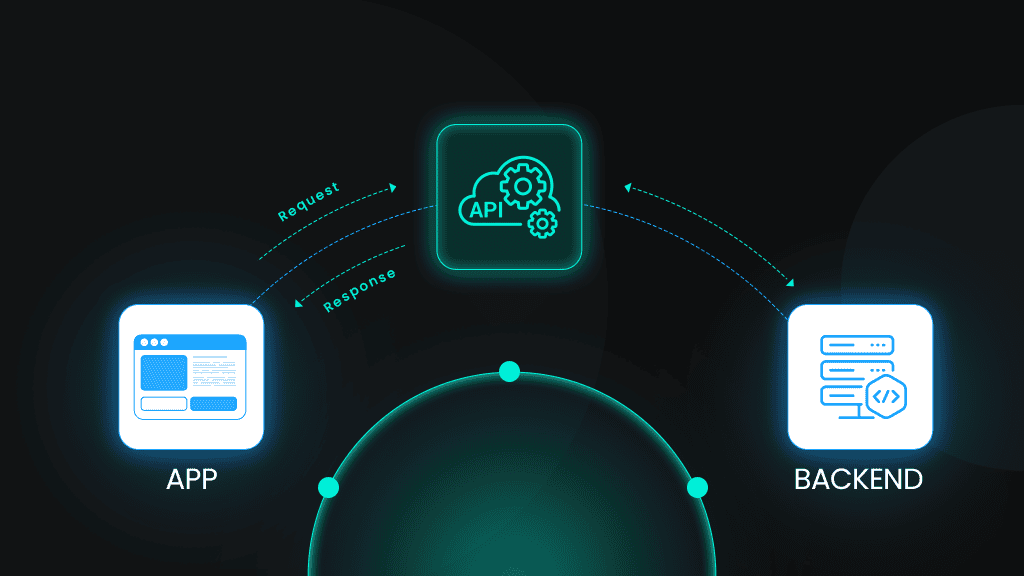
What is an API?
An application programming interface (API) works like a messenger. It allows different software systems to communicate without developers having to build custom links for every connection. For instance, one service might supply map data to a mobile app, while another handles payment processing for online transactions. In these times, that demands seamless integration, and APIs play a vital role. They automate tasks, enable large-scale data collection, and support sophisticated functions like web scraping and proxy management. By bridging diverse platforms and streamlining data exchange, they help businesses stay competitive and reduce the complexity of managing multiple, often inconsistent endpoints.
Kotryna Ragaišytė
Last updated: Mar 06, 2025
6 min read
How to Scrape Hotel Listings: Unlocking the Secrets
Scraping hotel listings is a powerful tool for gathering comprehensive data on accommodations, prices, and availability from various online sources. Whether you're looking to compare rates, analyze market trends, or create a personalized travel plan, scraping allows you to efficiently compile the information you need. In this article, we'll explain how to scrape hotel listings, ensuring you can leverage this data to its fullest potential.
Vilius Sakutis
Last updated: Nov 13, 2025
5 min read
What is Data Scraping? Definition and Best Techniques (2026)
The data scraping tools market is growing significantly, valued at approximately $875.46M in 2026. The market is projected to grow more due to the increasing demand for real-time data collection across various industries.
Vytautas Savickas
Last updated: Jan 30, 2026
6 min read
Web Crawling vs Web Scraping: What’s the Difference?
When it comes to gathering online data, two terms often create confusion: web crawling and web scraping. Although both involve extracting information from websites, they serve different purposes and employ distinct methods. In this article, we’ll break down these concepts, show you how they work, and help you decide which one suits your data extraction needs.
Justinas Tamasevicius
Last updated: Jul 01, 2025
7 min read
What Is Web Scraping? A Complete Guide to Its Uses and Best Practices
Web scraping is a powerful tool driving innovation across industries, and its full potential continues to unfold with each day. In this guide, we'll cover the fundamentals of web scraping – from basic concepts and techniques to practical applications and challenges. We’ll share best practices and explore emerging trends to help you stay ahead in this dynamic field.
Dominykas Niaura
Last updated: Jan 29, 2025
10 min read

Beautiful Soup Web Scraping: How to Parse Scraped HTML with Python
Web scraping with Python is a powerful technique for extracting valuable data from the web, enabling automation, analysis, and integration across various domains. Using libraries like Beautiful Soup and Requests, developers can efficiently parse HTML and XML documents, transforming unstructured web data into structured formats for further use. This guide explores essential tools and techniques to navigate the vast web and extract meaningful insights effortlessly.
Zilvinas Tamulis
Last updated: Mar 25, 2025
14 min read
Frequently asked questions
Is it legal to scrape Tumblr?
You own whatever ends up in your dataset. Broad collection from a platform like Tumblr can pull in material you never intended to hold. Filter at the point of collection rather than afterward. See what to know before you scrape.
How does the Tumblr scraper API bypass blocks and CAPTCHAs?
Tumblr's defenses are lighter than retail targets but real – rate limits, IP checks, and occasional JavaScript challenges. Requests rotate through the 125M+ pool with matched fingerprints and headers, and CAPTCHA handling covers the rare hard challenge. Long tag crawls run without babysitting.
What output formats does the Tumblr scraper API support?
Posts and tag pages can land as HTML, as structured JSON, or as PNG screenshots when visual layout matters – common for art-focused datasets. Markdown output suits text-analysis pipelines. Our guide on choosing reliable selectors for scraped pages helps if you parse custom blog themes yourself.
Can I geo-target Tumblr requests to a specific country or city?
Yes. The pool reaches 195+ geo-locations, city-level where supported. Tumblr content is mostly globally uniform, but regional trend research – which tags move in which markets – benefits from collecting through local exits for authenticity.
How fast is the Tumblr scraper API and can it handle large-scale jobs?
Tag archives run to millions of posts, and the API paces through them with parallel requests bounded by your plan. Individual fetches typically return in a couple of seconds. Scheduled recurring pulls keep longitudinal studies topped up without manual runs.
Can I try the Tumblr scraper API for free?
It's free to begin – activate the free starter plan in your dashboard with no credit card required, and up to 2K requests cover several tags' worth of sampling to confirm the filtering behavior fits your dataset rules.
Tumblr Scraper API for Your Data Needs
Gain access to real-time data at any scale without worrying about proxy setup or blocks.
14-day money-back option