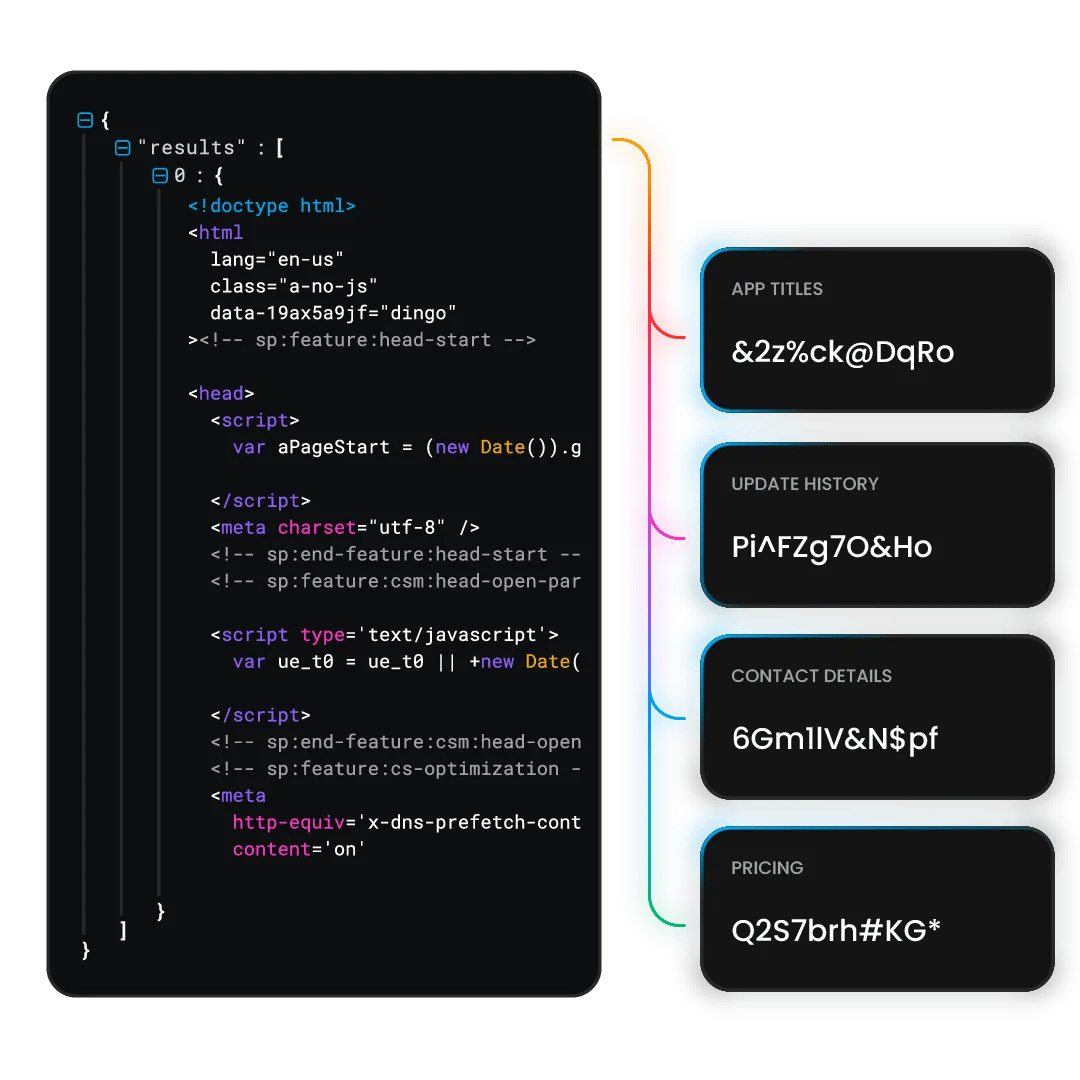
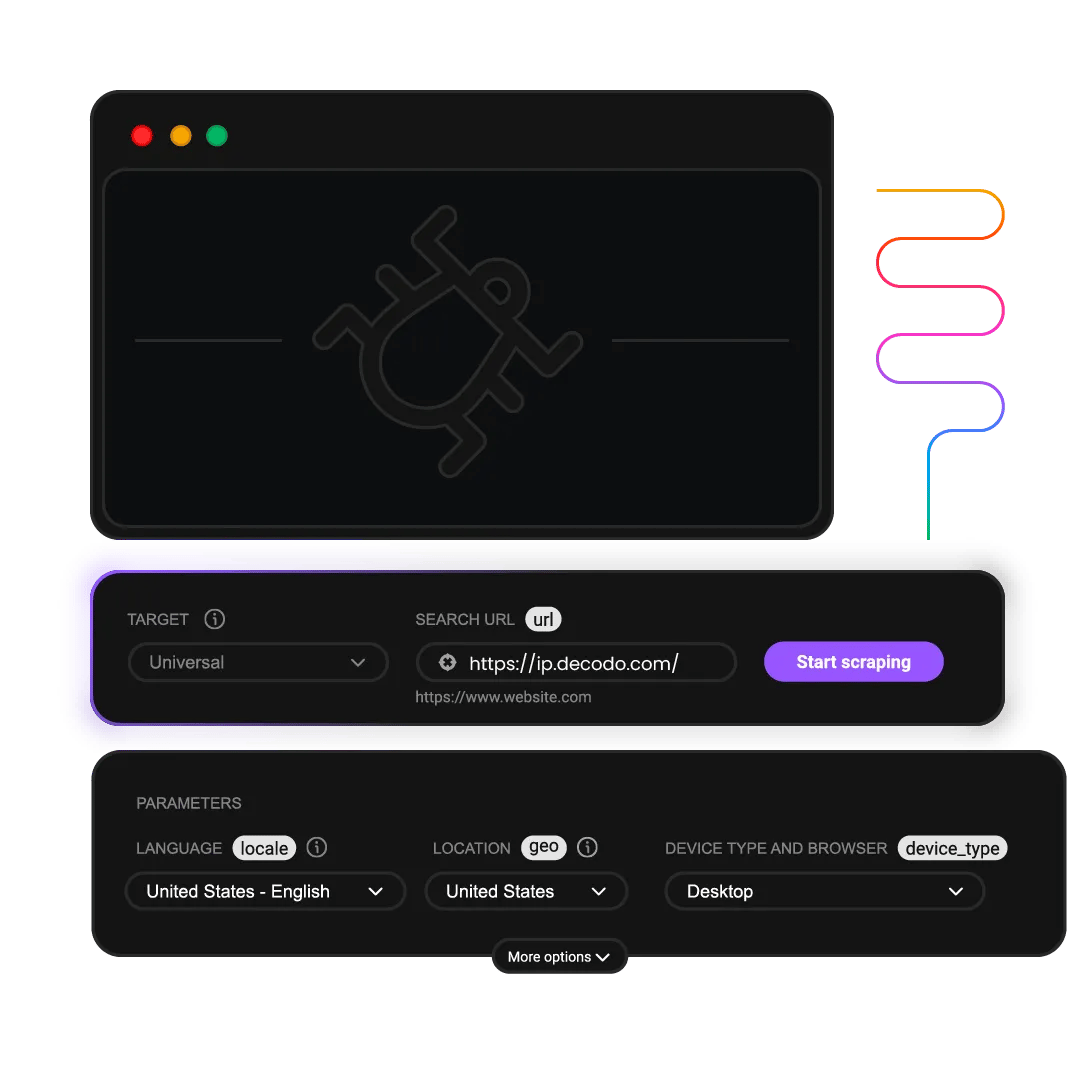
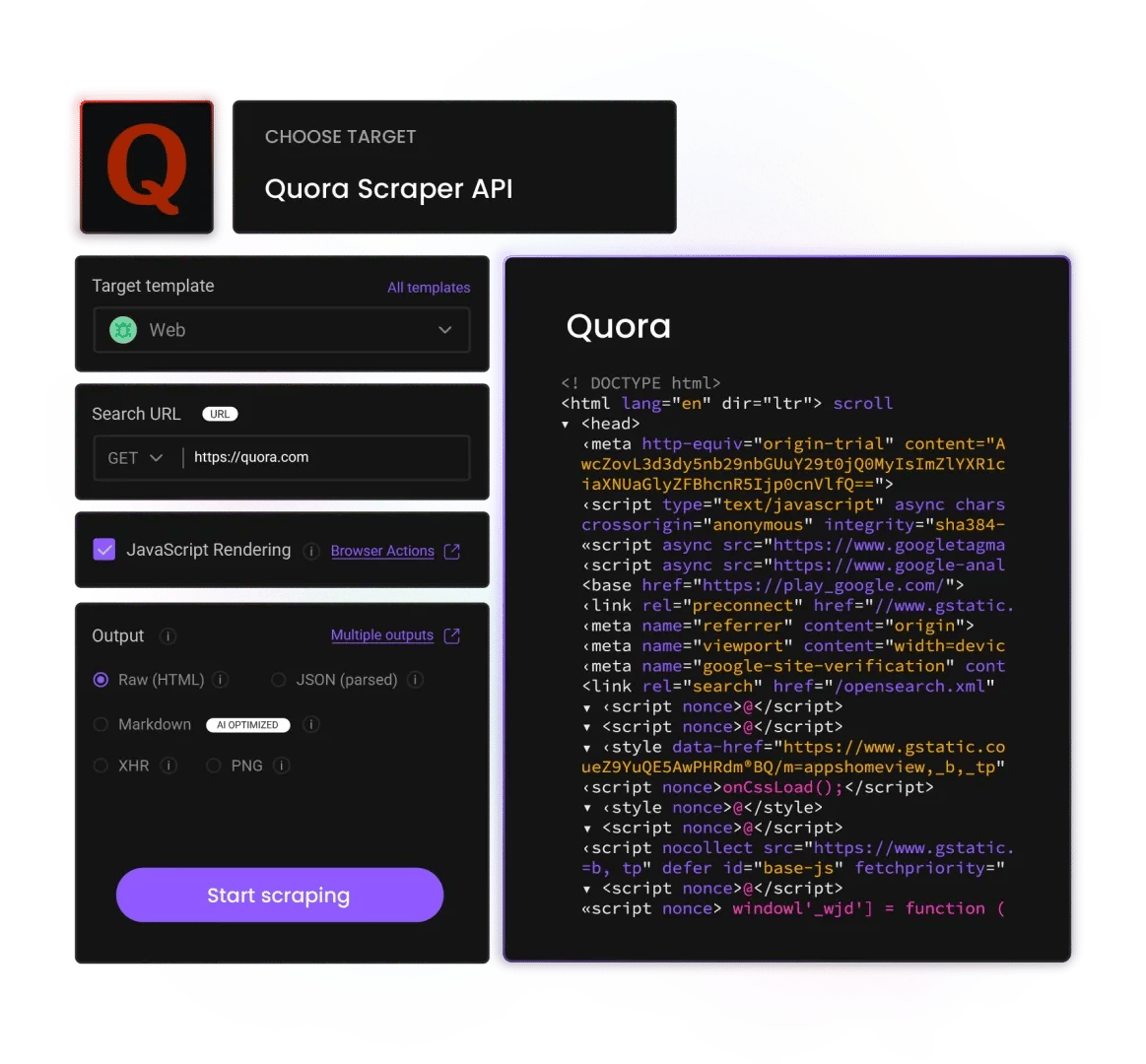
Anyone hunting for a Quora API finds nothing public to build on, while the platform holds one of the web's largest question-and-answer corpora. Our scraper API collects questions, answers, topics, and engagement signals from Quora's public pages – the part visible before the login wall – in formats built for analysis and AI pipelines.
* This scraper is now a part of the Web Scraping API.
125M+
IPs worldwide
99.99%
success rate
200
requests per second
100+
ready-made templates
Free
starter plan

Honesty first: Quora gates most of its depth behind a login wall after a few scrolls, so the collectable surface is the public one – question pages, top answers, and topic feeds as an anonymous visitor sees them. Within that boundary, the scraper returns:
That public slice is still enormous, and for intent research, SEO content mining, and LLM training corpora it's the slice that matters – the working substitute for the Quora API that doesn't exist. The Reddit scraper API covers the sibling discussion platform with the same request pattern.

Quora data mostly feeds language pipelines, so output format is the design decision. The Social Media Scraping API returns question pages as HTML or JSON, and Markdown output turns threads into clean text blocks that drop into RAG stores and training sets without a stripping pass. Rendering executes the client-side feed, rotation keeps anonymous access anonymous, and the login wall is respected rather than fought – sustainable collection beats a bigger corpus that breaks next month.
Built-in scraper
JavaScript rendering
Easy API integration
195+ geo-locations, including country-, state-, and city-level targeting
No CAPTCHAs or IP blocks
Our Quora Scraper API supports all popular programming languages for smooth integration with your business tools.
Scrape Quora using an API that handles JavaScript rendering and proxy integration for you, so you get the data you need without blocks or CAPTCHAs.
100% success rate
Pages that hit the login wall instead of content don't bill – you pay for delivered Q&A only.
Advanced anti-bot bypass
Quora watches session behavior closely – fresh rotating identities keep collection sessions from linking together.
Real-time or on-demand results
Pull one question thread for a client report now, or harvest a topic's public archive overnight.
125M+ proxy pool
Answer visibility is largely global, but topic feeds shift by region – local exits reveal the differences.
JavaScript rendering
Answer feeds assemble client-side as you scroll – rendering captures the initial visible set reliably.
Easy integration
Topic and question URLs work as-is – no session cookies or auth tokens to manage.
Choose a plan based on your scraping volume. All plans include the same powerful features – you only pay for what you use. Start with the free plan to test before committing.
Plan prices
+VAT / Billed monthly
Rate limit
All prices shown are per 1K req.
Plan price
$0
+VAT / Billed monthly
Request type
Price per 1k req.
2K req.
$0.50
1K req.
$0.75
1K req.
$1.00
667 req.
$1.50
Rate limit
10 req/s
Plan price
$19
+VAT / Billed monthly
Request type
Price per 1k req.
38K req.
$0.50
25K req.
$0.75
19K req.
$1.00
12K req.
$1.50
Rate limit
10 req/s
Plan price
$49
+VAT / Billed monthly
Request type
Price per 1k req.
163K req.
$0.30
75K req.
$0.65
54K req.
$0.90
39K req.
$1.25
Rate limit
25 req/s
Plan price
$99
+VAT / Billed monthly
Request type
Price per 1k req.
707K req.
$0.14
165K req.
$0.60
116K req.
$0.85
82K req.
$1.20
Rate limit
50 req/s
Need more?
Request type
Price per 1k req.
Custom
Custom
Custom
Custom
Rate limit
Custom
For low-security sites and simple access
For accessing guarded or sensitive pages
With each plan, you access:
99.99% success rate
Results in HTML, JSON, CSV, XHR or PNG
MCP server
JavaScript rendering
AI integrations
100+ pre-built templates
Supports search, pagination, and filtering
LLM-ready markdown format
24/7 tech support
14-day money-back
SSL Secure Payment
Your information is protected by 256-bit SSL
135K+ developers, SEOs, and data teams rely on Decodo to collect public web data at scale – including from Quora. Whether you're shipping a side project or running production pipelines, our infrastructure is built to keep your Quora scraper running while you focus on what to do with the data.
Decodo
Manual data collection
Other APIs
125M+ residential, mobile, datacenter, and ISP proxies
Manage proxy rotation yourself
Limited proxy pools
Advanced browser fingerprinting
Build CAPTCHA solvers
Frequent CAPTCHA blocks
Only pay for successful requests
Handle retries manually
Pay for failed requests
100+ ready-made scraping templates
Maintenance overhead
Complex documentation
Data in JSON, CSV, HTML, and Markdown formats
Days to implement
Limited output formats
135K+ developers, SEOs, and data teams rely on Decodo to collect public web data at scale – including from Quora. Ship a side project or run production pipelines – our infrastructure keeps your Quora scraper running while you focus on what to do with the data.
Attentive service
The professional expertise of the Decodo solution has significantly boosted our business growth while enhancing overall efficiency and effectiveness.
N
Novabeyond
Easy to get things done
Decodo provides great service with a simple setup and friendly support team.
R
RoiDynamic
A key to our work
Decodo enables us to develop and test applications in varied environments while supporting precise data collection for research and audience profiling.
C
Cybereg
Trusted by:
Build knowledge on our solutions and improve your workflows with step-by-step guides, expert tips, and developer articles.
Most recent

IPv4 vs. IPv6: Key Differences and Which One to Use
Understanding IPv4 vs. IPv6 is essential as the internet's aging infrastructure strains and legacy IPv4 runs out of room. IPv6 steps in as the long-term solution, offering a virtually limitless address space, built-in security, and efficient routing. This article explores their key differences, core benefits, and the practical challenges of transitioning.
Justinas Tamasevicius
Last updated: Sep 25, 2026
8 min read
Training a model is a separate question from analyzing data. Text gathered from Quora or anywhere else raises different issues once it becomes training material. Settle that use case on its own terms. Our scraping, AI, and the law covers the distinction.
The platform combines rate limiting, behavioral analysis, and an aggressive login wall. The scraper works the public surface with rotating residential, mobile, ISP, and datacenter exits, coherent browser fingerprints, and retries on challenges – and treats the wall itself as a boundary, not a puzzle. That posture is what keeps collection stable over months.
Threads return as HTML, as parsed JSON, or as Markdown – the last one built for LLM workflows, where a question plus its answers becomes one clean text unit. For extraction beyond the standard fields, the AI Parser pulls structured data from answer text with a prompt instead of a selector.
Yes – exits in 195+ geo-locations are available, and on Quora they're most useful for comparing topic-feed composition across regions and checking language-specific question surfaces. Core answer content stays fairly uniform globally, so most corpus jobs run fine from a handful of regions.
Harvesting a large topic's public archive is a weekend-scale job, not a month-scale one. Concurrency tracks your plan tier, responses come back in seconds, and scheduled incremental pulls keep a corpus fresh once the backfill lands. Rate discipline is built in – speed never comes at the cost of tomorrow's access.
Yes. The free starter plan is card-free and includes up to 2K requests – enough for a pilot corpus from a topic or two, and a check on text quality before scaling.
Gain access to real-time data at any scale without worrying about proxy setup or blocks.
14-day money-back option