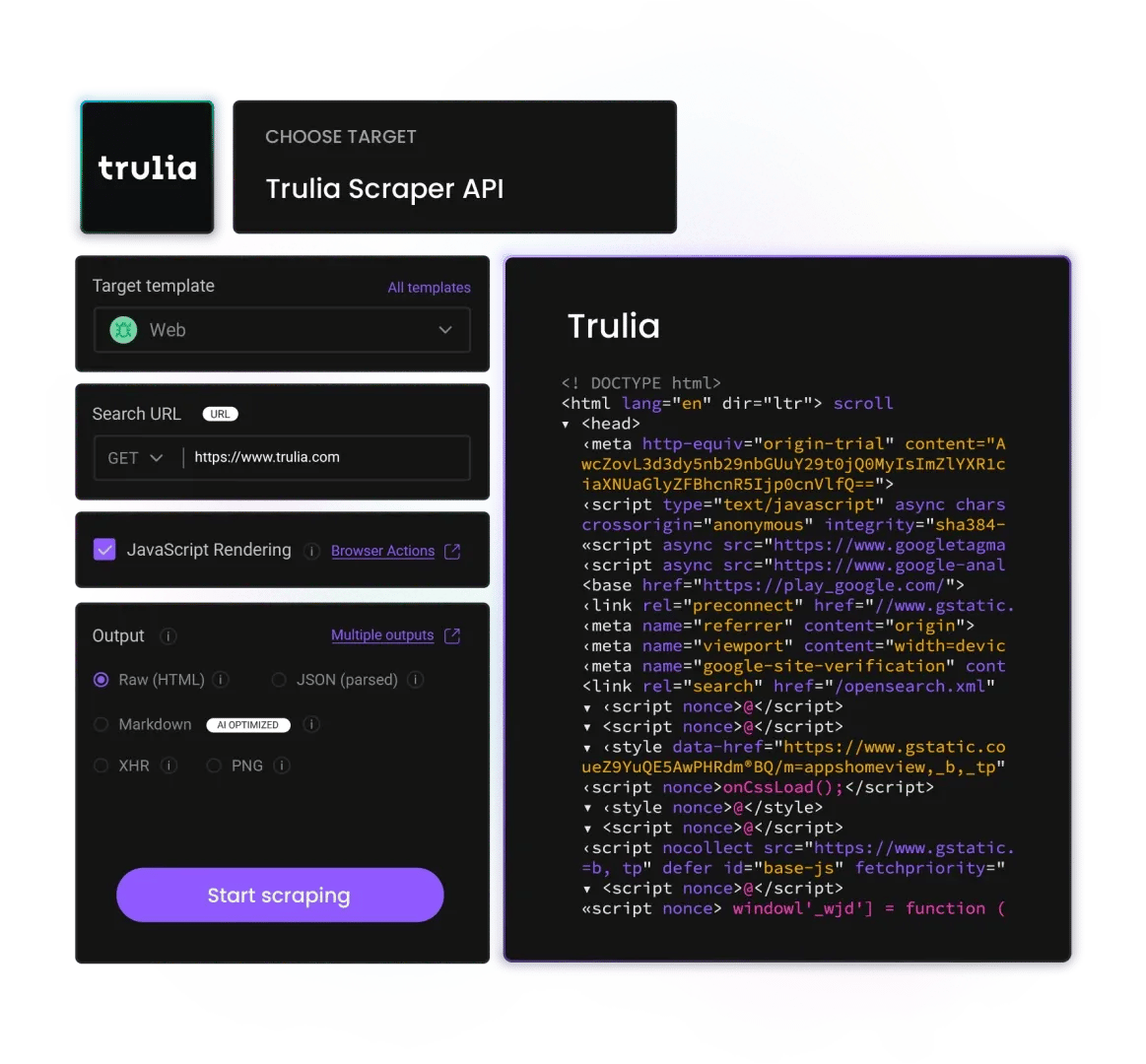
Trulia's neighborhood-first take on real estate has no public Trulia API behind it. Our scraper API collects what makes the site distinct – listings alongside crime maps, school ratings, and commute data – from public pages, giving proptech teams the local-context layer other portals don't surface.
* This scraper is now a part of the Web Scraping API.
125M+
IPs worldwide
99.99%
success rate
200
requests per second
100+
ready-made templates
Free
starter plan

Trulia scraper API covers two data layers, and the second is the differentiator:
With no public Trulia API on any roadmap, the pages carry the load. Zillow owns Trulia, and the Zillow scraper API covers the parent's larger inventory – but Trulia's neighborhood context is packaged differently, and for buyer-experience products that context is the product. Investors also cross-check both portals' estimates on the same address as a spread signal.
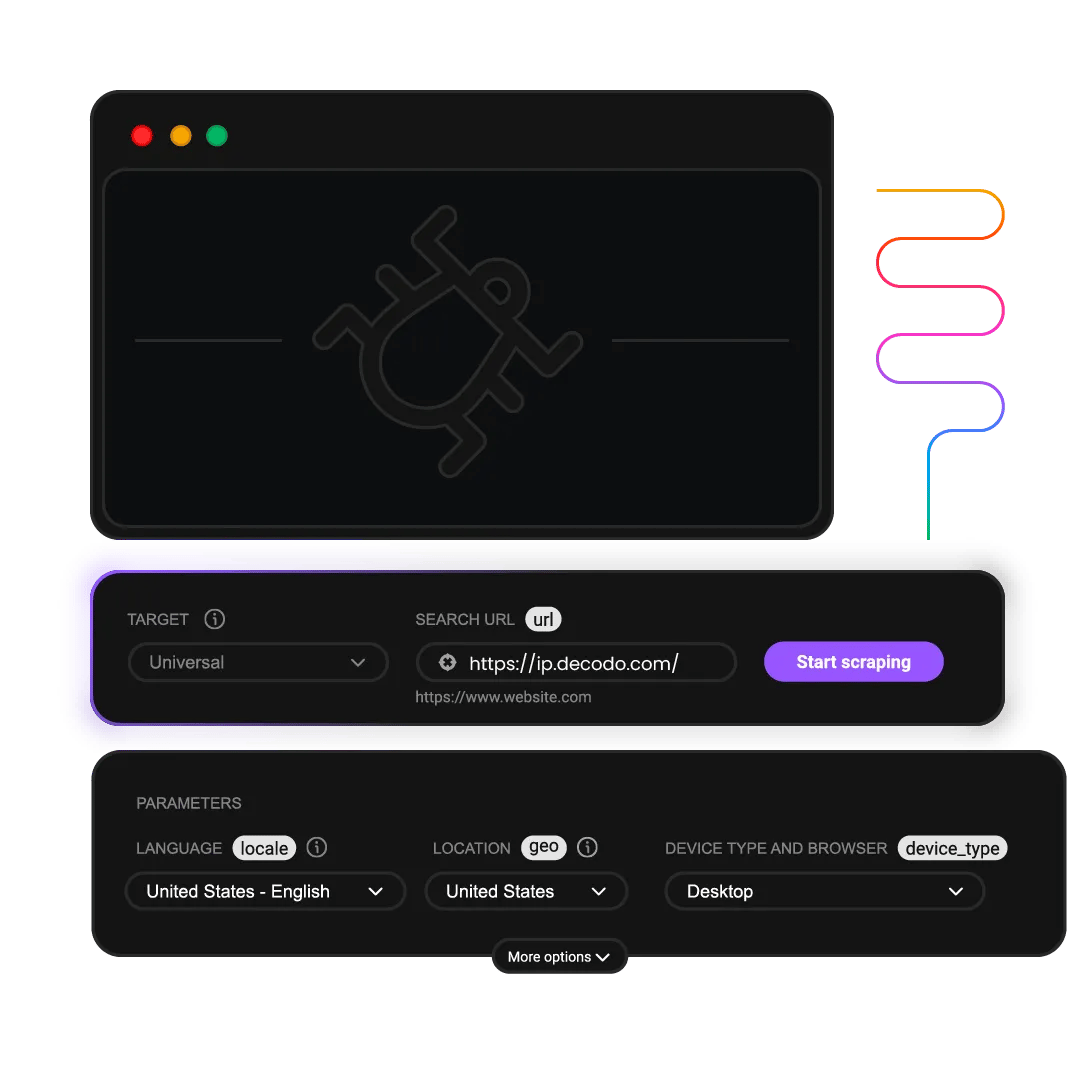
Collection here is neighborhood-shaped, mirroring the site's own structure. The Web Scraping API walks city and neighborhood URLs (the /CA/Los_Angeles/ pattern), returning listing grids and area pages as parsed records, with rendering capturing the map-side data that loads dynamically. A Zillow-owned property means ToS sensitivity worth respecting – measured sampling rates and monitoring-scale collection, not firehose crawls, is both the sustainable and the defensible design.
Built-in scraper
JavaScript rendering
Easy API integration
195+ geo-locations, including country-, state-, and city-level targeting
No CAPTCHAs or IP blocks
Our Trulia Scraper API supports all popular programming languages for smooth integration with your business tools.
Scrape Trulia using an API that handles JavaScript rendering and proxy integration for you, so you get the data you need without blocks or CAPTCHAs.
100% success rate
Listing and neighborhood pages bill on delivery – blocked requests retry without charge.
Advanced anti-bot bypass
Zillow-family properties share serious detection infrastructure – identity coherence and rotation are table stakes.
Real-time or on-demand results
Pull one neighborhood's fresh listings before a client tour, or refresh metro-wide inventory nightly.
125M+ proxy pool
Real estate is local by definition – region-matched exits keep each metro's results unfiltered.
JavaScript rendering
Map panes and school-score widgets hydrate client-side – rendering returns the full context layer.
Easy integration
City and neighborhood URLs follow a readable /state/city pattern – coverage lists write themselves.
Choose a plan based on your scraping volume. All plans include the same powerful features – you only pay for what you use. Start with the free plan to test before committing.
Plan prices
+VAT / Billed monthly
Rate limit
All prices shown are per 1K req.
Plan price
$0
+VAT / Billed monthly
Request type
Price per 1k req.
2K req.
$0.50
1K req.
$0.75
1K req.
$1.00
667 req.
$1.50
Rate limit
10 req/s
Plan price
$19
+VAT / Billed monthly
Request type
Price per 1k req.
38K req.
$0.50
25K req.
$0.75
19K req.
$1.00
12K req.
$1.50
Rate limit
10 req/s
Plan price
$49
+VAT / Billed monthly
Request type
Price per 1k req.
163K req.
$0.30
75K req.
$0.65
54K req.
$0.90
39K req.
$1.25
Rate limit
25 req/s
Plan price
$99
+VAT / Billed monthly
Request type
Price per 1k req.
707K req.
$0.14
165K req.
$0.60
116K req.
$0.85
82K req.
$1.20
Rate limit
50 req/s
Need more?
Request type
Price per 1k req.
Custom
Custom
Custom
Custom
Rate limit
Custom
For low-security sites and simple access
For accessing guarded or sensitive pages
With each plan, you access:
99.99% success rate
Results in HTML, JSON, CSV, XHR or PNG
MCP server
JavaScript rendering
AI integrations
100+ pre-built templates
Supports search, pagination, and filtering
LLM-ready markdown format
24/7 tech support
14-day money-back
SSL Secure Payment
Your information is protected by 256-bit SSL
135K+ developers, SEOs, and data teams rely on Decodo to collect public web data at scale – including from Trulia. Whether you're shipping a side project or running production pipelines, our infrastructure is built to keep your Trulia scraper running while you focus on what to do with the data.
Decodo
Manual data collection
Other APIs
125M+ residential, mobile, datacenter, and ISP proxies
Manage proxy rotation yourself
Limited proxy pools
Advanced browser fingerprinting
Build CAPTCHA solvers
Frequent CAPTCHA blocks
Only pay for successful requests
Handle retries manually
Pay for failed requests
100+ ready-made scraping templates
Maintenance overhead
Complex documentation
Data in JSON, CSV, HTML, and Markdown formats
Days to implement
Limited output formats
135K+ developers, SEOs, and data teams rely on Decodo to collect public web data at scale – including from Trulia. Ship a side project or run production pipelines – our infrastructure keeps your Trulia scraper running while you focus on what to do with the data.
Attentive service
The professional expertise of the Decodo solution has significantly boosted our business growth while enhancing overall efficiency and effectiveness.
N
Novabeyond
Easy to get things done
Decodo provides great service with a simple setup and friendly support team.
R
RoiDynamic
A key to our work
Decodo enables us to develop and test applications in varied environments while supporting precise data collection for research and audience profiling.
C
Cybereg
Trusted by:
Build knowledge on our solutions and improve your workflows with step-by-step guides, expert tips, and developer articles.
Most recent

IPv4 vs. IPv6: Key Differences and Which One to Use
Understanding IPv4 vs. IPv6 is essential as the internet's aging infrastructure strains and legacy IPv4 runs out of room. IPv6 steps in as the long-term solution, offering a virtually limitless address space, built-in security, and efficient routing. This article explores their key differences, core benefits, and the practical challenges of transitioning.
Justinas Tamasevicius
Last updated: Sep 25, 2026
8 min read
Some categories have been argued over for years. Where that's true, as with property portals like Trulia, expectations tend to be better defined and tighter. Read the category, not just the page. Our case history behind scraping law sets it out.
Expect the Zillow family's shared detection stack – behavioral analysis, fingerprint checks, and rate enforcement beyond a typical portal. Requests carry full browser coherence, rotate across residential-weighted exits, and retry automatically, at sampling rates deliberately tuned below attention thresholds. Restraint is part of the technique here.
Listing and neighborhood pages produce HTML, or parsed JSON holding price, property, and area-score fields. CSV export fits comp-sheet workflows. The broader real estate scraping toolkit applies the same output structure across portal targets.
Yes – exits across 195+ geo-locations, with US city-level matching doing the real work on this target. Regional exits keep any geo-dependent listing behavior aligned with the metro you're collecting, which matters most for rental availability and area-page content.
Nightly refreshes of a few metros' inventory sit well within normal usage – with pacing intentionally conservative for this target's ToS posture. Concurrency scales when a backfill demands it, and scheduling keeps the steady drumbeat that monitoring-scale collection should look like.
Yes, no credit card required – the free starter plan holds up to 2K requests, with room to collect one neighborhood's listings plus context data and evaluate the field coverage properly.
Gain access to real-time data at any scale without worrying about proxy setup or blocks.
14-day money-back option