WatchCharts turned secondary-market watch prices into indexes, then put its WatchCharts API behind enterprise pricing. Our scraper API reads the public layer instead – model price estimates, market indexes, and trend charts for Rolex, Omega, and every tracked brand – at a cost that fits research budgets.
* This scraper is now a part of the Web Scraping API.
125M+
IPs worldwide
99.99%
success rate
200
requests per second
100+
ready-made templates
Free
starter plan

WatchCharts is the market-data layer of the watch world. The paid WatchCharts API serves enterprises – the public pages carry most of the same signals for everyone else:
Index level
- Brand and overall market indexes with trend direction
Model level
The Rolex use case leads – reference-level price tracking for the market's most liquid brand – but the same collection covers Omega, Patek, and the long tail. Dealers sanity-check purchase prices against the index, funds treat watch indexes as alternative-asset data, and platforms refresh valuation widgets from the same series.

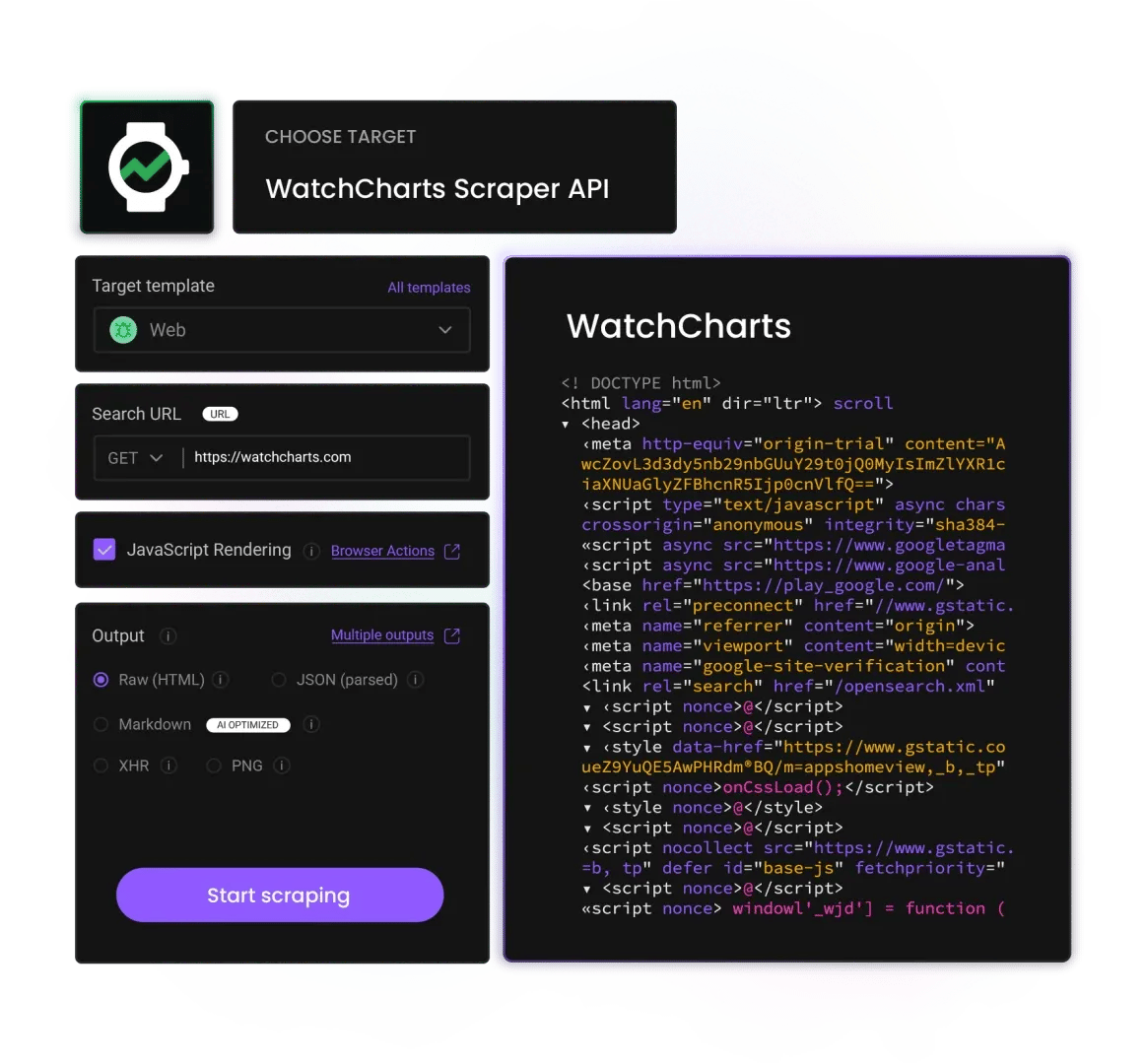
Index data earns value through unbroken sampling, so the design centers on schedule discipline. The Web Scraping API collects brand and model pages at fixed intervals, and because WatchCharts runs light defenses, datacenter proxies keep per-observation costs low – the economical choice when a target doesn't demand residential-grade identity. Chart data that loads via background requests is caught through XHR capture, turning rendered trend lines back into numbers.
Built-in scraper
JavaScript rendering
Easy API integration
195+ geo-locations, including country-, state-, and city-level targeting
No CAPTCHAs or IP blocks
Our WatchCharts Scraper API supports all popular programming languages for smooth integration with your business tools.
Scrape WatchCharts using an API that handles JavaScript rendering and proxy integration for you, so you get the data you need without blocks or CAPTCHAs.
100% success rate
Each successful observation bills once – misses retry free, keeping series costs predictable.
Advanced anti-bot bypass
Defenses here are light – sensible pacing and basic rotation keep daily index sampling frictionless.
Real-time or on-demand results
Pull one reference's estimate before a purchase call, or sample every tracked brand index daily.
125M+ proxy pool
Watch prices trade globally, but regional listing mixes differ – varied exits expose the spread.
JavaScript rendering
Trend charts draw client-side from background data – rendering plus XHR capture recovers the numbers.
Easy integration
Brand and model URLs are clean and hierarchical – a full coverage list writes itself.
Choose a plan based on your scraping volume. All plans include the same powerful features – you only pay for what you use. Start with the free plan to test before committing.
Plan prices
+VAT / Billed monthly
Rate limit
All prices shown are per 1K req.
Plan price
$0
+VAT / Billed monthly
Request type
Price per 1k req.
2K req.
$0.50
1K req.
$0.75
1K req.
$1.00
667 req.
$1.50
Rate limit
10 req/s
Plan price
$19
+VAT / Billed monthly
Request type
Price per 1k req.
38K req.
$0.50
25K req.
$0.75
19K req.
$1.00
12K req.
$1.50
Rate limit
10 req/s
Plan price
$49
+VAT / Billed monthly
Request type
Price per 1k req.
163K req.
$0.30
75K req.
$0.65
54K req.
$0.90
39K req.
$1.25
Rate limit
25 req/s
Plan price
$99
+VAT / Billed monthly
Request type
Price per 1k req.
707K req.
$0.14
165K req.
$0.60
116K req.
$0.85
82K req.
$1.20
Rate limit
50 req/s
Need more?
Request type
Price per 1k req.
Custom
Custom
Custom
Custom
Rate limit
Custom
For low-security sites and simple access
For accessing guarded or sensitive pages
With each plan, you access:
99.99% success rate
Results in HTML, JSON, CSV, XHR or PNG
MCP server
JavaScript rendering
AI integrations
100+ pre-built templates
Supports search, pagination, and filtering
LLM-ready markdown format
24/7 tech support
14-day money-back
SSL Secure Payment
Your information is protected by 256-bit SSL
135K+ developers, SEOs, and data teams rely on Decodo to collect public web data at scale – including from WatchCharts. Whether you're shipping a side project or running production pipelines, our infrastructure is built to keep your WatchCharts scraper running while you focus on what to do with the data.
Decodo
Manual data collection
Other APIs
125M+ residential, mobile, datacenter, and ISP proxies
Manage proxy rotation yourself
Limited proxy pools
Advanced browser fingerprinting
Build CAPTCHA solvers
Frequent CAPTCHA blocks
Only pay for successful requests
Handle retries manually
Pay for failed requests
100+ ready-made scraping templates
Maintenance overhead
Complex documentation
Data in JSON, CSV, HTML, and Markdown formats
Days to implement
Limited output formats
135K+ developers, SEOs, and data teams rely on Decodo to collect public web data at scale – including from WatchCharts. Ship a side project or run production pipelines – our infrastructure keeps your WatchCharts scraper running while you focus on what to do with the data.
Attentive service
The professional expertise of the Decodo solution has significantly boosted our business growth while enhancing overall efficiency and effectiveness.
N
Novabeyond
Easy to get things done
Decodo provides great service with a simple setup and friendly support team.
R
RoiDynamic
A key to our work
Decodo enables us to develop and test applications in varied environments while supporting precise data collection for research and audience profiling.
C
Cybereg
Trusted by:
Build knowledge on our solutions and improve your workflows with step-by-step guides, expert tips, and developer articles.
Most recent

IPv4 vs. IPv6: Key Differences and Which One to Use
Understanding IPv4 vs. IPv6 is essential as the internet's aging infrastructure strains and legacy IPv4 runs out of room. IPv6 steps in as the long-term solution, offering a virtually limitless address space, built-in security, and efficient routing. This article explores their key differences, core benefits, and the practical challenges of transitioning.
Justinas Tamasevicius
Last updated: Sep 25, 2026
8 min read
Keep the source visible in what you publish. Naming where a figure came from doesn't grant you a license, but hiding it makes a weak position weaker. That applies to WatchCharts and every source. See the legal fundamentals.
Lightly, because it rarely needs more – WatchCharts applies basic rate limits rather than layered commercial bot detection. The scraper distributes sampling across rotating exits at modest rates, retries handle occasional refusals, and identity escalation stays in reserve if the site's posture ever hardens.
Pages arrive in HTML or parsed JSON, and XHR capture recovers the chart data behind trend visualizations – the piece index pipelines actually chart. CSV export suits one-off valuation checks. For Python-side processing of the series, our walkthrough of Python scraping foundations covers the consumption end.
Yes – exits across 195+ geo-locations are available, though WatchCharts presents largely uniform data worldwide. The geographic angle worth testing is listing-source composition per region, useful when comparing where a reference actually trades hands.
Daily sampling of every brand index plus a few hundred tracked references is a small, fast job – this site responds quickly and the pages are light. Concurrency stays mostly idle at this scale, and schedule reliability, not speed, is what the series depends on.
Yes. The free starter plan is card-free, and up to 2K requests come with it – that comfortably covers a month of daily index sampling as a working evaluation.
Gain access to real-time data at any scale without worrying about proxy setup or blocks.
14-day money-back option