Unblock
Let the truth be told – unfortunately, websites and social media platforms may block the IP you're using. It can happen for various reasons; however, we understand the frustration you feel. And we got ya, pal – there are a couple of ways to unblock your IP and access blocked content without a hassle with proxies.
14-day money-back option

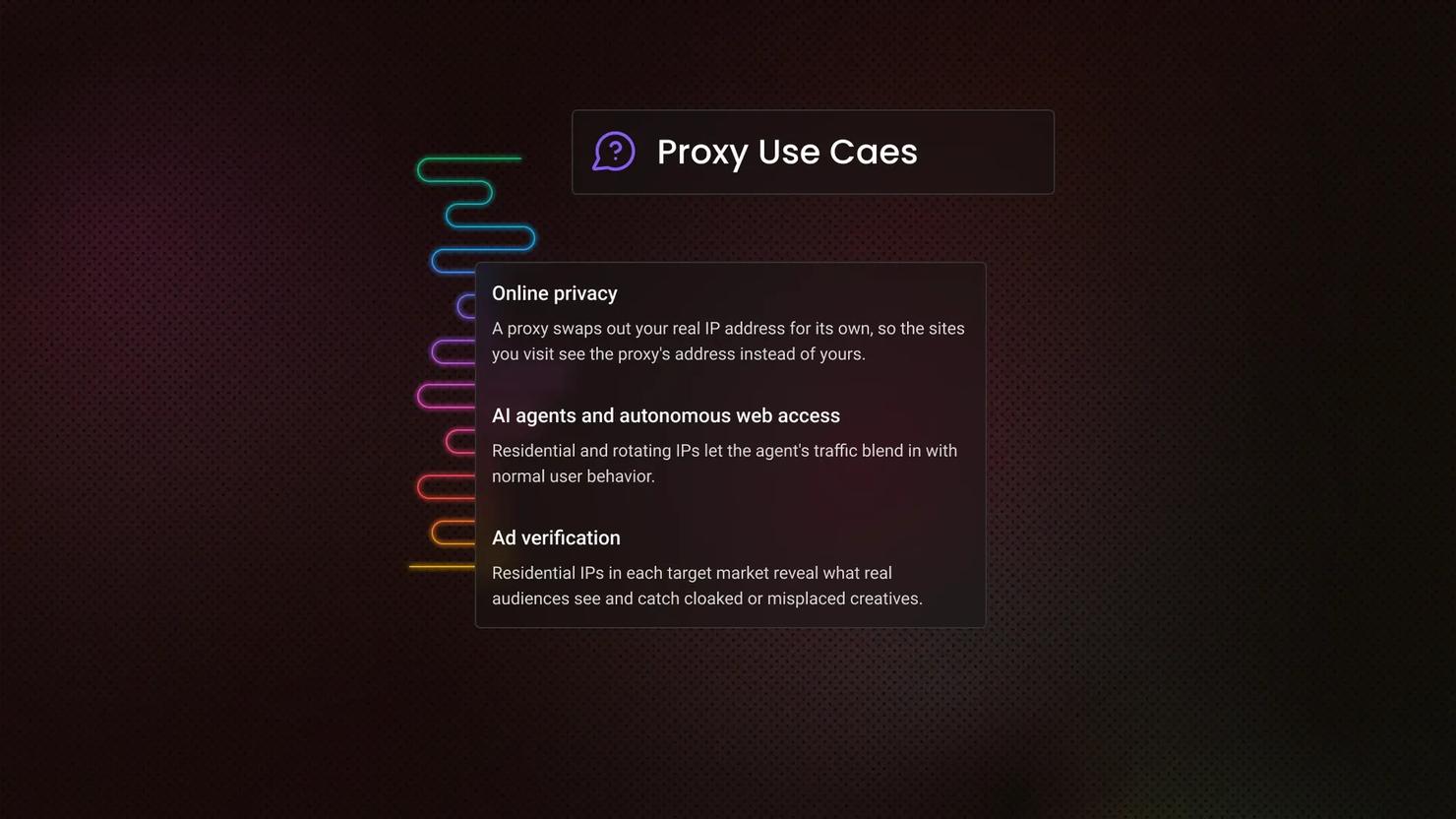
What Are Proxies Used for? 12 Common Proxy Use Cases
A proxy is an intermediary server that routes your request through its own IP address before it reaches the destination. So what are proxies used for? Far more than hiding a single IP. People use them for privacy and access, and businesses use them for scraping, monitoring, and market intelligence. This guide covers both, plus how to pick the right type.

Benediktas Kazlauskas
Last updated: Jul 22, 2026
7 min read

Kasada Bypass: How to Get Past Kasada Anti-bot Protection in 2026
Kasada is a bot-mitigation service protecting ticketing, limited-release retail, and financial platforms. Unlike Cloudflare, Akamai, or HUMAN, it shows no CAPTCHA and runs a proof-of-work challenge that a real browser solves by loading the page. A Kasada bypass, therefore, starts with a browser, not an HTTP client. This guide covers detection, the 5 layers, the tools, and the DIY limit.

Justinas Tamasevicius
Last updated: Jul 20, 2026
10 min read

502 Bad Gateway Error: Causes, Diagnostics, and Fixes for Users and Developers
A 502 bad gateway error means a gateway or proxy contacted an upstream server but didn't receive a valid response. The issue usually sits somewhere in the server path, not on your device. This guide explains what 502 means, why it happens, how to diagnose it, and how to fix it as a visitor, developer, or operator.

Vilius Sakutis
Last updated: Jul 13, 2026
5 min read

BotBrowser: What It Is, How To Set It Up, and Why It Matters for Fingerprint Defense
Browser fingerprinting allows websites to identify and track users across devices and sessions without relying on cookies. The W3C and major browser vendors flag it as a privacy threat that regulators are actively working to address. BotBrowser is an open-source, privacy-focused Chromium-based browser core designed to maintain a consistent fingerprint across operating systems. This guide covers its features, setup, validation, and practical use cases.
Justinas Tamasevicius
Last updated: Jul 01, 2026
8 min read

Webmaster Unblockers in 2026: Best Tools, Features & Buyer's Guide
Traditional proxies hide your IP, but struggle against anti-bot systems like Cloudflare, DataDome, and Akamai. Webmaster unblockers, also known as Site Unblockers, are managed request layers that take a URL and return rendered HTML. This guide explains how they work, when to pick 1 over a proxy or Web Scraping API, and which 5 tools stand out in 2026.

Kipras Kalzanauskas
Last updated: Jun 22, 2026
11 min read

Rank Tracker Getting Blocked? Why It Happens and How to Fix It
Rank tracker getting blocked is a frustrating problem that SEO teams will certainly run across while they’re collecting search engine rankings. They open their rank tracking dashboard only to find empty SERP positions, error logs, stale data, or unexplained errors, with the rank tracker getting blocked. A rank tracker monitors where each page appears in search engine results pages (SERPs), but today’s anti-bot systems will often stand in the way of the requests, interrupting them before position data can be collected. This guide shows how to diagnose and fix the issues: why blocks happen, how to identify them, and what to do to get valid data.
Vilius Sakutis
Last updated: Jun 17, 2026
7 min read
Python Cloudscraper: Bypass Cloudflare Protection, Configure Proxies, and Handle Common Errors
Most Python scrapers that use Requests stop working as soon as a site is protected by Cloudflare. You might see a 403 error, get stuck in a redirect loop, or land on a "Just a moment..." page that never loads. Cloudscraper solves this problem without needing a headless browser. It builds on Requests, handles Cloudflare's JavaScript challenges, and gives you a working session. This guide explains how to set up Cloudscraper, configure proxies, choose an interpreter, handle CAPTCHAs, parse data, fix common errors, and understand the library's limitations. If you're new to Python scraping, start with the Python web scraping guide first.

Mykolas Juodis
Last updated: Jun 16, 2026
17 min read

Block Requests in Puppeteer: A Practical Guide to Faster, Leaner Scraping
When you scrape the web with Puppeteer, you almost always pull in data you want alongside extras you don't need, like images, fonts, and tracking scripts that increase your request count, slow your pages, and drain your proxy bandwidth. In this guide, you'll learn how to block unnecessary requests with request interception and Chrome DevTools Protocol (CDP) so your scraper runs faster and scales more efficiently.
Justinas Tamasevicius
Last updated: Jun 16, 2026
16 min read

How Residential Proxies Work: A Technical Guide to Types, Networks & IP Sourcing
A residential proxy network routes your traffic through real ISP-assigned home IPs. But how routing actually happens, which proxy types you end up using, and how IPs are sourced have a much bigger impact on success rates. This guide breaks down how residential proxy networks work, including ASN-level routing, the different types of IPs, and the protocols they support.

Robertas Lisickis
Last updated: Jun 11, 2026
11 min read
Node Unblocker: A Comprehensive Guide
Node Unblocker is an open-source web proxy built on Node.js that allows users to bypass internet censorship, evade network filters, and access restricted content. Whether you are dealing with strict corporate firewalls, educational network restrictions, or geo-blocked websites, Node Unblocker acts as a seamless intermediary to securely route your web traffic.

Zilvinas Tamulis
Last updated: Jun 08, 2026
8 min read

How to Bypass Cloudflare: Complete Guide to Anti-Bot Evasion
Cloudflare is a massive global cloud network that sits firmly between your scraper and the data you need, blocking all requests that fail its multi-layered detection system. It powers nearly 21% of all websites globally, meaning that 1-in-5 sites rely on this network. Therefore, knowing how to bypass it is essential for serious scrapers. This practical walkthrough covers detection methods, tools like Puppeteer and Playwright, and both DIY approaches and managed solutions, including proxy strategies and web scraping APIs.
Vilius Sakutis
Last updated: Jun 02, 2026
10 min read

How to Use a Proxy With node-fetch: Setup, Rotation, and Troubleshooting Guide
A node-fetch proxy routes your fetch requests through an intermediary server, so the target site sees the proxy's IP instead of yours. It's the standard fix for IP blocks, geo-restrictions, and rate limiting in Node.js scraping. The catch: neither node-fetch nor Node's native fetch supports proxies natively, so you need an external agent library to bridge the gap.
Justinas Tamasevicius
Last updated: May 26, 2026
9 min read
500 Internal Server Error: Causes, Fixes, and How to Prevent It
A 500 Internal Server Error means the server encountered a generic internal error while processing your request. It's frustrating because the message is deliberately vague. This guide is for you if you run a website, build or maintain applications, or send programmatic requests, whether you are fixing your own site or dealing with 500s from external targets while collecting data from the web.
Justinas Tamasevicius
Last updated: May 05, 2026
9 min read
Residential vs Datacenter Proxies: Which Should You Choose?
At first glance, residential and datacenter proxies may seem the same. Both types act as intermediaries that hide your IP address, allowing you to access restricted websites and geo-blocked content. However, there are some important differences between residential and datacenter proxies that you should know before making a decision. We’re happy to walk you through the differences so you can choose what's right for you.
Vilius Sakutis
Last updated: Apr 22, 2026
7 min read

How to Bypass PerimeterX: Detection Methods, Tools, and Practical Workarounds
PerimeterX, now HUMAN, is a cybersecurity platform that employs multiple detection techniques to accurately identify and block threats to web applications. Since numerous high-traffic websites rely on PerimeterX, it's almost inevitable that developers will encounter it when web scraping. This guide explains how PerimeterX detects bots, how to bypass it (tools and strategies), and how to troubleshoot common failures.
Justinas Tamasevicius
Last updated: Apr 21, 2026
12 min read
How to Bypass Google CAPTCHA: Expert Scraping Guide 2026
Scraping Google can quickly turn frustrating when you're repeatedly met with CAPTCHA challenges. Google's CAPTCHA system is notoriously advanced, but it’s not impossible to avoid. In this guide, we’ll explain how to bypass Google CAPTCHA verification reliably, why steering clear of Selenium is critical, and what tools and techniques actually work in 2026.

Dominykas Niaura
Last updated: Apr 08, 2026
10 min read

How to Bypass CreepJS and Spoof Browser Fingerprinting
CreepJS is a browser fingerprinting audit tool used to test how detectable your automated browser is. If you’re trying to bypass CreepJS or improve browser fingerprinting, it helps you spot inconsistencies across signals like WebGL, fonts, and navigator data. This guide shows what actually gets flagged and how to fix the parts that still give your browser away.
Vilius Sakutis
Last updated: Apr 07, 2026
12 min read

nodriver Explained: How Undetected Chromedriver's Successor Actually Works
nodriver is a Python package for browser automation and web scraping built as the successor to undetected-chromedriver. It skips the usual WebDriver layer, talks to Chrome more directly than Selenium, and uses an async-first design. In this guide, you'll learn what nodriver is, how it works in Python, and where it fits for scraping JavaScript-heavy pages when basic browser automation starts showing its limits.

Lukas Mikelionis
Last updated: Apr 01, 2026
8 min read